

How Large Are GuoWang's Mega-Constellation Satellites?
No images of a GuoWang satellite have been released, but with a few clues, an idea of their design can be pieced together.

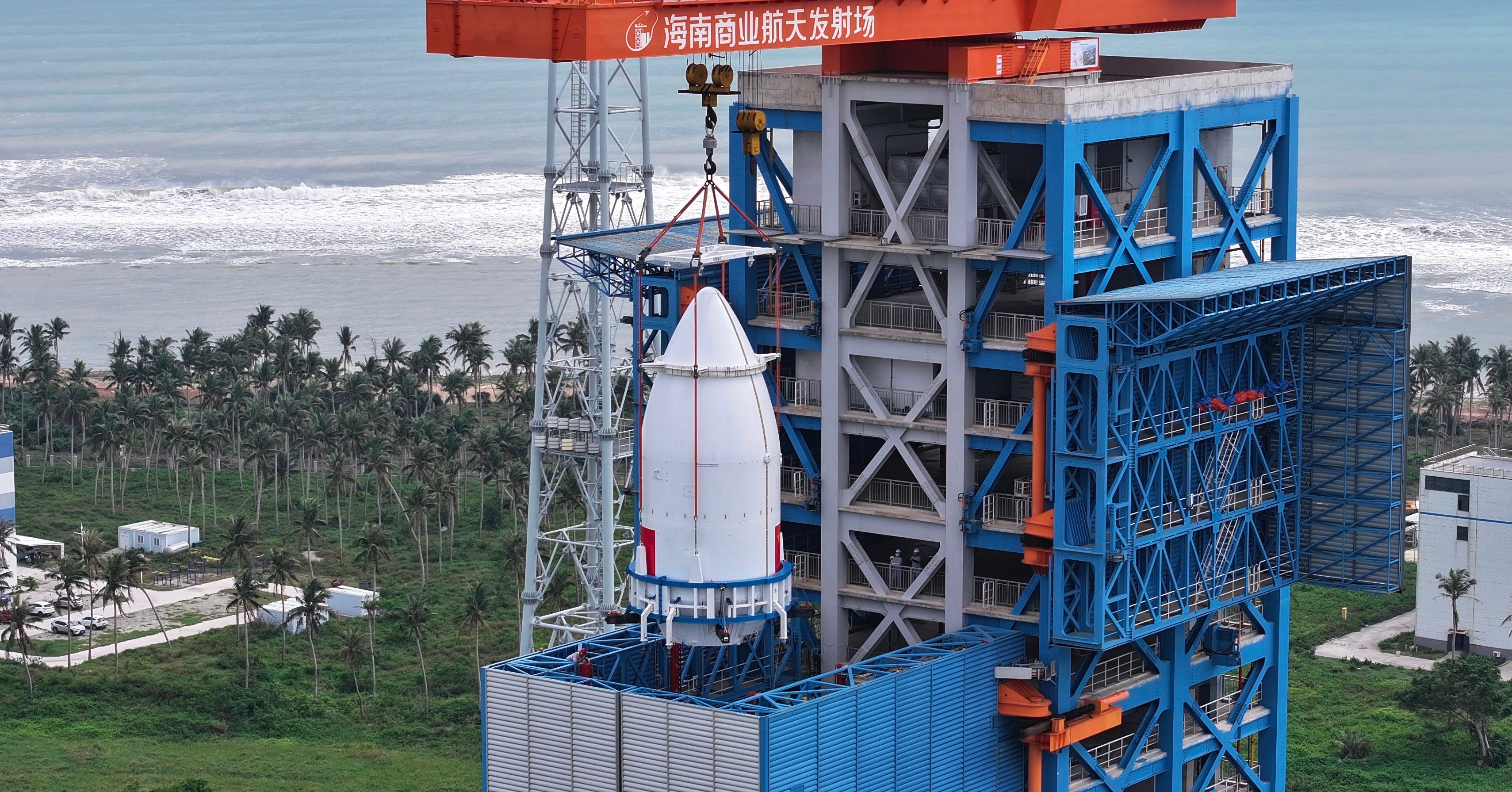
With nineteen launches to date and 154 satellites in orbit, the state-backed GuoWang (国网) connectivity mega-constellation, operated by China Satellite Network Group (中国卫星网络集团有限公司), is China’s most well-established equivalent to SpaceX’s Starlink. Despite that, the designs of the satellites making up the network remain fairly unclear.
Starting with what is known, after the first launch of GuoWang satellites in December 2024 the China Academy of Space Technology, one of the contracted manufacturers, stated that two satellite designs are in use, as the academy writes:
“The development team implemented a common platform design, creating two platforms, large and small, tailored to each satellite’s functional requirements and size. Satellites can seamlessly switch between platforms based on their specific characteristics, achieving comprehensive technical and economic integration.”
If there are any problems with this translation please reach out and correct me.
Those two platforms have allowed GuoWang satellites to fly on a handful of Long March launch vehicles, within 5.2 and 4.2 meter diameter fairings. Launchers with the wider fairing include the Long March 5B, deploying ten spacecraft per launch, the Long March 8A, deploying nine spacecraft, and the Long March 12, also deploying nine satellites. The Long March 6A is the only GuoWang launcher to use a 4.2-meter-diameter fairing, delivering five spacecraft into orbit.
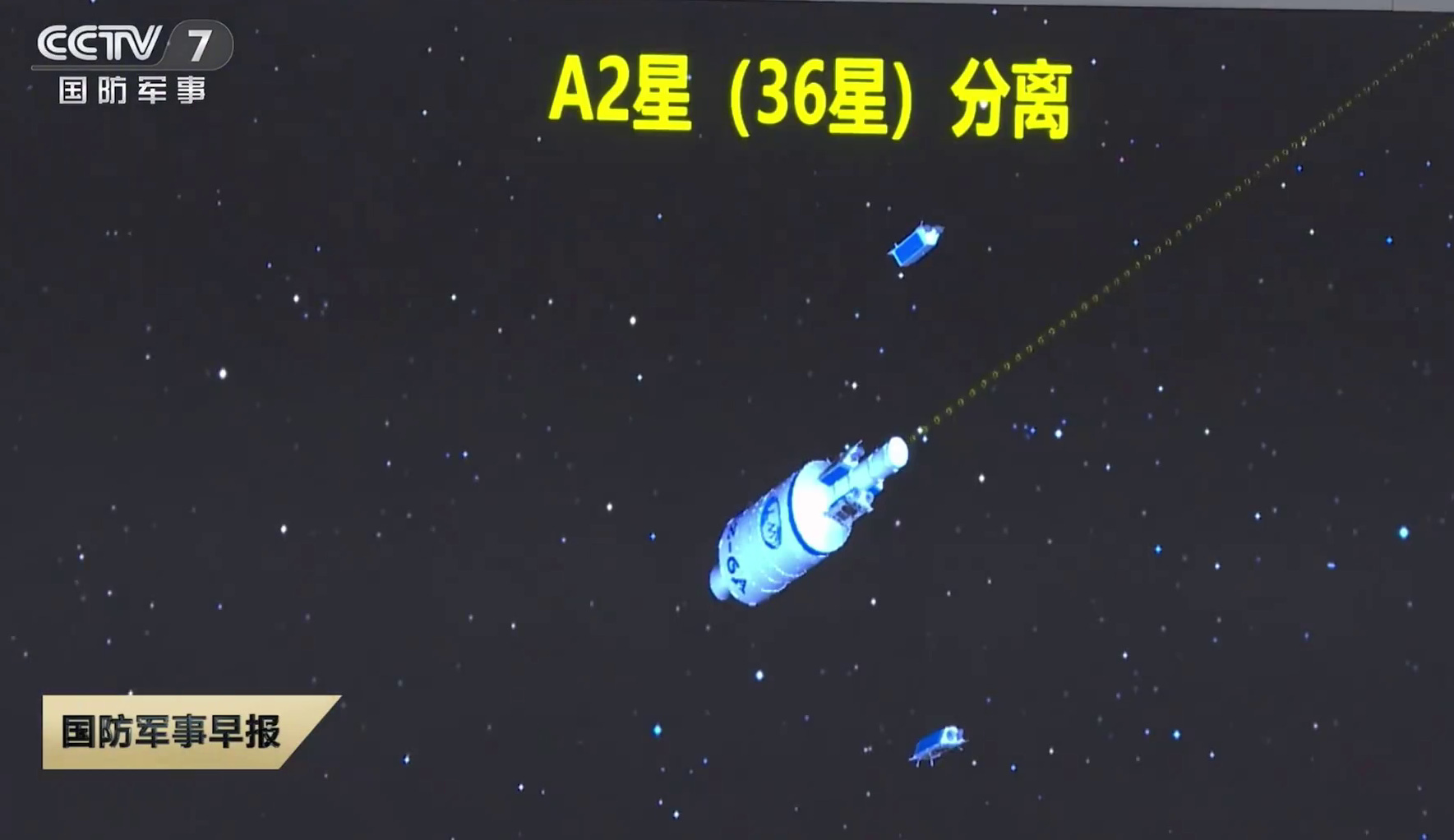
Several months into GuoWang deployments, China Central Television (中国中央电视台) shared a glance at a data-driven render shown within mission control at the Taiyuan Satellite Launch Center, providing a look at the basic design of GuoWang satellites. As shown in the render, the satellites utilize a trapezoidal-shaped design with their two solar panels stowed almost uniformly, similar to the design Amazon chose for its ‘Leo’ network.
As for what can be safely assumed about GuoWang satellites, that would be their propulsion system, which is likely employing electric propulsion thrusters. That is due to operational orbital altitudes above 1,100 kilometers, deployments a few hundred kilometers below operational orbits, and expected lifetimes of several years. Electric propulsion is a mass-efficient way to do all of those while ensuring several spacecraft can be deployed via each launch.
Heading abroad, outside of China a few organizations and firms are interested in figuring out more about GuoWang, one such is space monitoring firm LeoLabs. In an analysis published in ISR University’s Integrity Flash, LeoLabs Senior Technical Fellow Dr. Darren McKnight looked into and analyzed the Radar Cross Section (RCS) values1 of the GuoWang satellite deployed between December 2024 and September 2025. Dr. McKnight found that:
Long March 6A launched satellites have a median RCS of 6.2 square meters2.
Long March 5B deployed spacecraft have a median RCS of 5 square meters.
Long March 8A deployed satellites have a median RCS of 3.8 square meters.
Long March 12 launched spacecraft also have a median RCS of 3.8 square meters.
In the analysis, it was concluded that the near-polar groups (launched by the Long March 6A and Long March 5B) are probably using the larger satellite platform3, while those not flying over the poles (deployed via the Long March 8A and Long March) are utilizing the smaller satellite platform. The difference in size between the two platforms is estimated to be about thirty percent according to LeoLabs measurements.
A detail about GuoWang that has been partially confirmed is the mass of each satellite making up the mega-constellation. Following the Long March 8A’s sixth flight, Our Space (我们的太空)4 detailed that the launch vehicle had deployed 54 satellites collectively weighing 37,530 kilograms. All of those satellites were part of the GuoWang network, so with a little bit of math, each GuoWang satellite launched by the vehicle has a mass of 695 kilograms on average. Based on the RCS analysis, that mass may also apply to the small satellite platform.
For Long March 5B and Long March 6A deployed satellites, no similarly usable statements have been released, due to those vehicles carrying many other spacecraft. Looking at satellite separation of near-polar spacecraft and Long March 6A missions double-deploying to orbits skipped by the Long March 5B, it appears probable that GuoWang satellites flown by the vehicles are of a similar platform. Looking at the sun-synchronous orbit payload capacity of the Long March 6A and Long March 5B, while considering the approximately 8,000-kilogram weight of the Yuanzheng-2 upper-stage and a likely performance loss, GuoWang’s large satellite platforms’ mass could be between 700 kilograms at the low end and 1,000 kilograms at a maximum5.
It should be noted that production of GuoWang satellites has been contracted to a few enterprises, the China Academy of Space Technology and the Innovation Academy for Microsatellites, Chinese Academy of Sciences (中国科学院微小卫星创新研究院), and GalaxySpace (银河航天), as such, their mass may vary between each launch6.
Aggregated by over thirty thousand measurements using LeoLabs hardware.
Square meter measurements will measure one face of a spacecraft; a whole satellite measurement would be in cubic meters, but that would require many observing spacecraft in orbit.
Their minimum and maximum RCS measurements overlap despite the significant median difference.
A China National Space Administration-supported space-focused media entity.
Assuming a negligible performance loss with the Long March 5B launches.
This is part of why I presented a range at the end of the previous paragraph.