


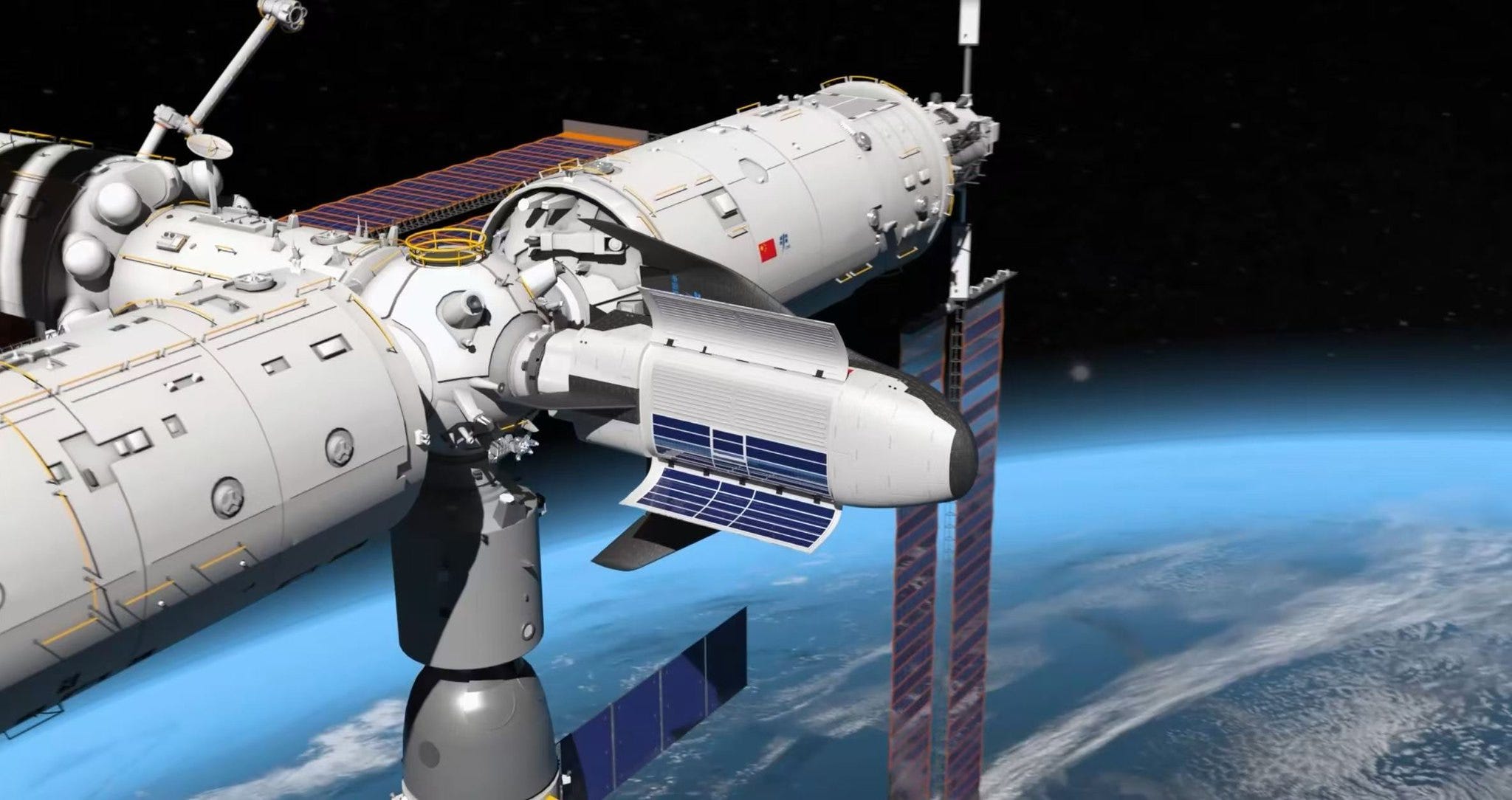
Having received a contract award to fly missions to the Tiangong Space Station in October 2024, Chengdu Aircraft Research and Design Institute’s (成都飞机设计研究所)1 Haolong (昊龙) cargo spaceplane has been quietly2 moving through development with occasional updates. A recent update shared, from its developers market situation, that the spacecraft is under a form of production, with a report writing:
“[The] development and production of the Haolong cargo spaceplane are proceeding according to plan. … Moving forward, [the enterprise] will closely align with the trend toward aerospace integration, focusing on core technology breakthroughs and capability system establishment, steadily promoting the implementation of key commercial aerospace projects represented by space station cargo, [etc].”
If there are any problems with this translation please reach out and correct me.
That is confirmation that the spaceplane is well into development if production is taking place, and a little unsurprising given that a design review was completed back in 2023.
Several components are also under work, as in January, the Chengdu Design Institute awarded a contract to Xi'an Xinyao Ceramic Composite Materials Co Ltd (西安鑫垚陶瓷复合材料股份有限公司) to produce Haolong’s flaps and rudders that are required to withstand atmospheric reentry heating while maintaining position to control orientation. The spaceplane's heat shield is the most complex and critical part, which must be well understood to enable returning cargo to Earth and then flying repeatedly.
Sometime not long after the Tiangong contract award, a full-scale mockup of Haolong appeared at one of its developers' facilities, likely to understand and test the dimensions of support equipment needed as well as the internal cargo layout. At the 2024 Zhuhai Airshow (珠海航展), a smaller mock-up of it showed off its two deployable doors3, one for generating power via solar panels and the other for removing heat through a radiator.
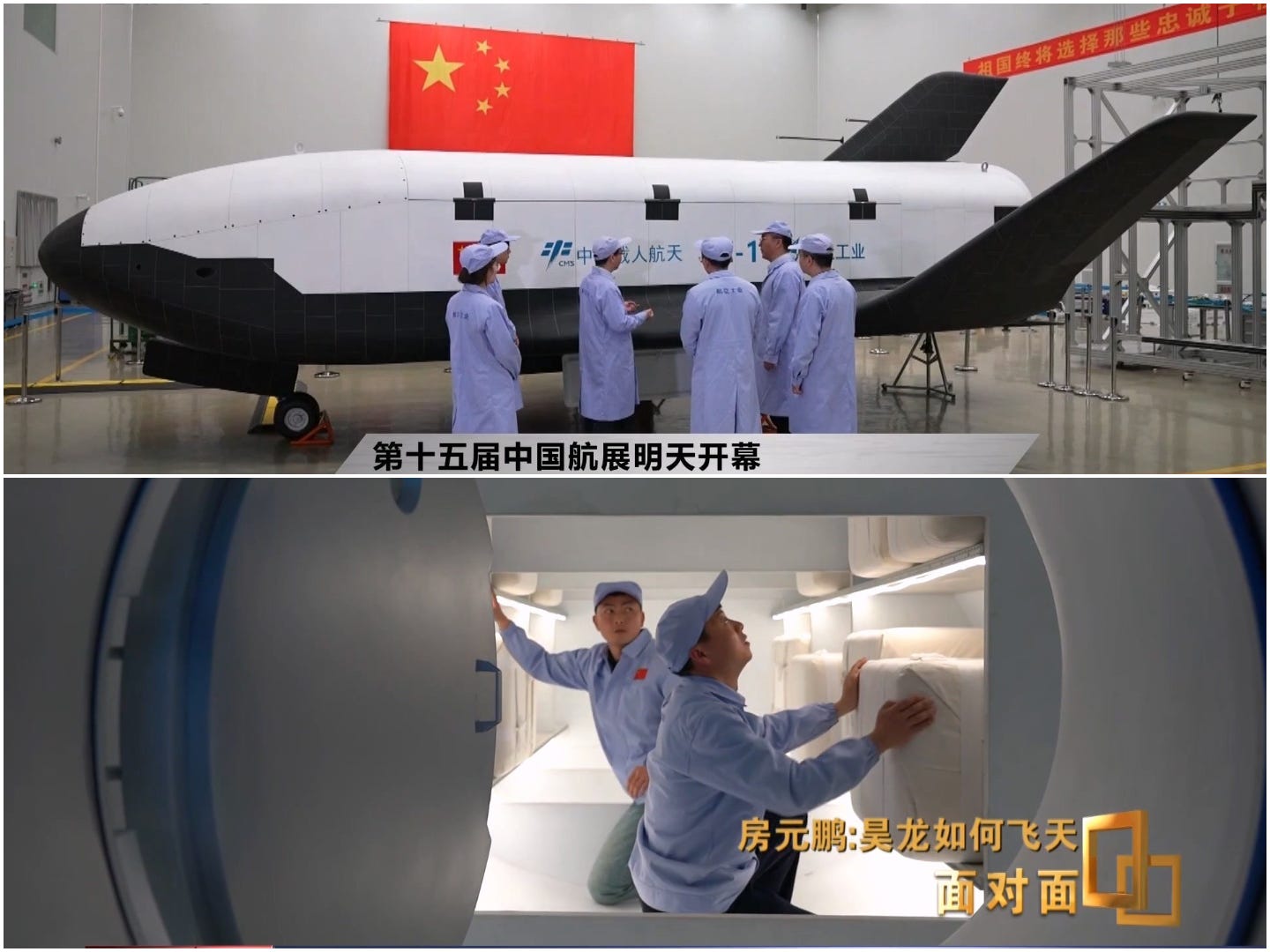
Once the first flight-worthy Haolong is produced, it is expected to weigh no more than 7,000 kilograms, being 10 meters long and 8 meters wide, with its wings folding in to fit inside the fairing of a launch vehicle. Cargo carrying capabilities to and from the Tiangong Space Station has not been specified, reportedly around a ‘two-ton’ class.
Advantages of utilizing a spaceplane over a capsule for returning cargo are a smoother descent profile and adaptability to target multiple existing runways for landings. Haolong is also set to be reusable with landings away from oceans or deserted flat lands improving the environment around it, as well as items that may need speedy removal4.
As for when Haolong will head into orbit for the first time, that has expectdly not been announced. It is known that at least one mission for the spaceplane will begin via a launch atop of LandSpace’s Zhuque-3 from the Jiuquan Satellite Launch Center.
Haolong is not China’s first spaceplane, as the country has its Reusable Experimental Spacecraft (可重复使用试验航天器), which has flown four times, but little is known about it.
Working with Chengdu Aircraft Industrial Group Co Ltd (中航工业成都飞机工业(集团)有限责任公司), who are owned by the Aviation Industry Corporation of China (中国航空工业集团公司).
Compared to the Qingzhou (轻舟) cargo spacecraft from the Innovation Academy for Microsatellites, Chinese Academy of Sciences (中国科学院微小卫星创新研究院), which was placed into orbit for a demonstration mission in March.
Unlike the U.S. Space Shuttle these do not open to a cargo bay.
Such as experiments that will have their results degraded the longer they experience gravity or are outside of a climate-controlled facility.