

Hyperbola-3 Hardware Qualified Before First Flight, New Funding Round
iSpace's partially reusable launch vehicle is nearing its debut flight and first landing attempt, with many development milestones complete.

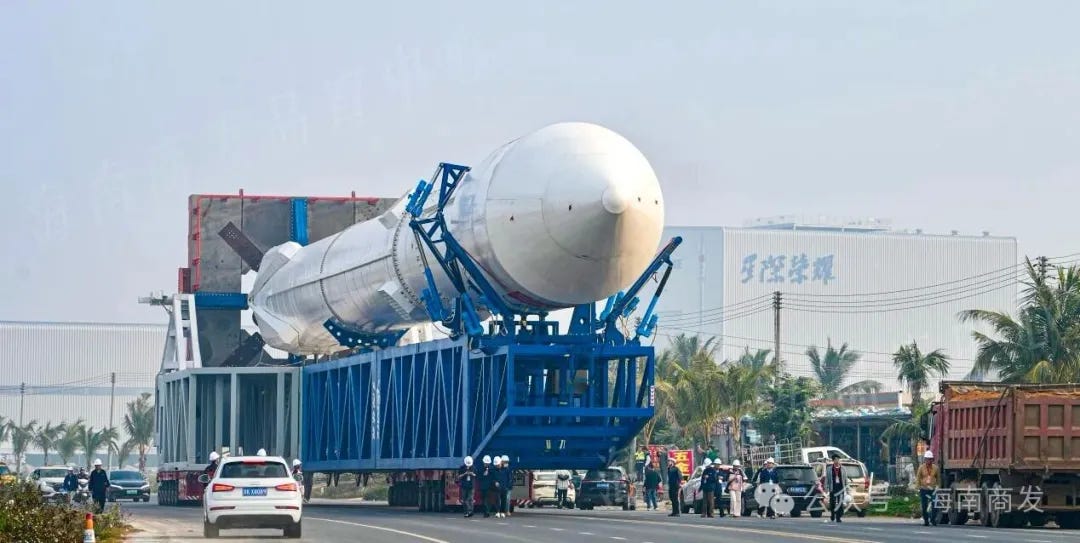
Several hardware items for iSpace’s partially reusable Hyperbola-3 launch vehicle have been completed in recent months and throughout last year, but the company is still secretive about when it may launch and land.
Recently, as of April 27th, the ten JD-2 liquid methane and liquid oxygen engines to power Hyperbola-3, with nine on the first-stage and one vacuum-optimized variant on the second-stage, have been qualified for flight according to Zhang Xi (张玺), General Manager of the company’s Sichuan (四川) subsidiary, who shared:
“The results of [recent tests] were very successful. Based on the current data, it fully meets the requirements for delivery to final assembly.”
If there are any problems with this translation please reach out and correct me.
Those engines will now be shipped out for integration with their respective stages, possibly for static fires as well.
Regarding progress on both stages, Hyperbola-3’s second-stage, 11 meters long and 4.2 meters in diameter with a common dome between propellant tanks, completed cryogenic testing in early February to receive the final approval ahead of flight. Similar testing of first-stage propellant tanks, with the same diameter, has been ongoing separately since April 2025. The liquid methane and liquid oxygen tanks will be joined via an intertank section at the launch site due to road transport limitations1.
Efforts in producing other parts of the launch vehicle have occurred too. In November 2025, the vehicles 5.2-meter diameter fairing underwent a separation test. A month later aft end of the second-stage had been built and equipped with in-space attitude control thrusters and two storable propellant tanks, which it was tested with to prove the overall attitude control system of the stage. Grid fin tests were published not long after that as well. In March of this year, the launch vehicle's auxiliary power system was approved for flight.
In preparation for flight, Hyperbola-3’s launch vehicle processing and refurbishment facility at the Wenchang Commercial Space Launch Site was opened in October 2025, with a pathfinder already delivered. By mid-February, a transporter-erector for the launch vehicle was completed at the site for several tests with the pathfinder and Commercial Launch Pad 2. The integration facility has seen the vehicles pathfinder installed with four landing legs quite recently, as part of tests of their post-landing stability.


Elsewhere for recovering Hyperbola-3 iSpace launched its ‘Qinglan (清澜)’ drone ship, in August 2025, for landing first-stage boosters at sea. That ship, 42 meters wide and 100 meters long with a booster landing area of 40 by 60 meters, has since been undergoing sea trials and hardware installation ahead of use.
Despite all of the development milestones listed above, iSpace has been tight-lipped as to when Hyperbola-3 will fly and land for the first time2, only indicating within a calendar year. Xie Hongjun (谢红军), company Vice President, maintained a vague indication, sharing in March that the launch vehicle will debut before the end of the year. iSpace is likely taking their time with Hyperbola-3 to ensure it is not as failure-riddled as Hyperbola-13.
Meanwhile, back on April 10th, it was reported that iSpace is looking to perform its ‘Series E’ funding round. That round will reportedly look to aim 7 billion Yuan (1.02 billion United States Dollars, as of May 1st) to improve JD-2 production, Hyperbola-3 launch frequency, and new Wenchang facilities. Almost three months ago the company completed its ‘D++ Series’ round, raising 5.037 billion Yuan (737.5 million United States Dollars).
A few days after the reporting about a new funding round, iSpace’s Sichuan subsidiary gained 100 million Yuan (14.6 million United States Dollars) in capital, noticed by a registered capital increase from 500 million to 600 million Yuan (73.2 million to 87.8 million United States Dollars).
LandSpace’s Zhuque-3 and Space Pioneer’s Tianlong-3 also adopt this design choice due to transportation limitations.
A first-stage booster landing attempt is part of the first flight plan. In a statement about the launch vehicle’s auxiliary power system, iSpace disclosed:
“At present, the system is ready for final assembly, laying a solid and reliable foundation for the Hyperbola-3 rocket’s first orbital insertion and sea-based recovery flight test.”
To date Hyperbola-1 has flown eight times since July 2019. It has failed during flight four times.