

iSpace Conducts Drone Ship Sea Trials With Hyperbola-3 Pathfinder
With integration yet to start for a debut flight, ‘Qinglan’ had its time occupied testing with inert launch vehicle systems.

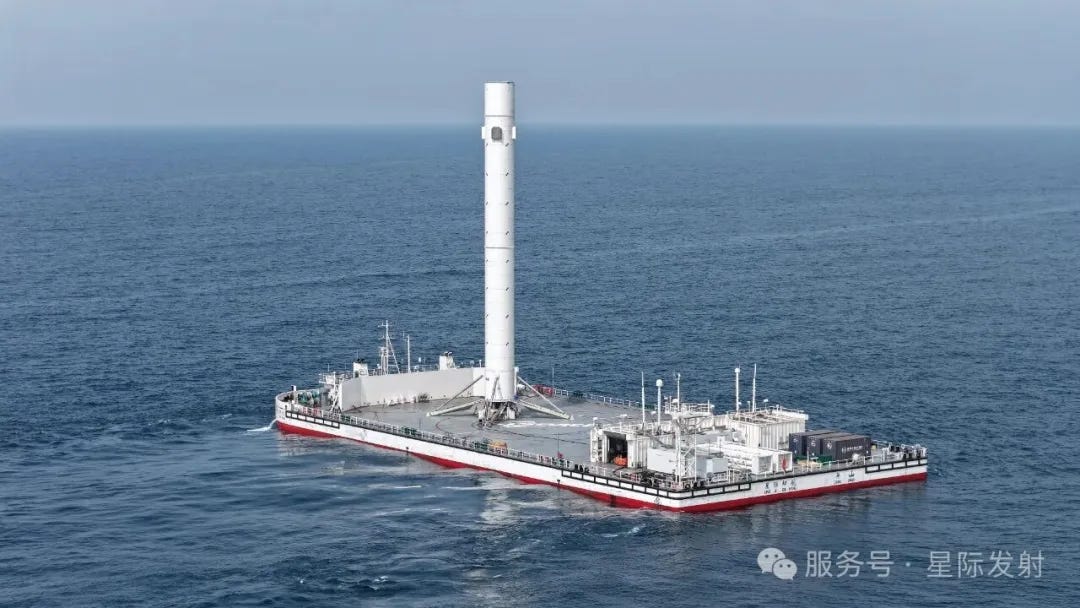
Last year in August, iSpace launched its first autonomous booster recovery drone ship, dubbed ‘Qinglan (清澜)’, Clear Waves in English, as the first part of its ‘Xingji Guihang (星际归航)’, Interstellar Homecoming, fleet. In the almost year since, the company has been conducting various trials of the 42-meter-wide and 100-meter-long vessel.
Those trials, taking place without any publicity, have gone well, as in June ‘Qinglan’ had an inert first-stage pathfinder loaded onto it. That pathfinder has full-scale grid fins and engines attached to a 4.2-meter-diameter representation of the boosters’ propellant tanks and structures, as well as semi-functional landing legs added in recent months. Around the middle of June, the booster pathfinder was placed onto the vessel at the city of Yangjiang’s (阳江市) port, in Guangdong (广东) province.
According to iSpace, ‘Qinglan’ was taken a significant distance offshore with the Hyperbola-3 pathfinder for extensive trials, supported by five other vessels for towing and assistance. A few of those ships were used to confirm that the drone ship was accurately relaying its position and maintaining communication links.
Regarding joint tests with the pathfinder, ‘Qinglan’ was left with it in various sea states to imitate the conditions a real booster would be in after a successful landing. That had the drone ship maintain its stability in waves up to four meters tall to prove that a Hyperbola-3 first-stage booster wouldn’t tip at the extreme end of acceptable weather. Passivating1 and stabilizing a booster was also practiced through the maneuvering and attaching of a dedicated robot, hardware pushed against landing legs, as well as a structure being attached to the base by teams once the pathfinder was verified as safe to approach.
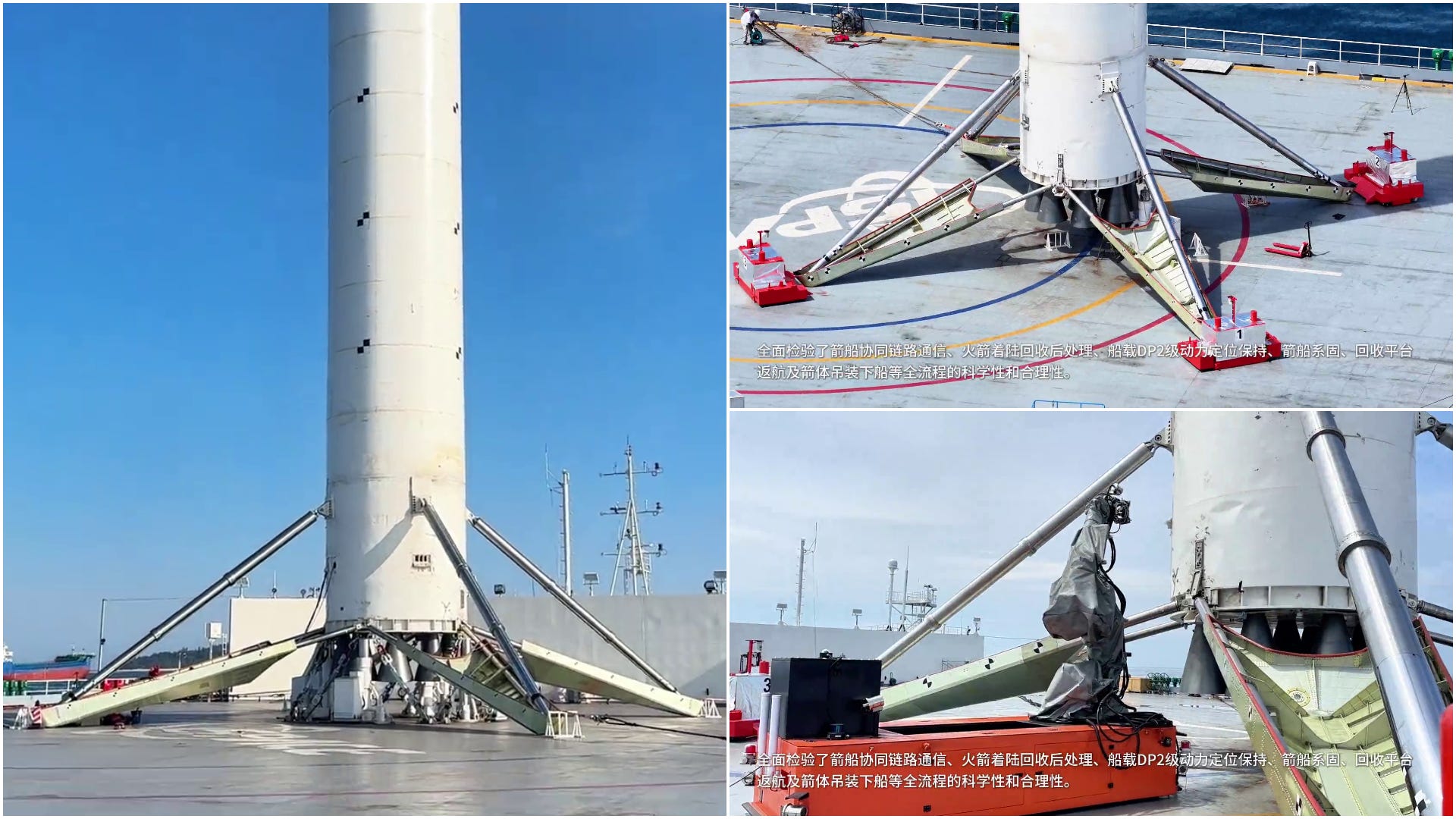
When ‘Qinglan’ was left alone with the pathfinder, it was commanded to hold position using its four propulsion units, two at the aft and two in the bow. Those units are not powerful enough, and there is limited onboard fuel for it, to allow the drone ship to bring itself to and from port. As such, it was towed to and from trial sites.
iSpace says that ahead of the first time ‘Qinglan’ is needed its recovery teams will continue to practice procedures for bringing a Hyperbola-3 first-stage back home after landing. That includes safely unloading it from the drone ship, which has been done at least twice to date.
It remains to be seen when the drone ship will be used for the first time, as iSpace is yet to integrate a Hyperbola-3 launch vehicle for a debut flight and recovery attempt. Officials have previously indicated that they are aiming to fly and attempt a landing at least once this year.
As mentioned previously, the first-stage pathfinder gained semi-functional landing legs in May for drop tests at iSpace’s launch vehicle processing and refurbishment facility next door to the Wenchang Commercial Space Launch Site. Those tests confirmed that the leg design can withstand the expected touchdown impact before stabilizing.
Removing leftover propellants and other energetic commodities.