

LandSpace Successfully Proves Stretched Zhuque-2E Launch Vehicle [Zhuque-2E Y5]
While flying with an inert ‘customized test load’, the upgraded vehicle successfully flew into orbit to prove new systems.

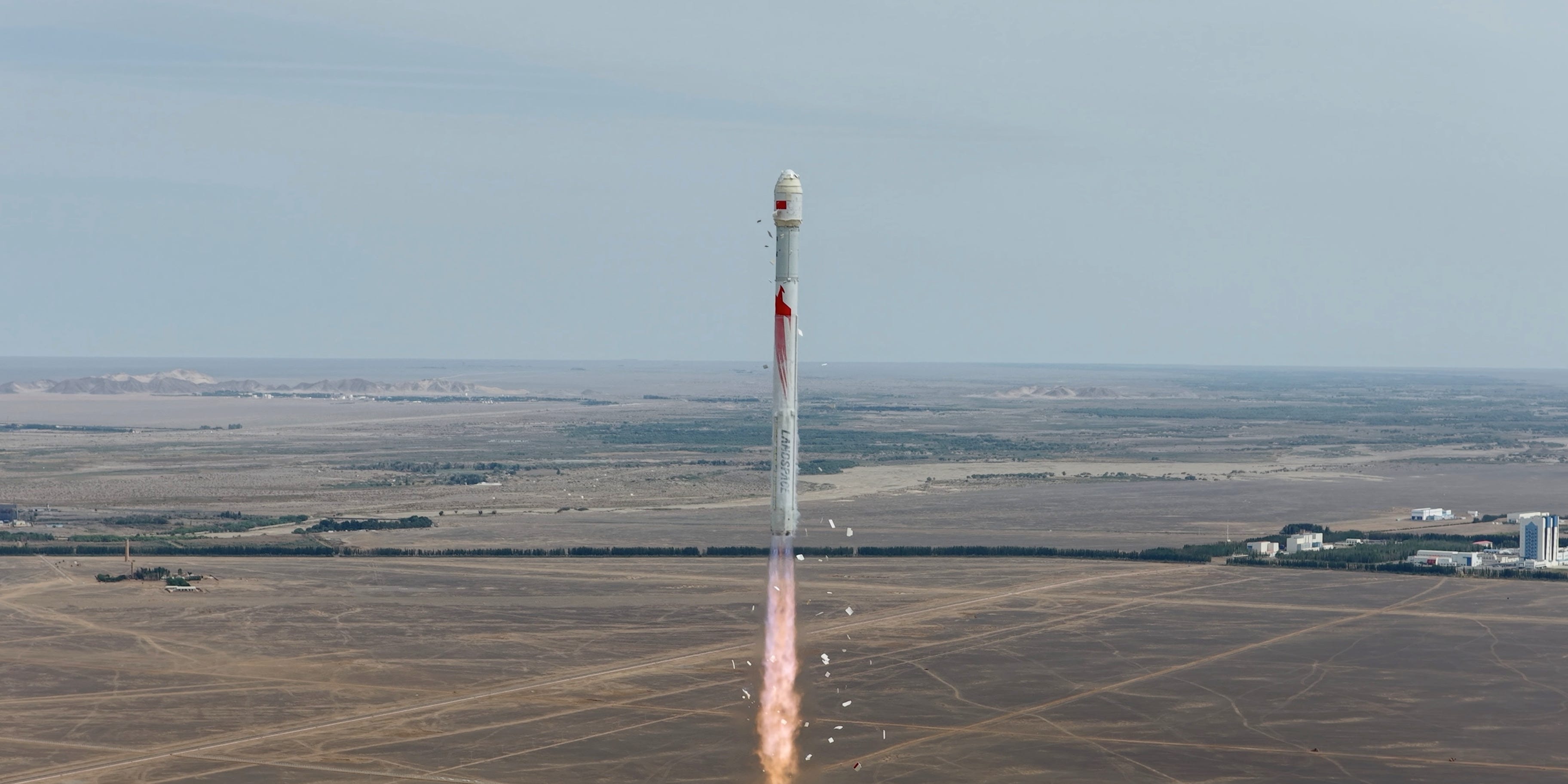
Lifting off from Launch Area 96A at the Jiuquan Satellite Launch Center at 11:00 am China Standard Time (03:00 am Universal Coordinated Time) on May 14th, LandSpace’s Zhuque-2E performed its latest test mission with a flight into an almost polar orbit.
No operational satellites from customers were onboard Zhuque-2E for this flight. Instead, an approximately 2,800-kilogram inert ‘customized test load’ was installed atop of the second-stage and protected within the fairing for ascent. That test load is said to have proven the delivery of a payload into a 900-kilometer near-polar orbit1, with LandSpace adding:
“This marks the achievement of the capability to launch heavy payloads with the Zhuque-2E model, which now meets the technical requirements for multi-satellite launches. It provides mature and reliable launch offerings for the objectives of establishing space as a new pillar industry, accelerating the development of satellite internet, and implementing future large-scale satellite constellation deployment projects.”
If there are any problems with this translation please reach out and correct me.
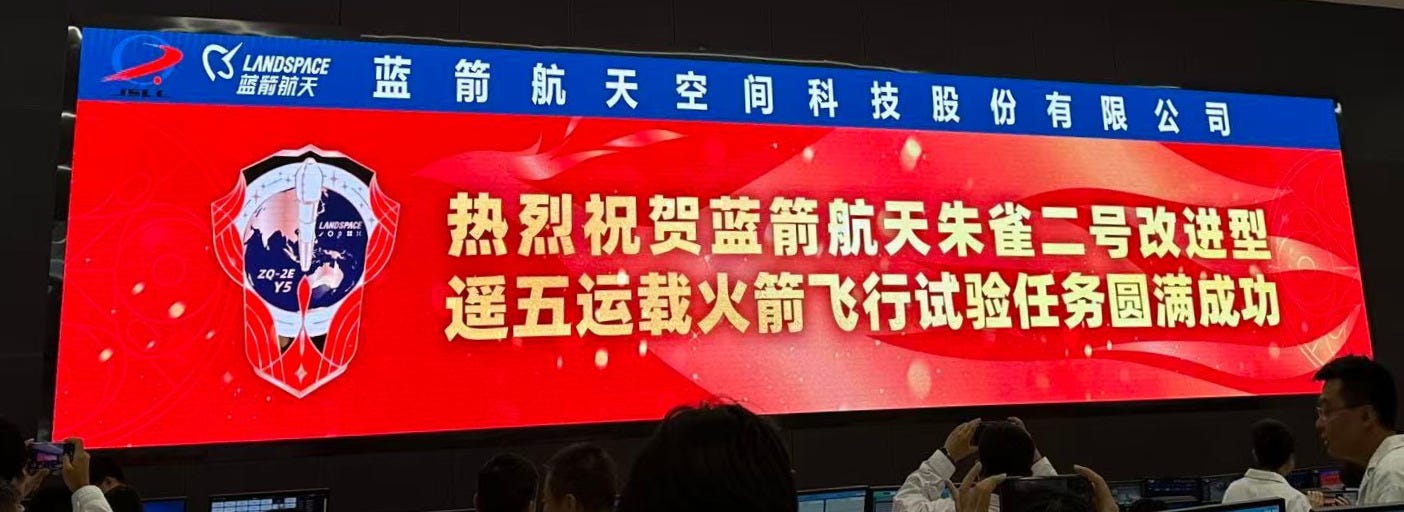
For today’s flight, Zhuque-2E was significantly upgraded and improved, with four significant parts listed by LandSpace:
On the first-stage, it has been stretched by about eight meters to increase liquid methane and liquid oxygen capacity while subcooling2 both propellants, and removing four aerodynamic fins.
The second-stage has adopted a tank pressure-based ullage system for relighting its TQ-15A engine, enabling faster deorbiting of it as well after payload deployment (and proven today).
Across the vehicle, ‘smart’ control systems were stated to have been installed for quickly adapting to potential anomalies in real time, along with monitoring second-stage propellant status.
And back on Earth Zhuque-2E’s transporter-erector has been lengthened to support the launch vehicle, with vehicle preparation time reduced to two weeks and fuelling taking about ninety minutes.
The stretching of the first-stage follows several upgrades across other areas of Zhuque-2E, like a common-dome second-stage and upgraded engines in November 2024, and the adoption of a larger fairing alongside improved guidance in May 2025.
In addition, today’s Zhuque-2E mission served as the vehicle’s return to flight following a failed launch back in mid-August 2025. The cause of that failure was found to have been caused by an electrical arc on the second-stage, leading to a loss of engine gimbal control and the flight termination activating shortly after. That electrical issue was fixed before LandSpace’s larger reusable launch vehicle, Zhuque-3, made it to Jiuquan for its maiden flight in December 2025.
Today’s mission was the 4th flight of Zhuque-2E, and the 7th flight of LandSpace’s Zhuque-2 series. This was also the 29th launch from China in 2026.
Liftoff video via LandSpace and 大漠问天 on WeChat.
Check out the previous Zhuque-2E launch
LandSpace Experiences in-Flight Failure [Zhuque-2E Y3]
![LandSpace Experiences in-Flight Failure [Zhuque-2E Y3]](https://substackcdn.com/image/fetch/$s_!5XKA!,w_1300,h_650,c_fill,f_webp,q_auto:good,fl_progressive:steep,g_auto/https%3A%2F%2Fsubstack-post-media.s3.amazonaws.com%2Fpublic%2Fimages%2F3ef6bffd-05d7-41b4-a769-67cf1159f1c2_2160x1301.jpeg)
LandSpace’s Zhuque-2E rocket departed from Launch Area 96A at the Jiuquan Satellite Launch Center on August 15th at 09:17 am China Standard Time (01:17 am Universal Coordinated Time) heading for low Earth orbit. Sadly, the rocket did not reach its intended orbit.
What is Zhuque-2E?
This section is for those less familiar with China’s various commercial launch vehicles.
Zhuque-2E is LandSpace’s privately-developed commercial launch vehicle, and is largely based on the company’s Zhuque-2 vehicle. The vehicle consists of two stages both burning liquid methane and liquid oxygen.
The payload capacity of the launch vehicle is currently as follows:
6,000 kilograms to low Earth orbit
4,000 kilograms to a 500-kilometer sun-synchronous orbit
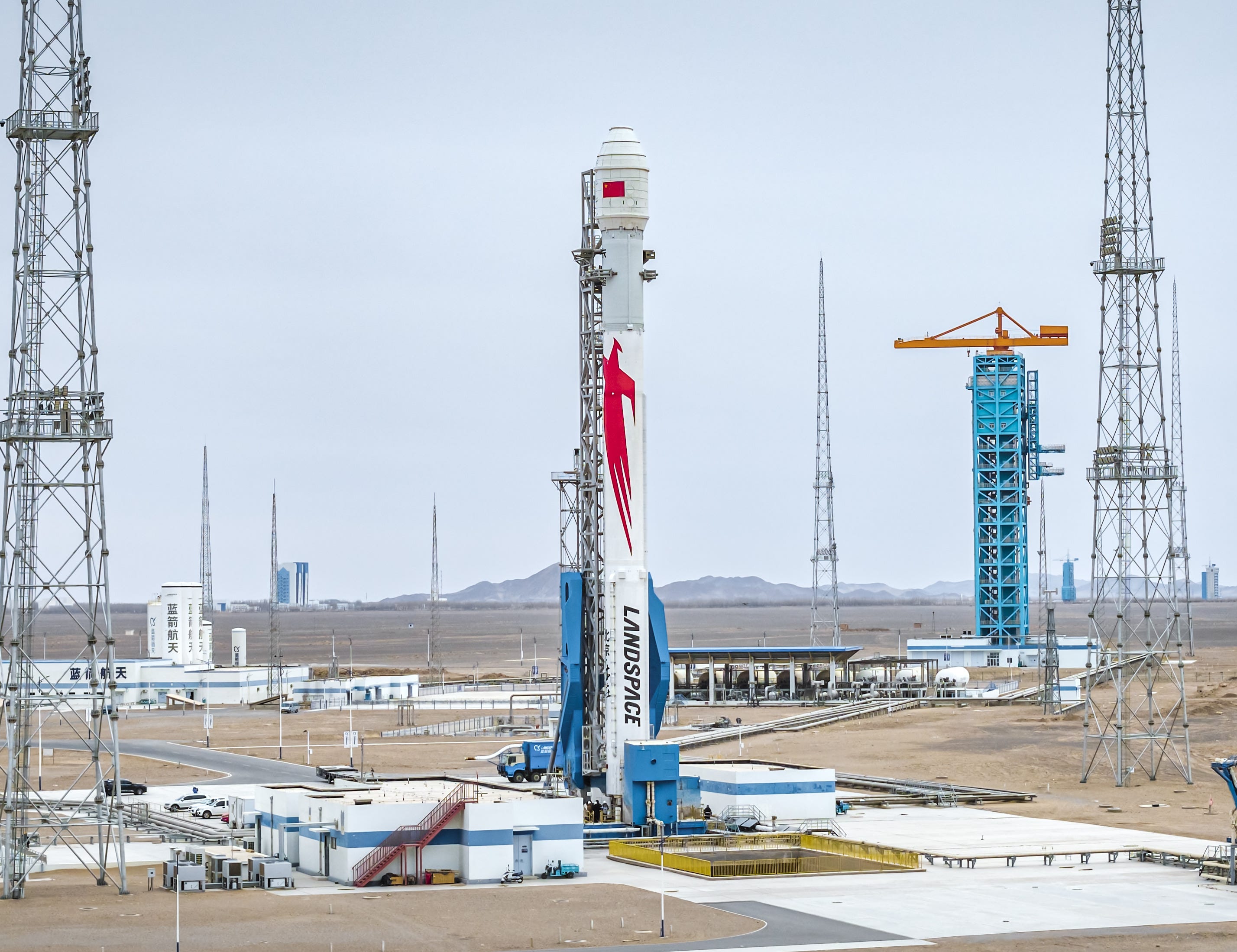
Four TQ-12A engines power the first stage to generate 338 tons of thrust while burning liquid methane and liquid oxygen. The second-stage is powered by a single TQ-15A engine, also burning liquid methane and liquid oxygen, to produce 85 tons of thrust.
On the launch pad, Zhuque-2E is 55.9 meters tall and weighs 267,000 kilograms when fully fuelled. The first-stage and second-stage, have a diameter of 3.35 meters, while the fairing has a diameter of 4.2 meters.


In theory, that performance could deliver four GuoWang (国网) satellites. See ‘How Large Are GuoWang’s Mega-Constellation Satellites?’.
Where the propellant is near-freezing, enabling a greater amount of it to be stored in a tank.