

LandSpace Wants to Reuse Zhuque-3 Boosters by Years End
Work has continued to make the launch vehicle into an attractive mega-constellation deployment choice.

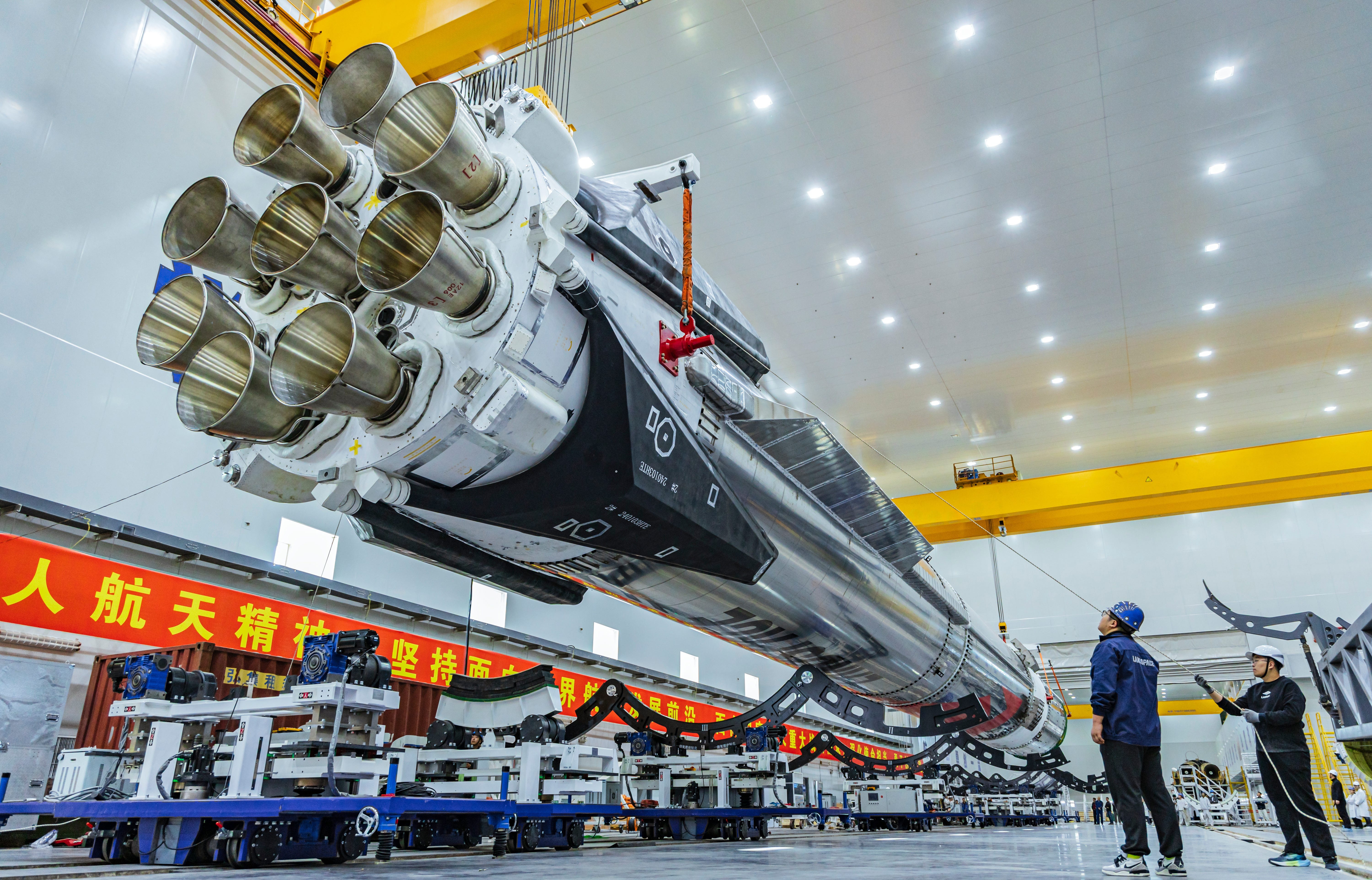
At the February 11th session of the Scientific and Technical Subcommittee’s 2026 meeting under the United Nations Office of Outer Space Affairs, LandSpace’s Cai Guorui, General Manager of the Department of Quality and Safety, led a brief presentation about Zhuque-3 to those present in-person and online1.
After introducing the company and Zhuque-3, the launch vehicle’s December 2025 maiden flight was spoken of, including its accurate but failed landing attempt. Cai detailed that almost all areas of flight were successfully completed, providing an insightful slide with event times, along with previously known pre-flight static fires in June and October. It was also shared that the second-stage demonstrated a 1400-second coast and engine relight, which resulted in the rocket stage decaying into the South Pacific on January 30th.
Technologies validated by the flight, stated to be firsts in China, were mentioned too, with those being a ‘lifting-body return aerodynamic-control’ configuration and grid-fin control during first-stage recovery, a pyrotechnic-free separation of the stages, and the proving of flight-worthy laser-welded stainless steel tanks while being propelled by a cluster of nine liquid methane and liquid oxygen engines. Two items were not verified during the flight: a ‘high-precision landing guidance’ and soft touchdown via landing leg deployment. Both were said to have been basically confirmed during hardware testing on the ground and simulations.
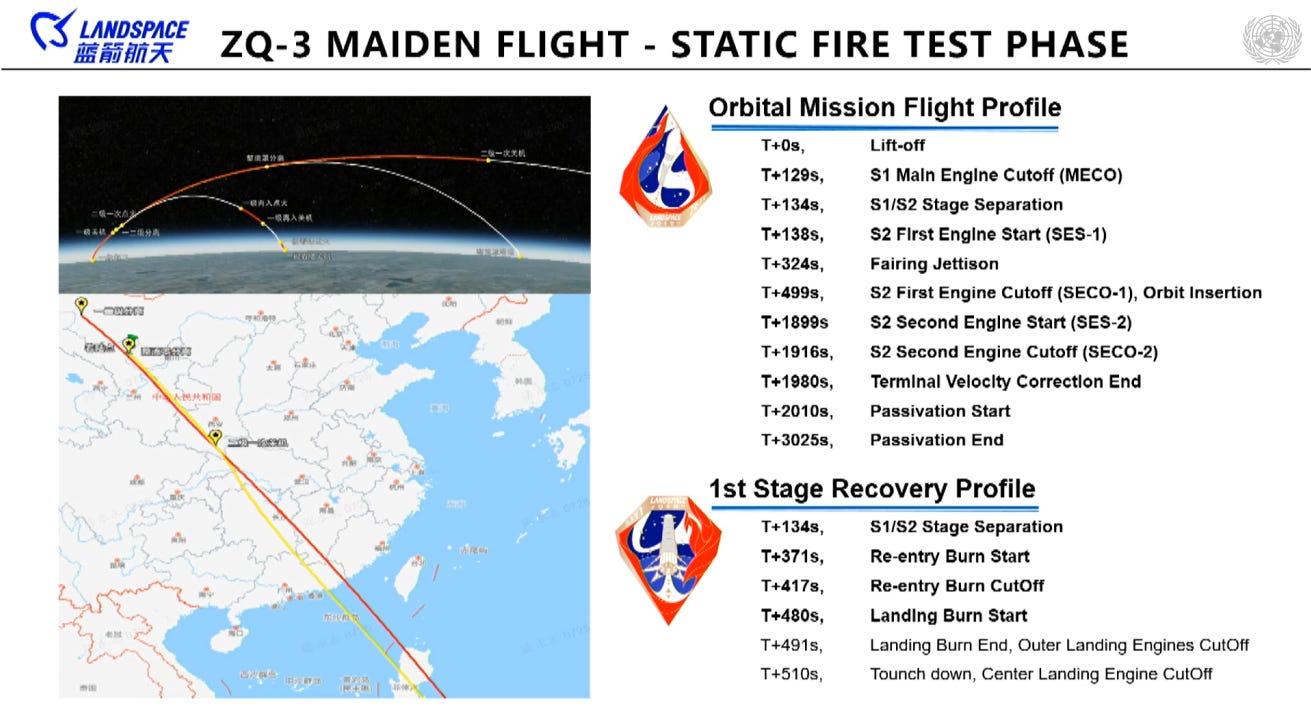
Looking to the upcoming year, Cai shared that Zhuque-3’s second flight and booster landing attempt is set for this year’s second quarter (April, May, June), while the first reflights of first-stages are desired to be within 2026’s fourth quarter (October, November, December). The full statement regarding those aims was:
“We are right now optimizing the recovery workflow, and we are confident in achieving a first-stage recovery in the next flight of Zhuque-3. Looking forward, we are planning a second recovery attempt in quarter two this year, followed by a reuse of recovered first-stages in quarter four. These steps will further mature our reusable launch system at LandSpace and in China.”
A few weeks after Zhuque-3’s first flight, it was revealed that first-stage booster landing is a goal of the second flight. When a second launch would occur was previously very vague, sometime between three to six months after the first, depending on the landing failure investigation. With Cai sharing that Zhuque-3 should fly again between April and June, it appears that the investigation is going smoothly, along with vehicle production.
As for the flight in the fourth quarter, that could use the second flight’s booster for Zhuque-3’s fourth mission to date. Production of launch vehicles for potentially three flights this year is believed to be well underway, with design changes learned from the December 2025 mission.
If LandSpace can reuse a booster in this calendar year, it bodes well for lowering the cost of future Zhuque-3 missions afterwards, for both improving the company’s profit margins with regular reflights2 and lowering launch costs to customers. In the long term, that may further reduce the cost of China’s already low-cost launch solutions in the international market3.
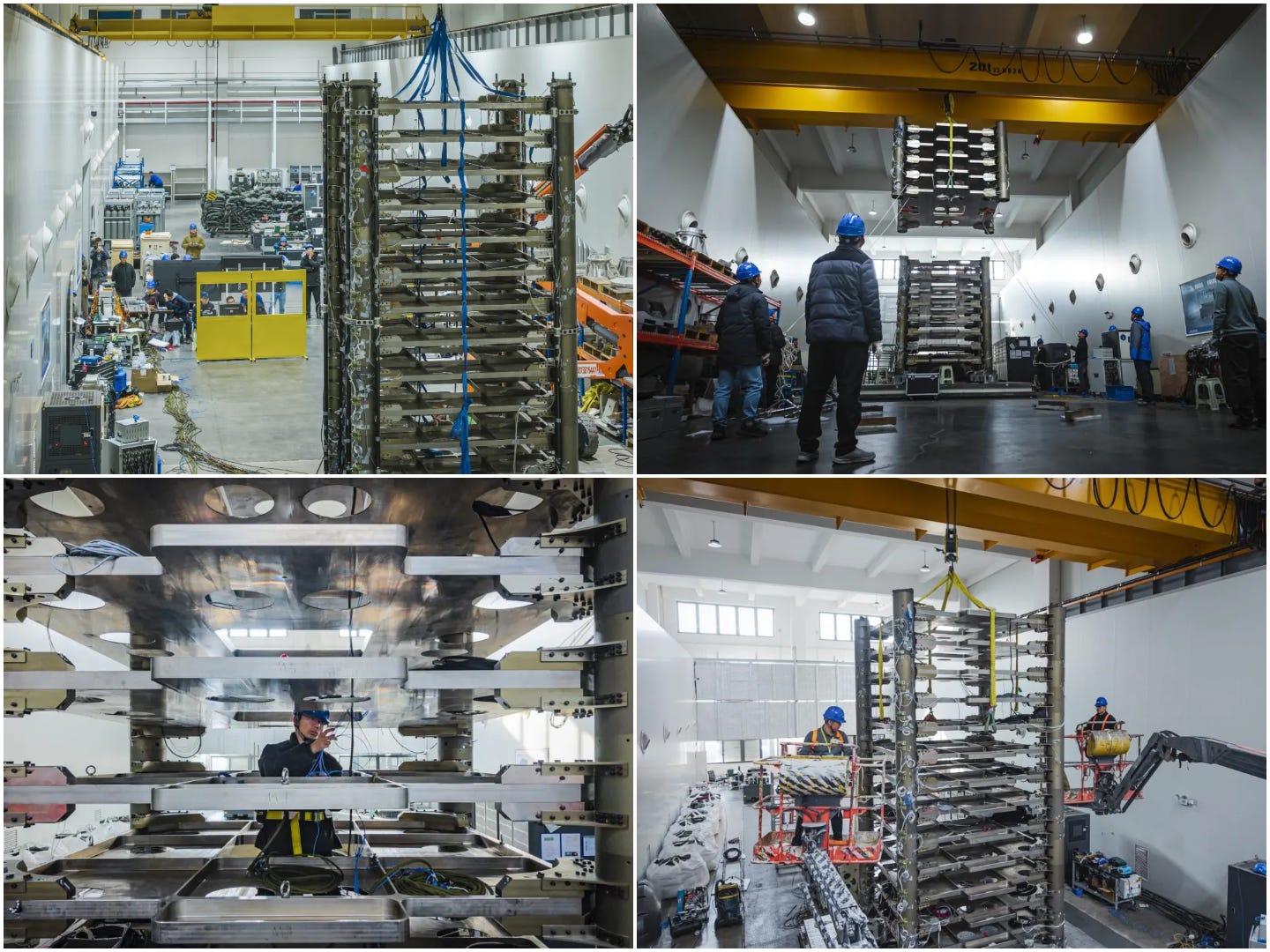
For future flights, LandSpace is actively working to fly Zhuque-3 for its designed purpose, deploying China’s mega-constellations. In a test published on February 6th, a stack of over a dozen representative spacecraft were reported to have passed vibration and ‘unlocking’ tests with a LandSpace-designed deployment mechanism to prove its suitability for launch. The mechanism was said to consist of four columns, each held to the second-stage by two carbon fiber rods, that unlatch in synchonized manner non-pyrotechnically to deploy the batch of satellites. All parts of the mechanism were stated as being designed to remain attached, reducing the creation of orbital debris.
The Zhuque-3 segment starts around 1:31:10 in the events recording.
It costs far less to inspect and refurbish an existing first-stage rather than producing a new one, proven by SpaceX’s dominance in the U.S. market.
Driven by a wider adoption of reusable launch vehicle’s across China’s space sector. There are already many reusable rockets preparing to fly for the first time in 2026. While the Shanghai Academy of Spaceflight Technology should fly the Long March 12A again this year, this time hopefully landing.