

Long March 10A Debut Moved Up For Lunar Satellite Mission, Report Says
Instead of carrying Mengzhou, the launch vehicle is now expected to deliver an experimental lunar satellite for its first mission.

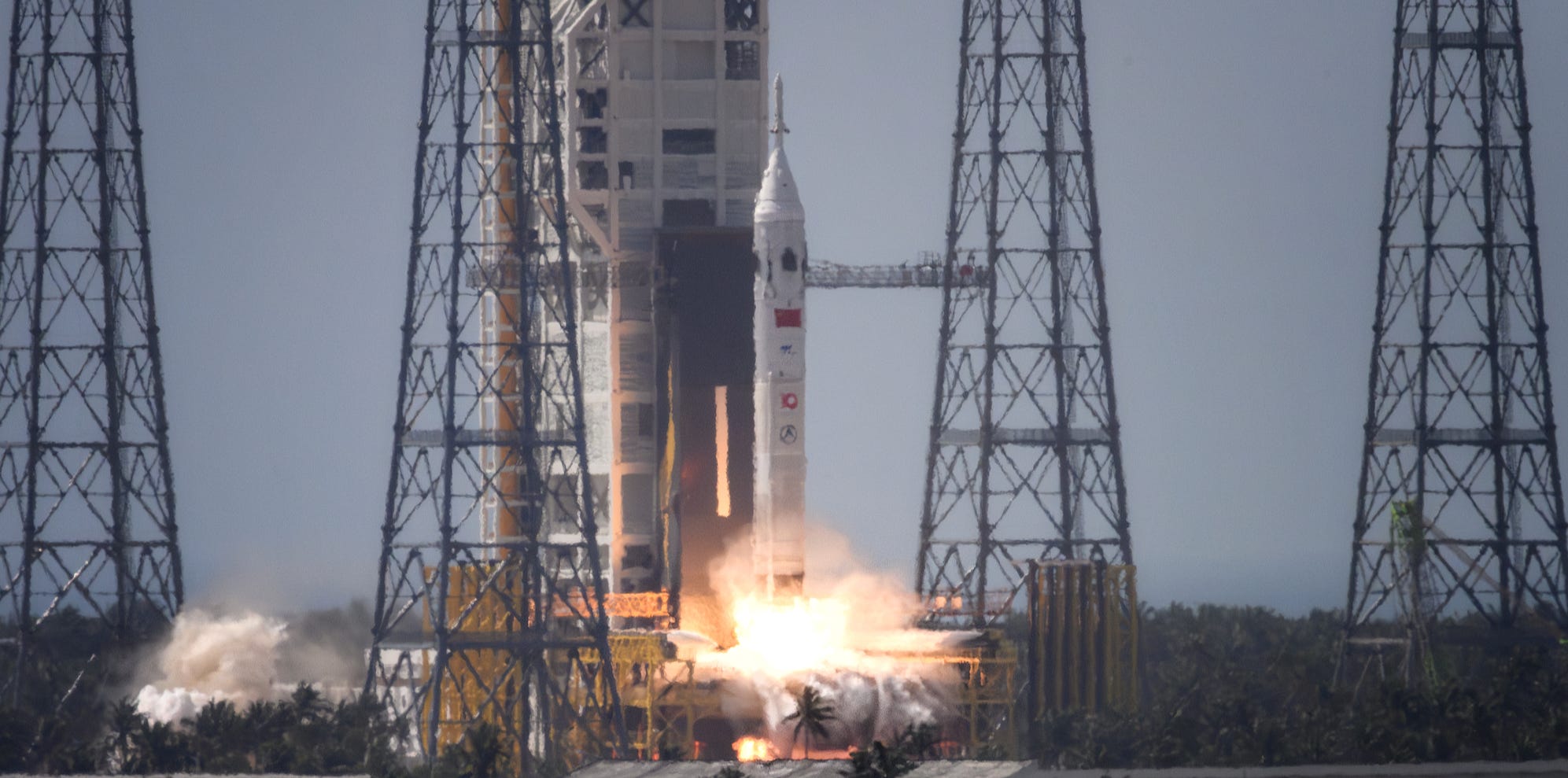
According to exclusive information told to STAR Market Daily (科创板日报)1, the debut flight of the Long March 10A launch vehicle2 will aim to deliver a satellite towards lunar space. That satellite will be sent towards the Moon by the CAS Space-developed ‘Kinastra (力巡)’ upper-stage after both are placed into Earth orbit by the two-stage launch vehicle. The report also stated:
“The flight plan for the Long March 10A, which will carry a combination of the upper-stage and the Space-Time Reference Satellite, has been approved by the 921 Office3. The debut flight is scheduled for mid-year, with the satellite to be placed into lunar transfer orbit.”
If there are any problems with this translation please reach out and correct me.
With the stated debut flight in the middle of the year, the Long March 10A’s first mission has been moved up several months, previously aimed towards the end of 2026, when it begins the uncrewed Mengzhou-1 mission to the Tiangong Space Station. The Mengzhou-1 mission is still expected in September, as said by the STAR Market Daily, and that would fit neatly into Tiangong’s visiting vehicle schedule4.
A possible challenge in meeting a mid-2026 launch while leaving time for Mengzhou-1 later this year, given vehicle integration and launch pad turnaround times, is the production of the first ‘Kinastra’ at CAS Space. A little over two weeks ago, the company was performing late development firings of the storable propellant-burning Kinecore-4 (力擎四号) engine that propels the stage.
As for what the Space-Time Reference Satellite (时空基准卫星) is, that was not shared. Based on its name, it will likely assist with spacecraft navigation around lunar space, like BeiDou does for Mengzhou in Earth orbit, and should be building on a handful of earlier satellites.
Since April 2025, the Innovation Academy for Microsatellites, Chinese Academy of Sciences (中国科学院微小卫星创新研究院) and the Technology and Engineering Center for Space Utilization (中国科学院空间应用工程与技术中心) have been testing a three-satellite lunar communications network, all launched about two years ago. That network exploits a near constant line of sight to most of space around the Moon by having one satellite in a distant lunar orbit, another floating between Lagrange points5, and a third in sun-synchronous orbit of Earth.
Back in 2018, China deployed its Queqiao (鹊桥卫星) lunar relay satellite out at the Earth-Moon L2 Lagrange point to enable communications with spacecraft on or passing by the far side of the Moon. In 2024, the Queqiao-2 (鹊桥二号卫星) was launched towards lunar space, arriving in a highly eccentric, highly inclined orbit, to broaden communication coverage, primarily focused on the South Pole. When not needed for Chang’e missions, the Queqiao relays have been performing tests with the small Tiandu-1 (天都一号卫星) and Tiandu-2 (天都二号卫星) satellites to improve lunar communications coverage and navigation.
In the long term, China’s Deep Space Exploration Laboratory (深空探测实验室) plans to build what it calls the ‘Queqiao constellation’ for communications with crewed spacecraft, remote sensing satellites, and space stations around the Moon. The Space-Time Reference Satellite is probably going to prove enabling systems for it.
Owned by Shanghai Media Group (上海文化广播影视集团有限公司), the outlet is focused on covering the Shanghai Stock Exchange’s Science and Technology Innovation Board, also called the STAR Market in short.
Dedicated to low Earth orbit tests of lunar mission hardware, the Tiangong Space Station, and government missions. The rocket is able to lift up to 18,000 kilograms into low Earth orbit. It is related to the Long March 10 Moon rocket, able to send up to 27,000 kilograms on a trans-lunar trajectory, without its third-stage or two additional first-stage boosters.
The China Manned Space Agency.
The Shenzhou-23 mission will arrive in late April and depart in late October. The Tianzhou-10 resupply mission will dock in May and stay into 2027. And the Shenzhou-24 mission will arrive in late October and stay until April 2027.
Via NASA’s ‘What is a Lagrange Point?’:
“Lagrange points are positions in space where objects sent there tend to stay put. At Lagrange points, the gravitational pull of two large masses precisely equals the centripetal force required for a small object to move with them. These points in space can be used by spacecraft to reduce fuel consumption needed to remain in position.”