

Qianfan System Testing Well Underway Ahead of Consumer Services
Trials of the current connectivity service have been taking place in the background for several months, with recent verifications of new ones too.

While deployments for the Qianfan (千帆) connectivity constellation have been speeding up this year, in the background its teams have been quietly working on bringing consumer services online since an early test back at the start of 2025.
On June 12th, China Central Television (中国中央电视台) news feature gained a behind-the-scenes look at Shanghai Spacesail Technologies’ (上海垣信卫星科技有限公司) efforts at preparing the Qianfan services for a consumer rollout. That showcased employees testing sending and receiving data from the 200-satellite constellation, at the time, in urban and remote regions through development terminals. One of those tests had speeds peaking at 394 Megabits per second1, above the median for mainland China and its Special Administrative Regions2.
To receive internet connectivity via terminals and through hundreds of satellites forming a network, Qianfan needs ground stations3 and has established several. The constellation’s flagship site, as shown off to China Central Television, appears to be in Songjiang (松江区), Shanghai (上海市), while others have been setup near Beijing (北京), as well as in Heilongjiang (黑龙江) province and the Xinjiang Uygur Autonomous Region (新疆维吾尔自治区 / شىنجاڭ ئۇيغۇر ئاپتونوم رايونى), among undisclosed others. Two ground stations have been established abroad in Brazil and Malaysia, as both nations have enterprises that signed agreements for the constellation.

Some basic connectivity services have already begun to be offered to maritime users, as of Qianfan’s last deployment on June 5th. According to Shanghai Spacesail Technologies, the currently operational satellites are able to provide support to automatic identification systems for connecting maritime vessels away from the shore.
Towards the end of the year, around the fourth quarter (October, November, December), the constellation is reportedly expected to begin consumer internet connectivity services in at least Brazil and China, with Malaysia possibly following soon after. Agreements are also in place to bring those to Kazakhstan, Türkiye, and airlines in the near future.
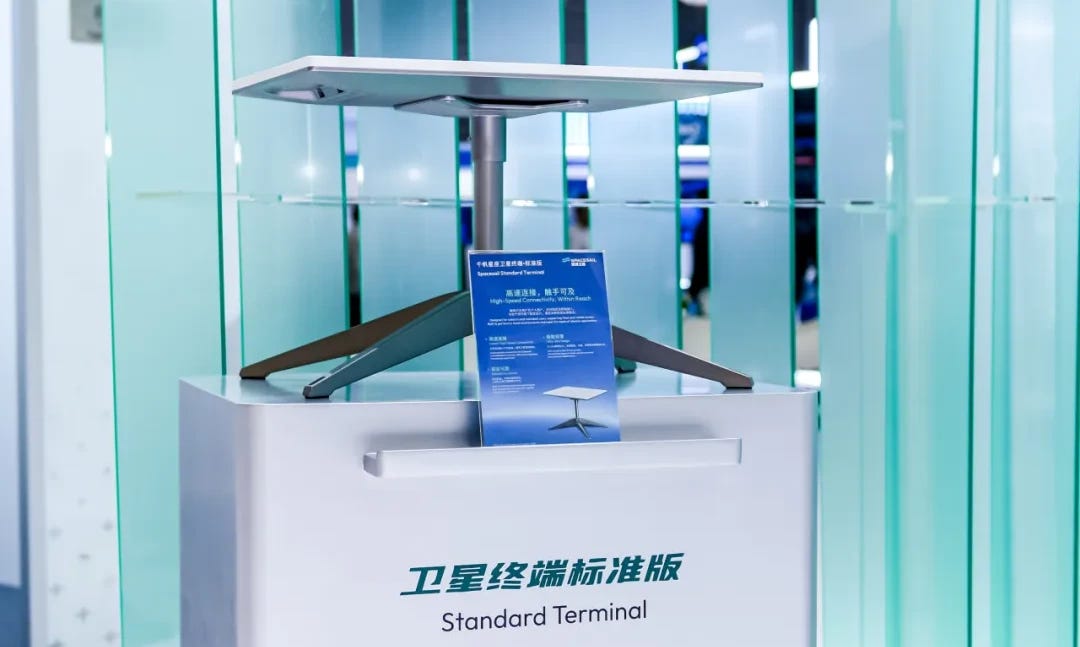
For consumer use in those nations, Shanghai Spacesail Technologies has designed two phased-array antenna-utilizing terminals, one for terrestrial use and another for installation on aircraft. Those terminals, as showcased at the 2026 Mobile World Congress in Shanghai, are stated to be capable of providing download speeds of up to 450 Megabits per second and upload speeds of 150 Megabits per second, while being able to operate in ‘harsh’ environments4.
When Qianfan services begin, its 200 satellites will slowly become bottlenecked as consumers begin using the service. That bottleneck can be overcome quite simply by launching more satellites, with one of the constellations’ contractors suggesting that 124 satellites might be added by the end of July5, alongside a desire to have the cumulative total of satellites reach 6486 by the end of the year.
While preparing to roll out consumer services, Shanghai Spacesail Technologies is also looking to the future of Qianfan, which saw ‘Qianfan Direct-To-Cell-01 Satellite (千帆DTC01星)’ delivered into low Earth orbit on June 9th, theorized to trial second-generation systems. By June 19th, that satellite demonstrated that its systems can provide connectivity to an unmodified consumer mobile device with connectivity comparable to 5G services.
Deploying satellites and exploring upgrades both cost money to pursue, and as services are yet to begin, Shanghai Spacesail Technologies has no recurring revenue stream while contracting out its production efforts. That has seen the constellation operator aiming to raise around 5 billion Yuan (736.36 million United States Dollars, as of June 23rd) in new capital by mid-July. Previously, the company looked to raise a similar amount in October 2025 and secured 6.7 billion Yuan (986.73 million United States Dollars) in February 2024 ahead of any satellite deployments.
Here is a screengrab from the news feature with connection speeds over the course of a few minutes:
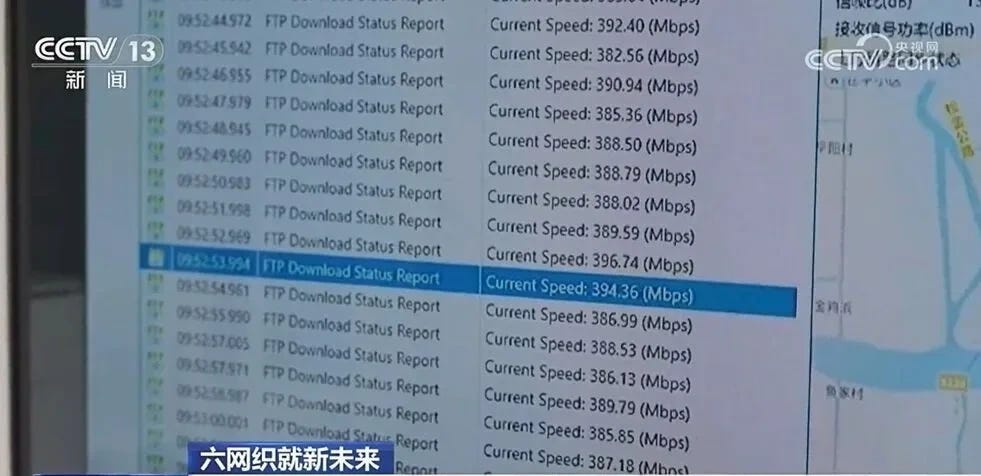
China’s median speed, as of May 2026, is 222 Megabits per second. Hong Kong’s (香港) is 350 Megabits per second, while Macao’s (澳门) is 315 Megabits per second.
To act as access points to the wider internet.
Regarding temperature range, winds, and vibrations.
Which would require seven launches if deployed in groups of 18 satellites.
Twenty-five launches if deployed in groups of 18 satellites.