

Replacement Haiyang-2 Ocean Spacecraft Delivered Into Orbit [Long March 4B Y56]
From Jiuquan, Haiyang-2E was delivered to perform ocean environment monitoring tasks as the first part of a new trio of spacecraft.

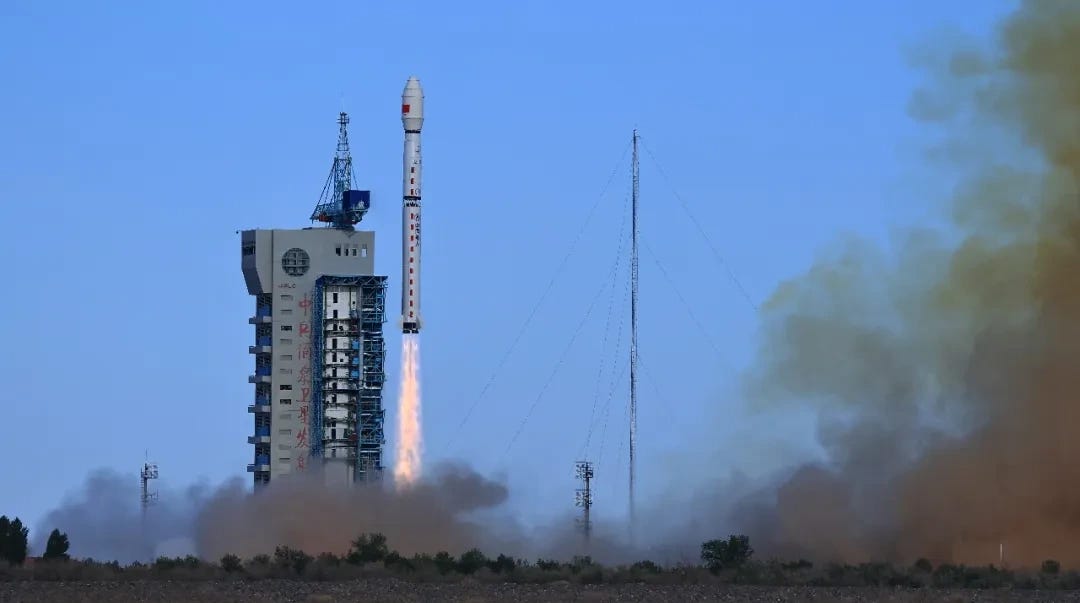
At the Jiuquan Satellite Launch Center’s Launch Site 94, a Long March 4B lifted off to fly towards sun-synchronous orbit at 07:46 am China Standard Time on July 2nd (23:46 pm Universal Coordinated Time on July 1st), carrying a new ocean monitoring spacecraft.
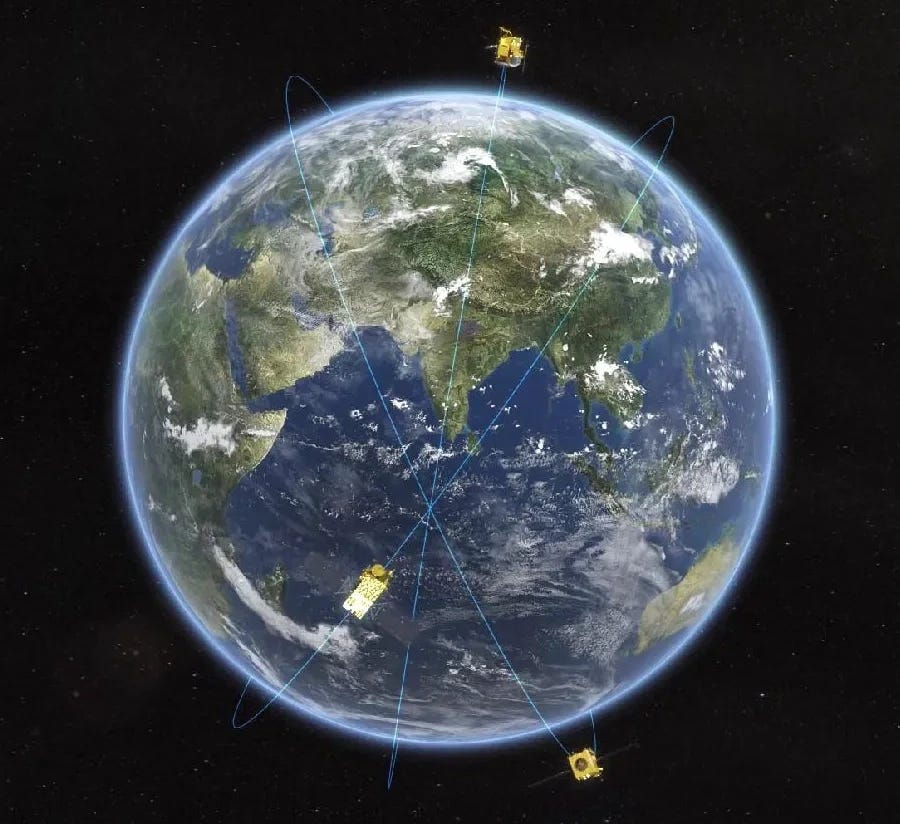
Atop of the vehicle was the China Academy of Space Technology-built 1,500-kilogram Haiyang-2E (海洋二号E卫星), on behalf of China’s National Satellite Ocean Application Service (国家卫星海洋应用中心), under the State Oceanic Administration (国家海洋局). The spacecraft is planned to monitor the environment of the world’s oceans, measuring their waves, temperatures, and winds. To do that, a handful of instruments are onboard:
A 1,600-kilometer swath Microwave Radiometer Imager for surface temperature, wind, and vapor monitoring;
a dual-beam, 1,300-kilometer swath Scatterometer for collecting wind data;
a 25-kilometer resolution Calibration Microwave Radiometer for measuring water vapor;
a 16-kilometer resolution Radar Altimeter for tracking wave height;
and a Laser Retroreflector Array to enable accurate distance measurements.
To assist the spacecraft with its tasks, France’s DORIS (Doppler Orbitography and Radiopositioning Integrated by Satellite) system is onboard as part of a regular collaboration for the Haiyang-2 series. That system assists the spacecraft by measuring its location in orbit with centimeter accuracy, allowing teams on the ground to better understand instrument data collected.
Haiyang-2E joins eight other spacecraft of its series currently in orbit, while being the eleventh deployed since the first launch in May 2002. The last addition was Haiyang-4-01 in November 2024 for monitoring ocean salinity. Across the current spacecraft, those designated under Haiyang-11 for measuring ocean color, Haiyang-22 keeps track of the marine environment, and Haiyang-33 performs surveillance of the oceans.
Today’s Haiyang-2 spacecraft is also part of a new trio that will be launched this year and next, at least with Haiyang-2F and Haiyang-2G set to be added. Those will replace the aging Haiyang-2B, Haiyang-2C, and Haiyang-2D, respectively.
To enable a successful launch mission of the Long March 4B, the Shanghai Academy of Spaceflight Technology said that its teams adapted preparations to Jiuquan’s current high temperature and dry weather by modifying insulation materials, while ensuring sand particles cannot be carried inside by wind. The China Aerospace Science and Technology Corporation added that multiple rounds of joint testing, between the spacecraft and launch vehicle, occurred too.
Today’s launch was the 57th mission for the Long March 4B, the 118th launch for the Long March 4 series, the 270th Long March vehicle from the Shanghai Academy of Spaceflight Technology, and the 654th launch of the Long March launch vehicle series. This was also the 45th launch from China in 2026.
Liftoff video via 大漠问天 on WeChat.
Check out the previous Long March 4B launch
New Cartography Satellite Launched via Final Jiuquan Mission of 2025 [Long March 4B Y69]
![New Cartography Satellite Launched via Final Jiuquan Mission of 2025 [Long March 4B Y69]](https://substackcdn.com/image/fetch/$s_!nfH2!,w_1300,h_650,c_fill,f_webp,q_auto:good,fl_progressive:steep,g_auto/https%3A%2F%2Fsubstack-post-media.s3.amazonaws.com%2Fpublic%2Fimages%2F58cac1a2-2c8f-4a82-8161-252cd8deb029_5508x3142.jpeg)
A Long March 4B lifted off from Launch Site 94 at the Jiuquan Satellite Launch Center at 12:12 pm China Standard Time (04:12 am Universal Coordinated Time) on December 30th, heading toward a sun-synchronous orbit with a single space…
What is the Long March 4B?
This section is for those less familiar with China’s Long March series of launch vehicles.
The Long March 4B is an older generation low Earth and sun-synchronous orbit workhorse of the Shanghai Academy of Spaceflight Technology. All three stages of the rocket burn Dinitrogen Tetroxide and Unsymmetrical Dimethylhydrazine, with no engine restart capability.
The payload capacity of the launch vehicle is currently as follows:
4,200 kilograms to low Earth orbit
2,800 kilograms to a sun-synchronous orbit
1,500 kilograms to a geostationary transfer orbit
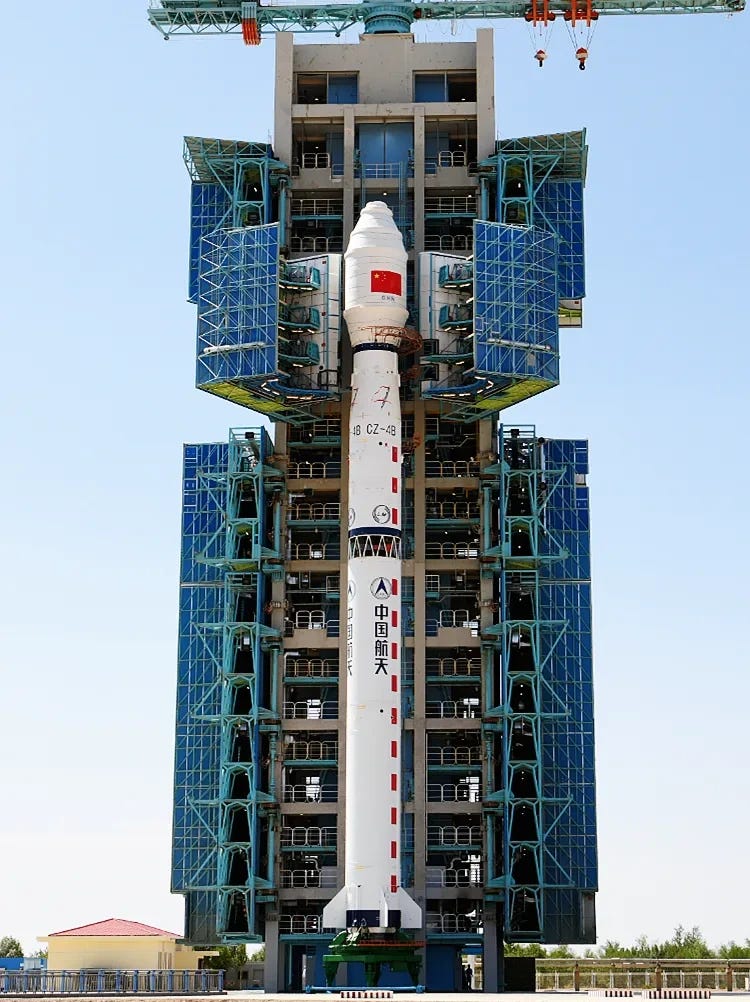
The first-stage is powered by four YF-21C engines, which generate 302 tons of thrust burning Dinitrogen Tetroxide and Unsymmetrical Dimethylhydrazine. The second-stage is powered by a single YF-22C engine and four YF-23C verniers that generate 80 tons of thrust while also burning Dinitrogen Tetroxide and Unsymmetrical Dimethylhydrazine. The third-stage is propelled by two YF-40 engines that provide 10 tons of thrust by once again burning Dinitrogen Tetroxide and Unsymmetrical Dimethylhydrazine.
On the launch pad, the Long March 4B is 44.1 meters tall and weighs 249,200 kilograms when fully fuelled. The first and second-stage have a diameter of 3.35 meters, while the third-stage has a diameter of 2.9 meters, and a fairing diameter of either 3.8 or 4.2 meters.
So far, the Long March 4B has flown from all three inland launch sites, the Jiuquan Satellite Launch Center, the Taiyuan Satellite Launch Center, and the Xichang Satellite Launch Center.
Two are presently in orbit: Haiyang-1C, launched September 2018, and Haiyang-1D, deployed June 2020.
With four currently in space: Haiyang-2A, delivered August 2011, Haiyang-2B, added October 2018, Haiyang-2C, launched September 2020, and Haiyang-2D, deployed May 2021.
Just Haiyang-3A is in orbit, through a launch in November 2023.