

Second Algerian Remote Sensing Spacecraft Deployed Into Orbit [Long March 2C]
A little over two weeks after the last deployment, the North African nation has gained another satellite for imaging the Earth below.

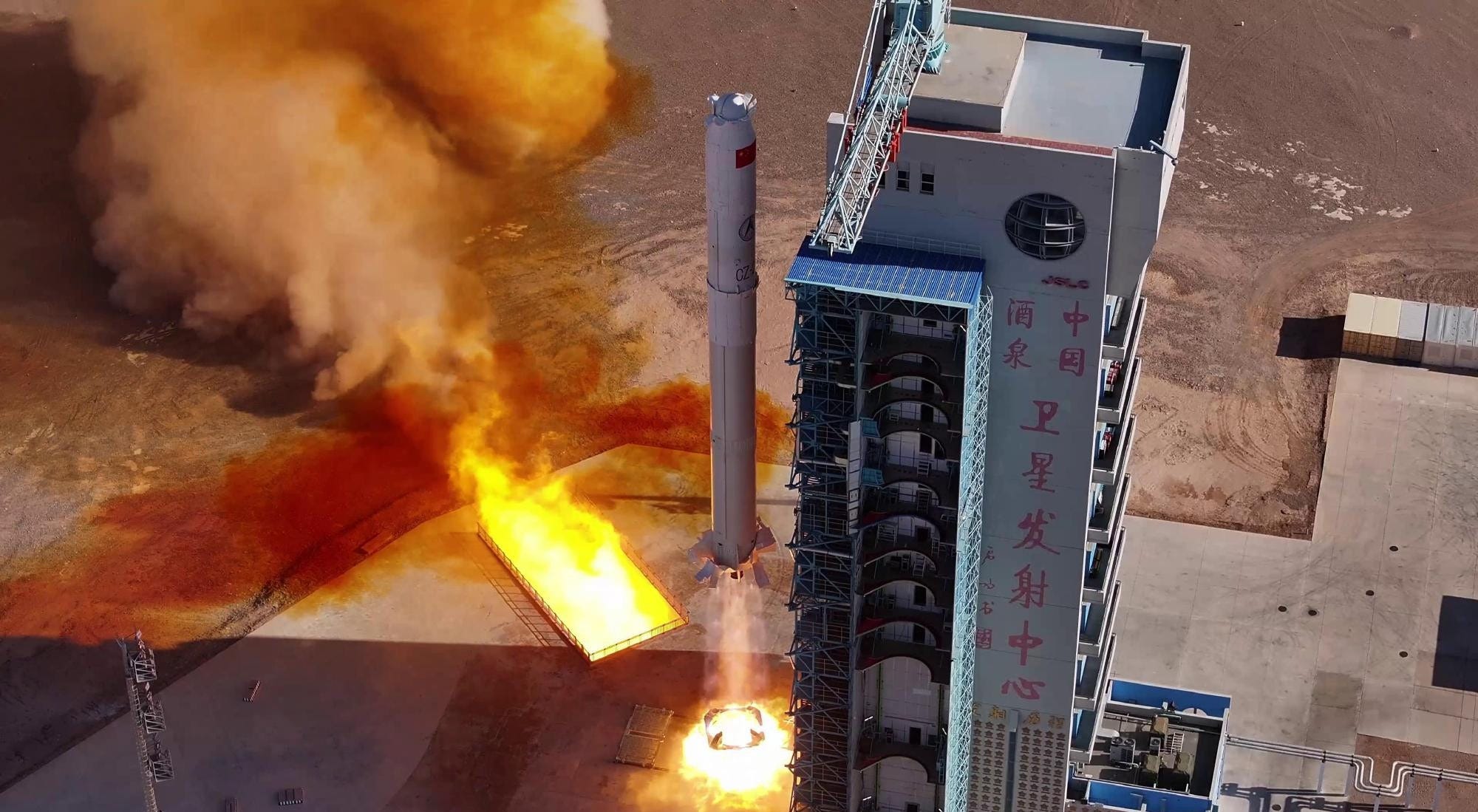
From Launch Site 94 at the Jiuquan Satellite Launch Center, a Long March 2C blasted off at 12:01 pm China Standard Time (04:01 am Universal Coordinated Time) on January 31st, once again heading into sun-synchronous orbit for an international customer.
For the second time this January, the customer was the Algerian Space Agency with the AlSat-3B (阿尔及利亚遥感三号B) satellite, produced by the China Academy of Space Technology and procured through China Great Wall Industry Corporation. AlSat-3B is the second of two Chinese-made remote sensing satellites for Algeria, agreed for in July 2023, with the first having launched a little over two weeks ago on January 15th.
The primary uses for AlSat-3A and AlSat-3B are reportedly supporting land-use planning as well as enhancing capabilities for disaster prevention and mitigation, according to the involved Chinese enterprises. Meanwhile, Algerian media focused on the two satellites’ capabilities in geospatial intelligence and information, alongside their ‘high’ imaging resolution.
The launches of AlSat-3A and AlSat-3B are under the second Algeria-China Strategic Cooperation Plan (2022-2026), with space being one of the key cooperation areas. China’s state-owned space enterprises supporting today’s launch once again hailed it as an example of the One Belt, One Road Initiative’s (一带一路) cooperation, which Algeria is part of.
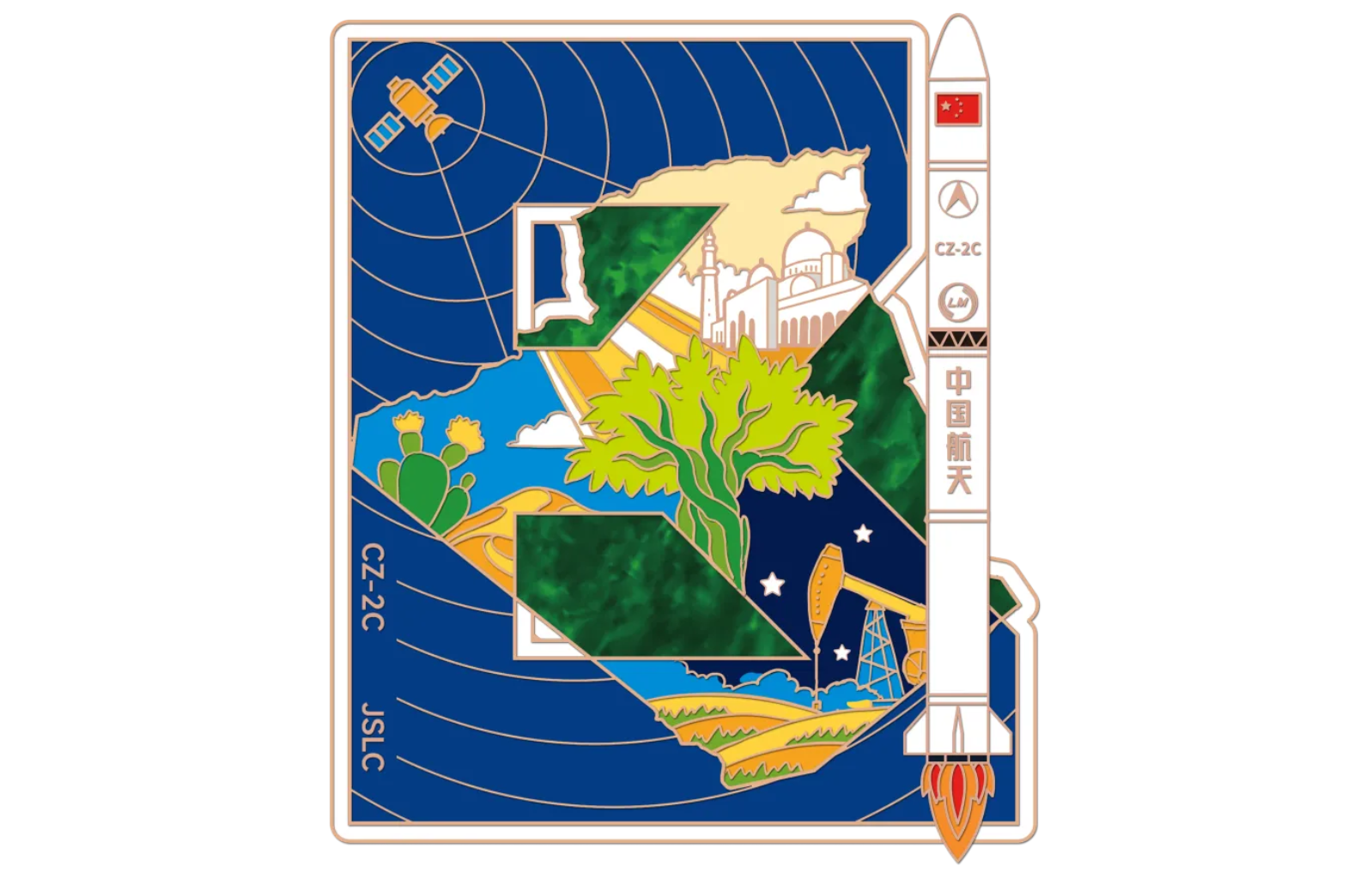
Following the successful conclusion of the launch mission, the China Academy of Launch Vehicle Technology spoke on how this mission followed just seventeen days after the Long March 2C’s previous flight, said to be enabled by parallel launch preparations by teams at Jiuquan. After the vehicle’s first flight of 2026, the Launch Vehicle Academy stated that the Long March 2C will have a period of high-density launches during the year.
Not mentioned by the Launch Vehicle Academy, but quite obviously implemented, was a change to the Long March 2C’s paint scheme. Like the Long March 3B/E and Long March 7A, the vehicle previously had blue bands of paint for tracking and aesthetics. With improvements to tracking technology, the blue bands have been removed, slightly reducing weight as a bonus, for a mostly-white paint scheme with manufacturer, customer, and national branding being retained.
Today’s launch was the 86th launch of the Long March 2C, and the 629th launch of the Long March launch vehicle series. This was also the 8th launch from China in 2026.
Liftoff footage via 大漠问天 and 我们的太空 on WeChat.
Check out the previous Long March 2C launch
Algerian Remote Sensing Satellite Delivered to Orbit From Jiuquan [Long March 2C]
![Algerian Remote Sensing Satellite Delivered to Orbit From Jiuquan [Long March 2C]](https://substackcdn.com/image/fetch/$s_!MhpM!,w_1300,h_650,c_fill,f_webp,q_auto:good,fl_progressive:steep,g_auto/https%3A%2F%2Fsubstack-post-media.s3.amazonaws.com%2Fpublic%2Fimages%2Fd36ffdf6-d4aa-4f8e-97a4-b6716f1da61f_2415x1466.jpeg)
Off of Launch Site 94 at the Jiuquan Satellite Launch Center, a Long March 2C lifted off at 12:01 pm China Standard Time (04:01 am Universal Coordinated Time) on January 15th, heading toward sun-synchronous orbit on behalf of an i…
What is the Long March 2C?
This section is for those less familiar with China’s Long March series of launch vehicles.
The Long March 2C is one of the oldest launch vehicles from China performing missions regularly to low earth and sun-synchronous orbits by the China Academy of Launch Vehicle Technology. The two stages of the launch vehicle both burn Dinitrogen Tetroxide and Unsymmetrical Dimethylhydrazine.
The payload capacity of the launch vehicle is currently as follows:
3,850 kilograms to low Earth orbit
1,900 kilograms to a sun-synchronous orbit
1,250 kilograms to a geostationary transfer orbit
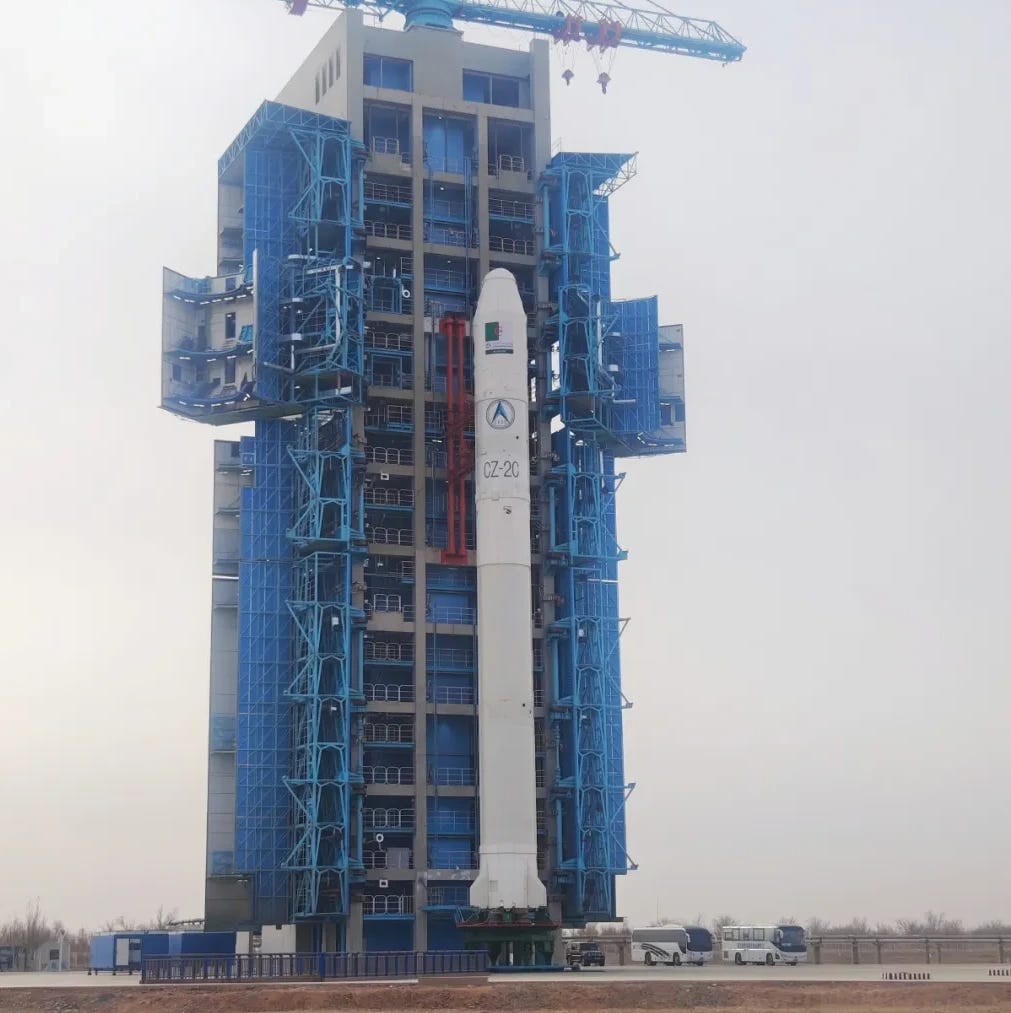
The first-stage is powered by four YF-21C engines, which generate 302 tons of thrust burning Dinitrogen Tetroxide and Unsymmetrical Dimethylhydrazine. The second-stage is powered by a single YF-22E engine and four YF-23C verniers that generate 80 tons of thrust while also burning Dinitrogen Tetroxide and Unsymmetrical Dimethylhydrazine.
On the launch pad, the Long March 2C is 42 meters tall and weighs 233,000 kilograms when fully fuelled. The first and second stages have a diameter of 3.35 meters, with the fairing having a diameter of either 3.35 or 4.2 meters.
So far the Long March 2C has flown from all three inland launch sites, the Jiuquan Satellite Launch Center, the Taiyuan Satellite Launch Center, and the Xichang Satellite Launch Center.


