

Second Massive TJSW Spacecraft Launched From Wenchang [Long March 5 Y10]
The Long March 5 has delivered its second TJSW spacecraft of 2025 using its larger payload fairing.

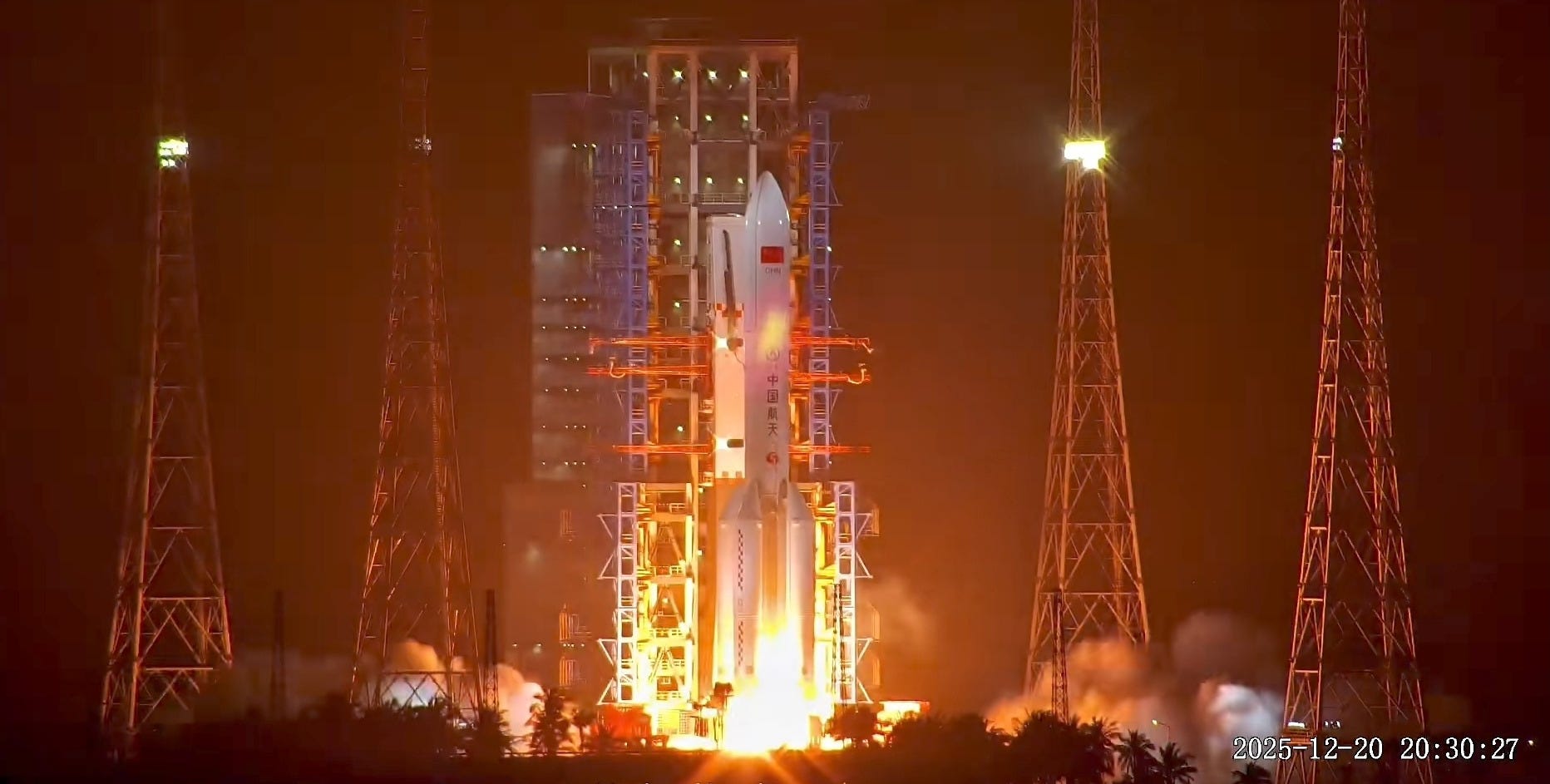
From the Launch Complex 101 at the Wenchang Space Launch Site, a Long March 5 roared into the night sky at 20:30 pm China Standard Time (12:30 pm Universal Coordinated Time) on December 20th, carrying a singular payload to a geostationary transfer orbit.
Atop of the rocket was the China Academy of Space Technology-produced TJSW-23 (通信技术试验卫星二十三号) spacecraft. As with previous TJSW series satellites, its tasks are reportedly for communications, radio, television, and data transmission, with other uses relating to technology verification of multi-band high-speed throughput communications.
TJSW-23 is the ninth in the series to be sent into orbit this year. Starting in January, TJSW-14 was delivered by a Long March 3B/E, then in March, TJSW-15 rode atop another Long March 3B/E while TJSW-16 hitched a ride on a Long March 7A, which was then followed by TJSW-17 on a Long March 3B/E, and TJSW-19 flew on another Long March 3B/E, next TJSW-20 launched atop of a Long March 5 in October, and following in November, TJSW-21 was carried by a Long March 3B/E. Finally, in December, another Long March 3B/E launched TJSW-22 into space.

Today’s launch mission had the Long March 5 utilizing its longer 18.5-meter fairing, typically reserved for the Long March 5B, for its fourth time. Two months ago, in October, it was used to deliver a TJSW communication technology test (通信技术试验) satellite, like in February 2024, to a geostationary transfer orbit. Before that, for a December 2023 mission, it carried a Yaogan (遥感) optical remote sensing satellite, also to a geostationary transfer orbit.
In their post-launch blog posts, the China Academy of Launch Vehicle Technology and the Shanghai Academy of Spaceflight Technology (who make the four boosters) noted that improvements to reliability were made to various systems. The Launch Vehicle Academy linked its improvements to the 18.5-meter fairing and its continued use. Those improvements by the two academies will enable the Long March 5 series to fly up to ten times a year.
Today’s launch was the 10th mission for the Long March 5, the 17th launch for the Long March 5 series, and the 618th launch of the Long March launch vehicle series. This was also the 88th launch from China in 2025.
Liftoff footage via ThatSpaceDogeGuy on YouTube.
Launch livestream replay via ThatSpaceDogeGuy on YouTube.
Check out the previous Long March 5 launch
Large TJSW Spacecraft Launched Toward Geostationary Orbit [Long March 5 Y9]
![Large TJSW Spacecraft Launched Toward Geostationary Orbit [Long March 5 Y9]](https://substackcdn.com/image/fetch/$s_!pGl1!,w_1300,h_650,c_fill,f_webp,q_auto:good,fl_progressive:steep,g_auto/https%3A%2F%2Fsubstack-post-media.s3.amazonaws.com%2Fpublic%2Fimages%2F6e8e0eb3-c827-4e47-af62-66b48d9e2887_1953x1040.jpeg)
A Long March 5 blasted off in its tallest configuration from Launch Complex 101 at the Wenchang Space Launch Site on October 23rd at 22:30 pm China Standard Time (14:30 pm Universal Coordinated Time), heading into a geostationary transfer orbit with a single…
What is the Long March 5?
This section is for those less familiar with China’s Long March series of launch vehicles.
The Long March 5 is China’s largest and most capable launch vehicle currently in service, and was developed by the China Academy of Launch Vehicle Technology, with the Shanghai Academy of Spaceflight Technology providing the boosters. The two-and-a-half-stage launch vehicle is fuelled with liquid hydrogen and liquid oxygen in its first and second stages, along with rocket-grade kerosene and liquid oxygen in four boosters.
The payload capacity of the launch vehicle is currently as follows:
15,000 kilograms to a 700-kilometer sun-synchronous orbit
14,000 kilograms to a geostationary transfer orbit
13,000 kilograms to medium Earth orbit
9,400 kilograms to a trans-lunar trajectory
6,700 kilograms to a 2,000-kilometer sun-synchronous orbit
6,000 kilograms to a trans-Martian trajectory
5,100 kilograms to geostationary orbit
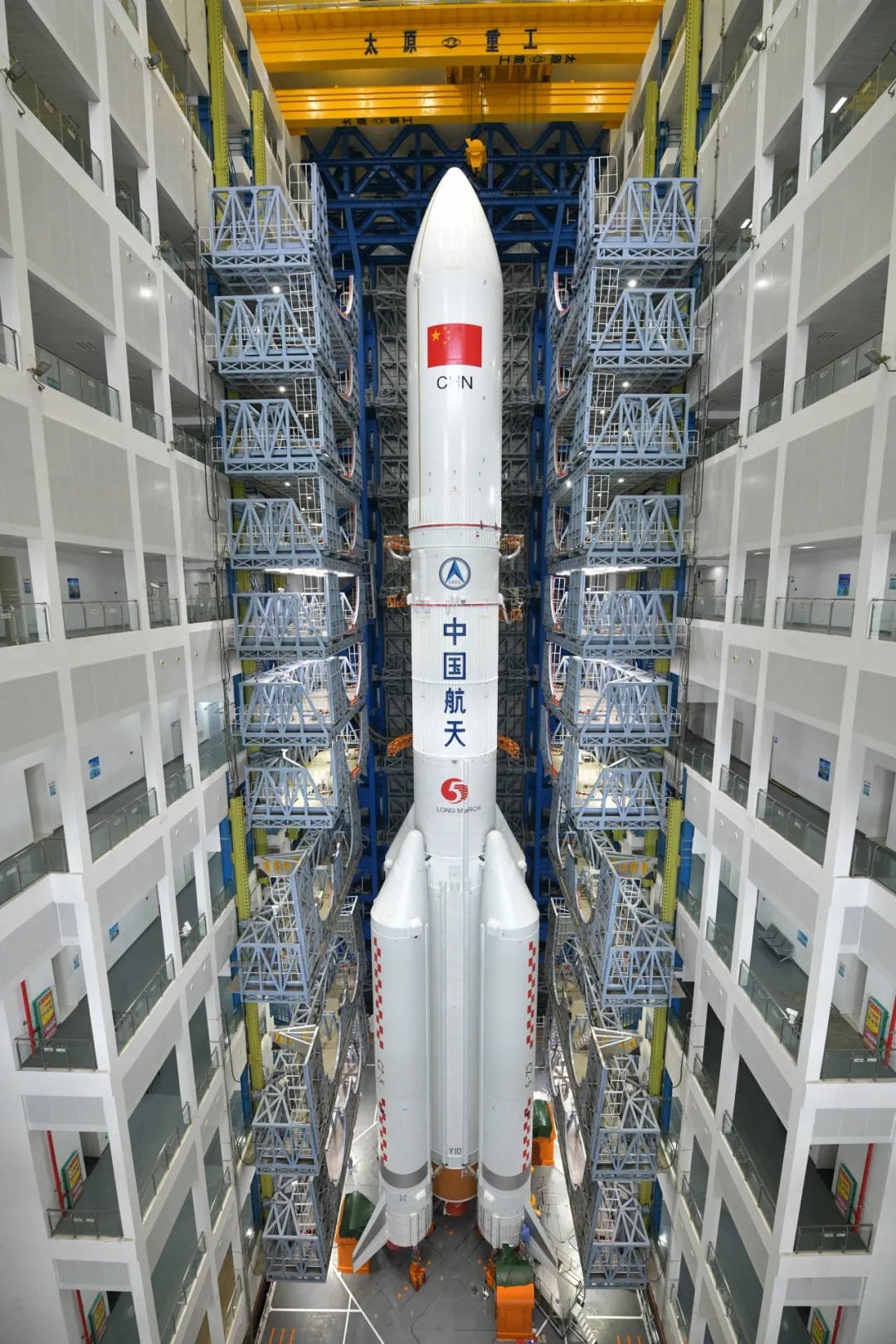
The Long March 5’s first-stage is powered by two YF-77 engines, which produce 143 tons of thrust using liquid hydrogen and liquid oxygen. To assist with liftoff, the rocket is equipped with four side boosters, each powered by two YF-100 engines that generate 245 tons of thrust using rocket-grade kerosene and liquid oxygen, providing a combined booster thrust of 979 tons. Together, the first-stage and boosters deliver a total thrust of 1,122 tons. The second stage features two YF-75D engines, generating 18 tons of thrust with liquid hydrogen and liquid oxygen.
On the launchpad, the Long March 5 stands at up to 63.2 meters tall, with the longer of its two fairing options, and weighs up to 851,800 kilograms fully fuelled. The first and second stages have a diameter of five meters, while the four boosters have a diameter of 3.35 meters, and the fairing has a diameter of 5.2 meters.
So far, the Long March 5 has only flown from the Wenchang Space Launch Site, on the east coast of Hainan province.


China seriously needs to increase the frequency of LM-5 launches and especially those classified TJSW payloads . Next year in 2026 , China should target at least 10 of those classifed heavy duty launches and should think about cluster of classified networks at various orbits in case of mishap or failure . In future those space eyes would matter a lot to counter adversaries and to preplan strategies.