

Shenzhou-21 Crew Particpate in More Medical Experiments, Tests at Halfway Point of Mission
Tiangong TV: February 8th 2026.

Now over halfway through their mission, Shenzhou-21’s Zhang Lu (张陆)1, Wu Fei (武飞)2, and Zhang Hongzhang (张洪章)3 have participated in standard medical tests onboard the Tiangong Space Station, alongside supporting ongoing experiments and maintaining the space station. Those activities were detailed in the newest episode of ‘Tiangong TV’.
Attached below is a translated transcript of the episode:
The Shenzhou-21 crew’s space mission has now spanned over three months. Last week, scientific experiments, station maintenance, equipment upkeep, and health management tasks all proceeded smoothly and systematically. Let’s take a look.
In the field of space medicine experiments, the crew completed blood sample collection and processing focused on research areas such as bone metabolism regulation and space omics4. The samples will be used to study the patterns of change and adaptive mechanisms in taikonauts’ physiological systems, including skeletal, neurological, and cardiovascular systems, during long-duration spaceflight. The crew conducted experiments using laptops to study the effects of microgravity on visual asymmetry between upward and downward fields of view, as well as the underlying cognitive neural mechanisms.
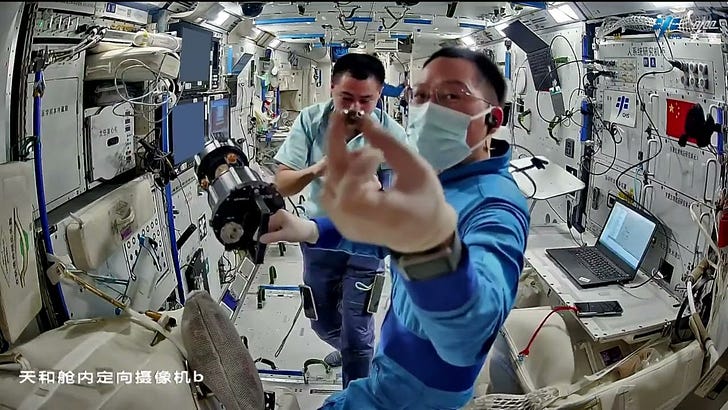
Additionally, experiments in the field of microgravity physics continue to progress. The crew completed tasks such as cleaning the sample chamber of the containerless cabinet, maintaining the motor of the transfer mechanism, cleaning the lens of the viewing window cover, and disassembling and assembling the fluid physics cabinet experimental module and replacing experimental samples.
Regarding station environmental monitoring and equipment inspection and maintenance, the crew utilized dew point meters5 and other instruments to monitor the thermal environment within the cabin and conducted air cleanliness tests. In addition, they completed routine inspections of the station maintenance and adjustment operation console, replaced gloves in the scientific glove box, organized supplies, and performed cabin environmental cleaning and maintenance tasks.
In terms of health management, the taikonauts utilized adhesive devices to deliver force stimulation to lower limb muscles during exercise in microgravity, thereby meeting their physical training requirements. Additionally, targeted medical examinations were completed, including intraocular pressure and fundus examinations6, comprehensive cardiac function assessments, and ultrasound measurements of muscle function.
The journey to the stars is far from over, the Chinese people's exploration of the vast cosmos will continue to shine. See you next week.
If there are any problems with this translation please reach out and correct me.
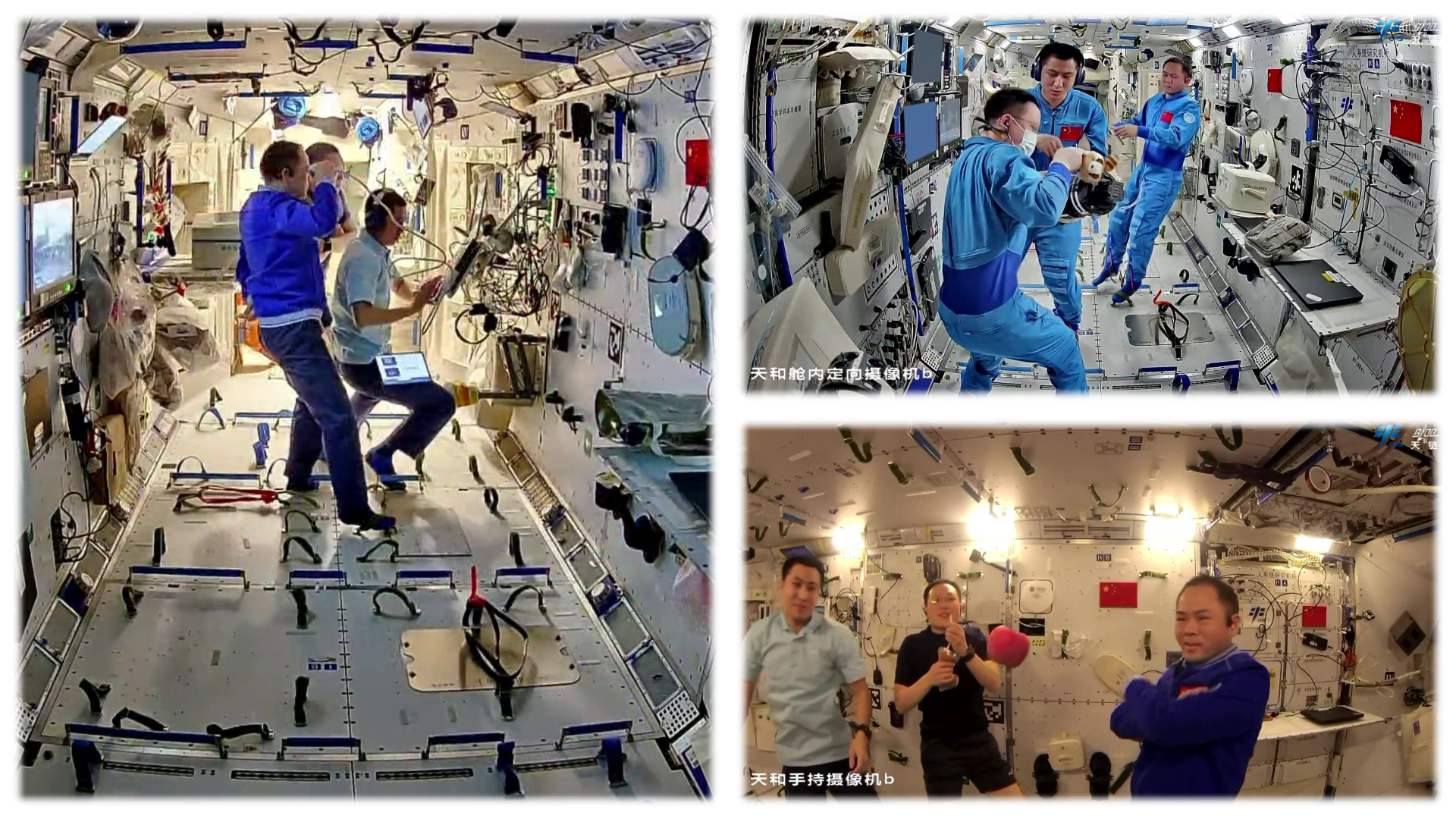
Tiangong TV Episode February 8th 2026 originally from the China Manned Space Agency, cloned to YouTube for archival.
Zhang Lu is the Commander and Pilot of the mission for his second spaceflight, having flown for the Shenzhou-15 mission between November 2022 and June 2023. He is from Hanshou County (汉寿县), Hunan (湖南) province, and was selected as part of China’s second taikonaut group in 2010, also being considered a ‘post-70s’ taikonaut having been born in November 1976.
Before becoming a taikonaut, Zhang served in the People’s Liberation Army Air Force and achieved the rank of Senior Colonel. He also joined the Communist Party of China in April 1999. After the Shenzhou-15 mission, Zhang was awarded the Spaceflight Merit Medal (Third Class) along with the honorary title of hero taikonaut.
Wu Fei is the Flight Engineer for this mission, which will be his first trip into space. He is from Baotou (包头市 / ᠪᠤᠭᠤᠲᠤᠬᠣᠲᠠ), in the Inner Mongolia Autonomous Region (内蒙古自治区 / ᠥᠪᠥᠷ ᠮᠣᠩᠭᠣᠯ ᠤᠨ ᠤᠨᠥᠪᠡᠷᠲᠡᠭᠨ ᠵᠠᠰᠠᠬᠤ ᠣᠷᠣᠨ), and was selected as part of the third taikonaut group in October 2020, while being considered a ‘post-90s’ taikonaut having been born in 1993.
Before his selection as a taikonaut, Wu was an engineer at the China Aerospace Science and Technology Corporation. He also joined the Communist Party of China in 2015.
Zhang Hongzhang is the Payload Expert for this mission, with it being his first trip to space. He is from Binzhou (滨州市), Shandong (山东) province, and was also selected as part of the third taikonaut group in October 2020, while being considered a ‘post-80s’ taikonaut having been born in 1986.
Prior to being selected as a taikonaut, Zhang was a researcher at the Dalian Institute of Chemical Physics, Chinese Academy of Sciences (中国科学院大连化学物理研究所), where he explored new materials and technology for batteries. He also joined the Communist Party of China in 2004.
Space omics is the study of the effects of space travel on biological molecules. More information on this field is available here.
An instrument used to measure the moisture in the air.
Also known as a comprehensive eye test.