

Shenzhou-21 Taikonauts Prepare for Spring Festival Onboard Tiangong
Tiangong TV: February 15th 2026.

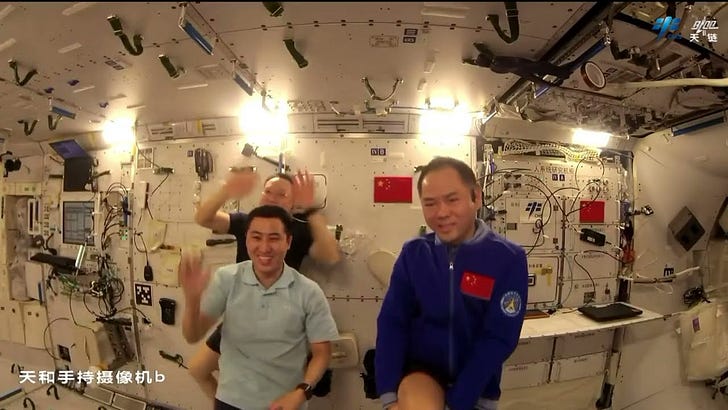
With the upcoming Spring Festival (春节), running from February 15th to 23rd, taikonauts Zhang Lu (张陆)1, Wu Fei (武飞)2, and Zhang Hongzhang (张洪章)3 are preparing to celebrate the holiday in space soon4 as part of the Shenzhou-21 mission. But before the celebrations, the three crewmates are continuing to support experiments onboard the Tiangong Space Station, including working with a robot assistant, as shown in this week’s episode of ‘Tiangong TV’.
Attached below is a translated transcript of the episode:
The space station is filled with festive cheer, while space missions proceed with purpose and order. As the Lunar New Year of the Horse draws near, the Shenzhou-21 crew continues to advance their in-orbit tasks without pause. What have the three taikonauts been up to this past week? Let’s take a look.
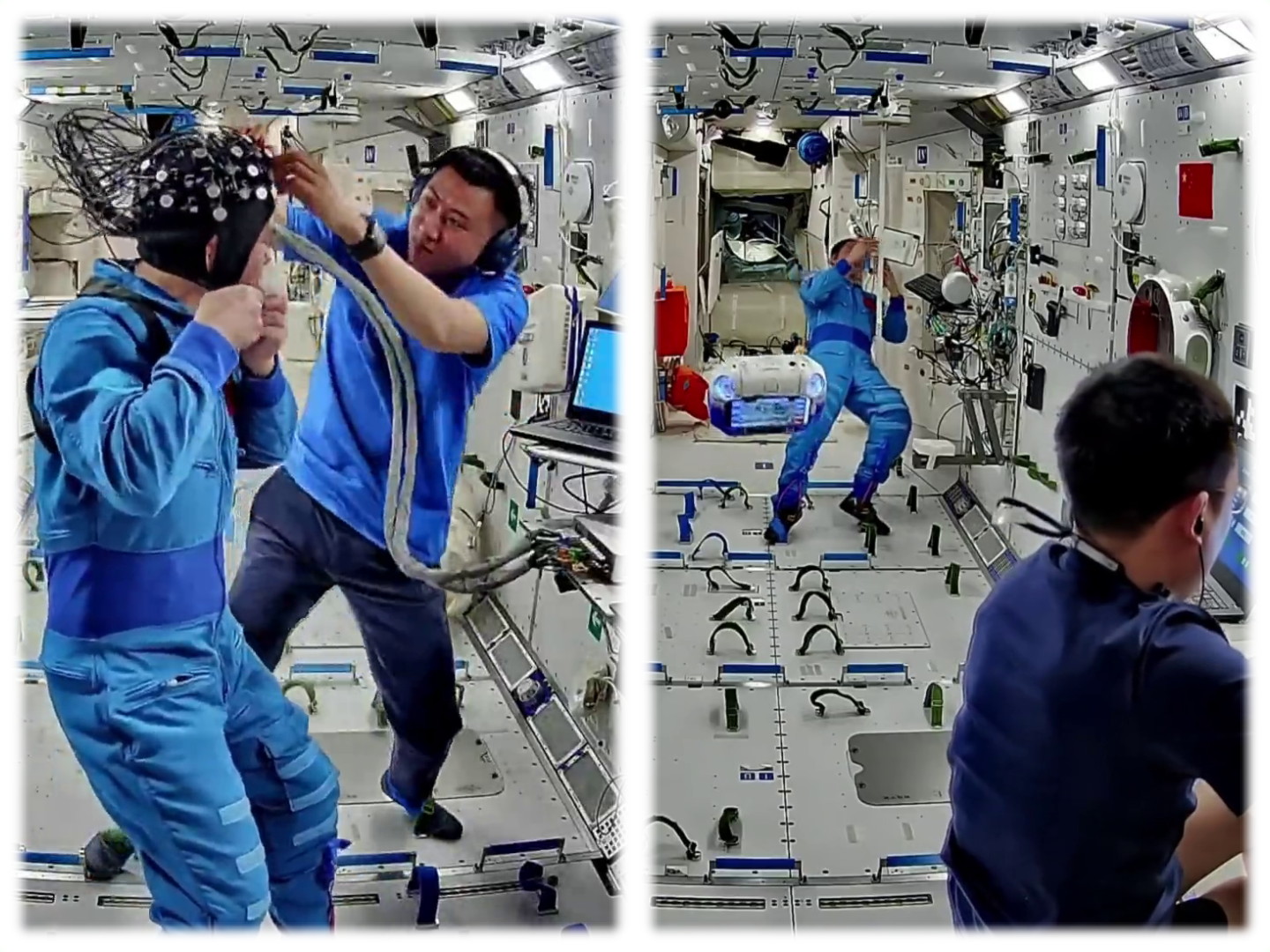
Inside the station, on-orbit training and microgravity intuitive physics behavior experiments are being conducted simultaneously. The crew used the original cognitive training system to complete training content such as image recognition and operation tests under different initial conditions, and used laptops to conduct microgravity intuitive physics behavior experiments, acquiring relevant behavioral data and exploring the impact and recovery mechanism of long-term spaceflight on intuitive physical representations.
Last week, the robot Xiao Hang (小航)5 was once again spotted aboard the space station. Using human-machine collaborative interaction experiment software, taikonauts and Xiao Hang can jointly conduct multiple experiments, including studies on human-machine spatial relationships and multimodal interaction technologies.
The taikonauts in the footage are conducting research on musculoskeletal loading during spaceflight. Utilizing equipment such as plantar pressure sensors and patch-type ultrasound devices, they collect data on plantar pressure, joint kinematics, and muscle parameters related to motion imagery during activities like running under varying load conditions during flight. This enables the mapping of parameters across different movement states to plantar pressure, as well as the characterization of changes in muscle-tendon interactions. Additionally, the crew wore bionic viscoelastic vests to complete lower-limb muscle stimulation tests, collecting data to explore muscle function maintenance capabilities and the relationship between movement patterns achieved through muscle stimulation and the collected data.
The on-orbit electroencephalography testing and research projects are proceeding as planned. The crew conducted experiments using near-infrared brain functional imaging equipment to study the time-varying characteristics of the brain’s networks in space. They investigated the effects of long-term spaceflight environments on taikonauts’ brain functional networks, as well as the brain’s spontaneous adjustment and adaptation mechanisms in response to external environmental changes.
In the field of microgravity physics, the crew completed several tasks according to the experimental plan, including replacing the sample in the fluid physics cabinet, replacing the plug-in in the combustion cabinet, cleaning the spherical sample in the containerless cabinet, maintaining the motor of the axis mechanism, and cleaning the lens of the viewing window cover.
Regarding onboard equipment inspections and maintenance, as well as in-orbit supply management, the crew completed checks and maintenance of the regenerative life support system equipment and performed cabin environment cleaning and upkeep. In addition, the crew replaced the foot restraints inside the cabin. In the microgravity environment of space, foot restraints help taikonauts stabilize their body posture.
In terms of health management, medical examination items such as clearance tests and quality measurements were carried out as scheduled, with the relevant data used to monitor the taikonauts’ health and physiological changes. Additionally, the three taikonauts actively engaged in physical exercise.
The Shenzhou-21 crew is about to celebrate the Lunar New Year in orbit, marking Commander Zhang Lu’s second space-based Spring Festival. How will they spend this special holiday? Let’s look forward to it together.
If there are any problems with this translation please reach out and correct me.
Tiangong TV Episode February 15th 2026 originally from the China Manned Space Agency, cloned to YouTube for archival.
Zhang Lu is the Commander and Pilot of the mission for his second spaceflight, having flown for the Shenzhou-15 mission between November 2022 and June 2023. He is from Hanshou County (汉寿县), Hunan (湖南) province, and was selected as part of China’s second taikonaut group in 2010, also being considered a ‘post-70s’ taikonaut having been born in November 1976.
Before becoming a taikonaut, Zhang served in the People’s Liberation Army Air Force and achieved the rank of Senior Colonel. He also joined the Communist Party of China in April 1999. After the Shenzhou-15 mission, Zhang was awarded the Spaceflight Merit Medal (Third Class) along with the honorary title of hero taikonaut.
Wu Fei is the Flight Engineer for this mission, which will be his first trip into space. He is from Baotou (包头市 / ᠪᠤᠭᠤᠲᠤᠬᠣᠲᠠ), in the Inner Mongolia Autonomous Region (内蒙古自治区 / ᠥᠪᠥᠷ ᠮᠣᠩᠭᠣᠯ ᠤᠨ ᠤᠨᠥᠪᠡᠷᠲᠡᠭᠨ ᠵᠠᠰᠠᠬᠤ ᠣᠷᠣᠨ), and was selected as part of the third taikonaut group in October 2020, while being considered a ‘post-90s’ taikonaut having been born in 1993.
Before his selection as a taikonaut, Wu was an engineer at the China Aerospace Science and Technology Corporation. He also joined the Communist Party of China in 2015.
Zhang Hongzhang is the Payload Expert for this mission, with it being his first trip to space. He is from Binzhou (滨州市), Shandong (山东) province, and was also selected as part of the third taikonaut group in October 2020, while being considered a ‘post-80s’ taikonaut having been born in 1986.
Prior to being selected as a taikonaut, Zhang was a researcher at the Dalian Institute of Chemical Physics, Chinese Academy of Sciences (中国科学院大连化学物理研究所), where he explored new materials and technology for batteries. He also joined the Communist Party of China in 2004.
Do note, ‘Tiangong TV’ episodes are released a few days to a week after the showcased events onboard the space station.
First online during the Shenzhou-19 mission and previously mentioned in mid-January.