


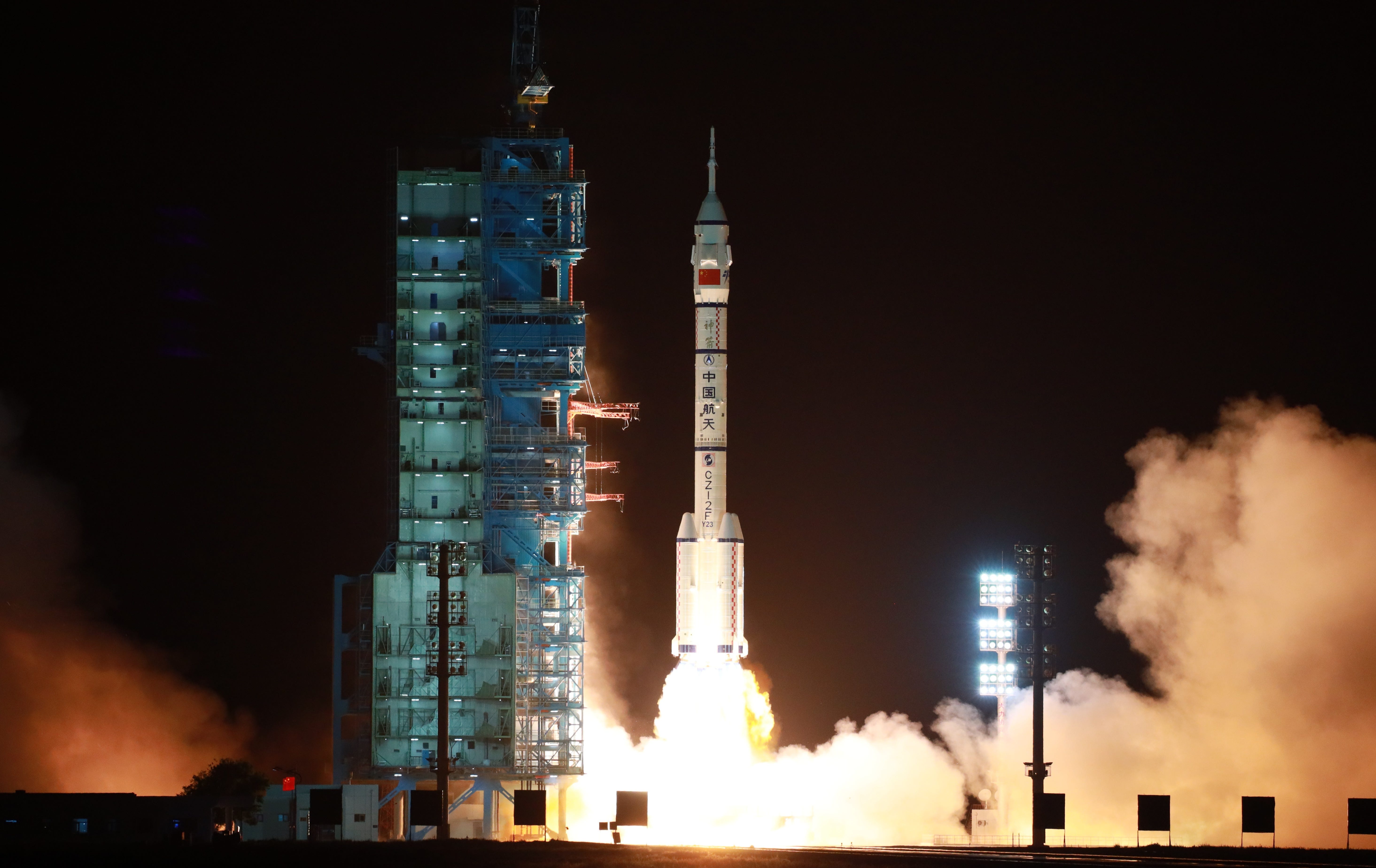
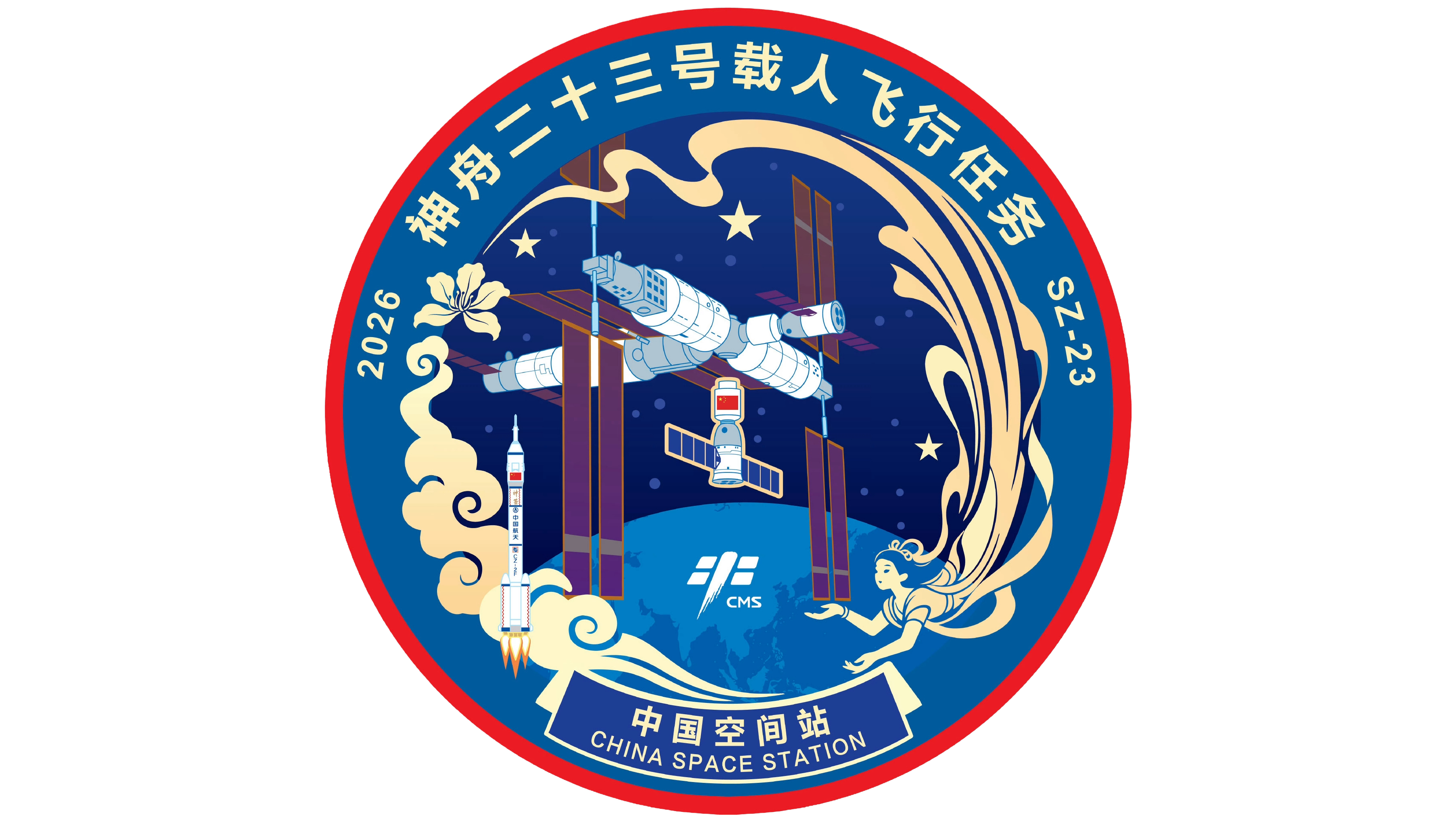
Lighting up the night sky, a Long March 2F/G lifted off from Launch Site 91 at the Jiuquan Satellite Launch Center at 23:08 pm China Standard time (15:08 pm Universal Coordinated Time) on May 24th, bringing the crew of China’s latest human spaceflight mission into low Earth orbit.
After separating from its launch vehicle, the Shenzhou-23 spacecraft unfurled its two solar panels to begin generating electrical power. At the time of publication, the spacecraft is expected to chase down and dock with the orbiting laboratory within four hours, at Tianhe’s Earth-facing docking port.
Update: the Shenzhou-23 spacecraft docked at the afore-mentioned port on May 25th at 02:45 am China Standard Time, with the crew entering the station at 05:13 am (on May 24th at 18:45 pm and 21:13 pm in Universal Coordinated Time).
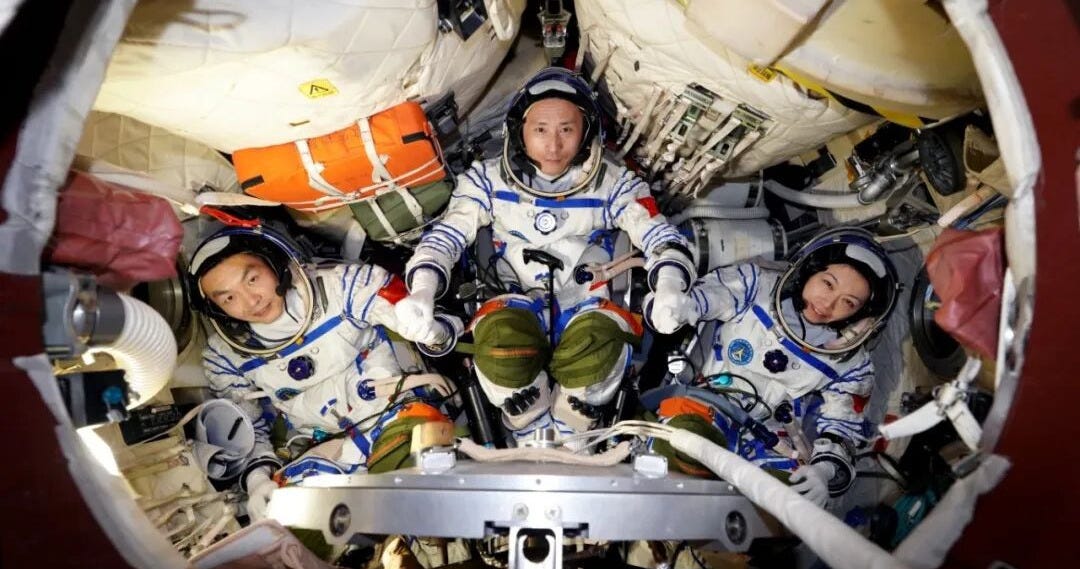
As revealed yesterday, May 23rd, the Shenzhou-23 crew consists of Commander Zhu Yangzhu (朱杨柱)1, Payload Specialist Li Jiaying (黎家盈)2, and Spacecraft Pilot Zhang Zhiyuan (张志远)3. Two of them will be onboard the station for the next six months, while one will stay for about a year, depending on their physical and psychological health status.
Upon entering Tiangong, the three taikonauts will be greeted by Shenzhou-21’s Zhang Lu (张陆)4, Wu Fei (武飞)5, and Zhang Hongzhang (张洪章)6, who have been in space since October 31st 2025, then working alongside them as part of a week-long handover period before they return to Earth.
Throughout the Shenzhou-23 mission, the three crewmates are planned to support over one hundred experiments, nine heading up with them, in areas including space life sciences, material sciences, fluid behaviour in microgravity, space medicine, and new technology. Some of those were delivered by Tianzhou-10 earlier this month, including a greenhouse gas monitoring instrument, embryos of zebrafish, mice, and stem cell-derived artificial human ones, crop seeds, biocatalytic materials, microbial samples, as well as experimental lunar fibers and thin, flexible solar cells.
Preparations to begin today’s mission intensified on May 16th when the Long March 2F/G launch vehicle rolled out to its launch pad. Once there, the Shenzhou-23 crew and site staff performed rehearsals of launch attempt and emergency procedures to guarantee the safety of all involved.
Further back, during 2025, the Shenzhou spacecraft line was upgraded it optimze its internal layout and systems, boosting cargo capacity as well. Systems were also made more reliable, and the experience for taikoanuts was said to be of greater comfort. The spacecraft’s porthole has also been reinforced following the Shenzhou-20 to Shenzhou-22 saga late last year7.
The Shenzhou-23 mission is, expectedly, the 23rd flight of the Shenzhou vehicle, and is stated to be the 40th launch for the China Manned Space Agency. It is also the 17th time a crewed mission has begun in China.
Today’s launch was the 29th for the Long March 2F series, and the 644th launch of the Long March launch vehicle series. This was also the 32nd launch from China in 2026.
Launch livestreams via ThatSpaceDogeGuy and CCTV+ China Space Station on YouTube.
Check out the previous Long March 2F launch
China's Reusable Spaceplane Departs Jiuquan to Begin Fourth Mission [Long March 2F/T]
![China's Reusable Spaceplane Departs Jiuquan to Begin Fourth Mission [Long March 2F/T]](https://substackcdn.com/image/fetch/$s_!rz4_!,w_1300,h_650,c_fill,f_webp,q_auto:good,fl_progressive:steep,g_auto/https%3A%2F%2Fsubstack-post-media.s3.amazonaws.com%2Fpublic%2Fimages%2F9e895090-faa6-4b46-847f-e05073e59904_1600x998.jpeg)
Between 11:48 am and 12:07 pm China Standard Time (03:45 and 04:07 am Universal Coordinated Time) on February 7th, a Long March 2F/T launch vehicle lifted off from Launch Site 91 at the Jiuquan Satellite Launch Cent…
What is the Long March 2F?
This section is for those less familiar with China’s Long March series of launch vehicles.
The Long March 2F is the only human-rated launch vehicle currently active in China, with it developed by the China Academy of Launch Vehicle Technology. Two versions of the launch vehicle are currently active, the 2F/G and 2F/T. The Long March 2F/G launches the Shenzhou spacecraft, while the 2F/T launches China’s reusable spaceplane and did launch the first two Tiangong space stations. All versions of the Long March 2F have had the boosters, first, and second-stage burn Dinitrogen Tetroxide and Unsymmetrical Dimethylhydrazine.
The payload capacity of the launch vehicle is currently as follows:
8,400 kilograms to low Earth orbit with Shenzhou’s abort systems
8,600 kilograms to low Earth orbit with a 4.2-meter-wide fairing
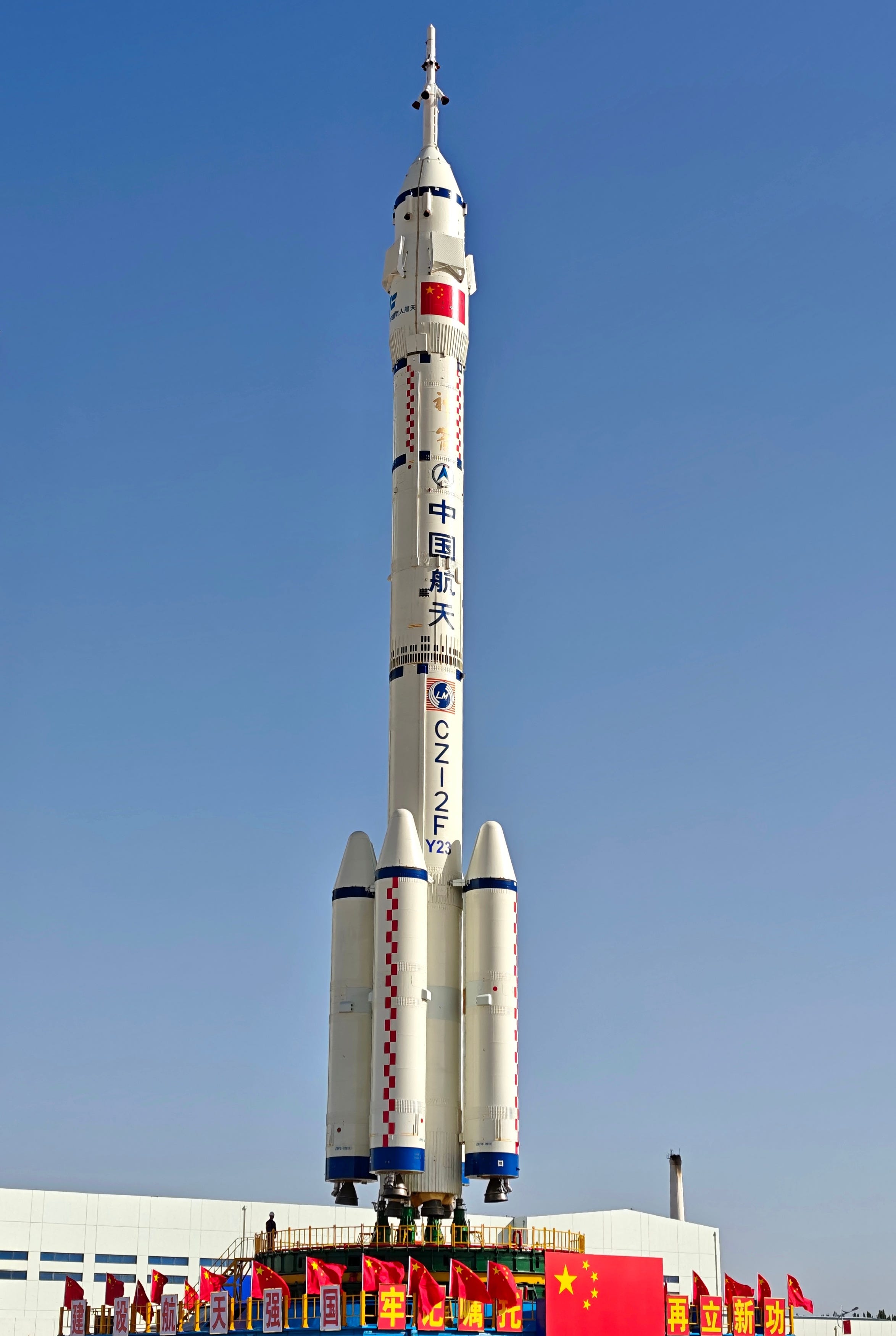
Powering the first-stage are four YF-20B engines generating a combined 332 tons of thrust, burning Dinitrogen Tetroxide and Unsymmetrical Dimethylhydrazine. Augmenting the thrust of the first-stage are four boosters, each powered by one YF-20B, each generating 83 tons of thrust each for a combined booster thrust of 332, while also burning Dinitrogen Tetroxide and Unsymmetrical Dimethylhydrazine. The combined thrust of the first-stage and four boosters is 664 tons of thrust. The second-stage of the vehicle is powered by one YF-24B generating 85 tons of thrust, once again burning Dinitrogen Tetroxide and Unsymmetrical Dimethylhydrazine.
On the launchpad, the Long March 2F is 62 meters tall, with the Shenzhou spacecraft’s launch escape system, and weighs 464,000 kilograms when fully fuelled. The first and second stages have a diameter of 3.35 meters, with the four boosters having a diameter of 2.3 meters, and the Shenzhou spacecraft’s protective fairing has a maximum diameter of 3.6 meters.
So far, the Long March 2F has only flown from the Jiuquan Satellite Launch Center, in the west of the Inner Mongolia Autonomous Region and the north of Gansu province.
What is the Shenzhou spacecraft?
The Shenzhou spacecraft is China’s only operational crewed spacecraft and is currently used to ferry its crews to and from the Tiangong space station. The spacecraft has a pressurized volume of almost fifteen cubic meters with a habitable volume of seven cubic meters. Currently, the Shenzhou spacecraft has a crew capacity of three.
Shenzhou consists of a service module, a re-entry module, and an orbital module. The only part of the spacecraft that the crew cannot access is the service module, which also houses the four main engines for performing in-space maneuvers. For generating power, the Shenzhou spacecraft has two solar wings with four panels each that are unfolded after launch, a rotating fixture also attaches them to the service module.
During launch and return to Earth, the crew is seated in the re-entry module. The re-entry module is the only part of the spacecraft that can survive the heat of re-entry and has parachute systems and a landing motor to safely land after return from space. Inside the module, the crew can take control of the spacecraft, access some of the cargo stored during launch and landing, and look out the windows from their seats.
The Shenzhou spacecraft currently launches on the Long March 2F/G rocket from the Jiuquan Satellite Launch Center. Each Shenzhou spacecraft has a believed launch weight of 8,100 kilograms and an in-space mass of 7,840 kilograms.
Commander of the mission for his second spaceflight, having flown as part of the Shenzhou-16 mission, for 153 days from May 30th 2023 to October 31st 2023. Born in September 1986, he is from Peixian (沛县), in Jiangsu (江苏) province, and was selected as part of China’s third taikoanut group in 2020.
Before becoming a taikonaut, he worked as an Associate Professor of aerospace engineering within the People’s Liberation Army, where he achieved the rank of Colonel. Since December 2006, Zhu Yangzhu has been a member of the Communist Party of China. He has been awarded the title of ‘Heroic Astronaut’ too.
Mission Specialist for the mission, she is flying for the first time following selection as a fourth batch taikonaut in 2024. Born in November 1982, she is from the Hong Kong (香港) Special Administrative Region.
Prior to being selected, she was a Chief Inspector of the Hong Kong Police Force and holds a PhD in computational and information science-related subjects.
Spacecraft Pilot of the mission, he is in space for the first time after being selected as part of the third group in 2020. Born in June 1986, he is from Gansu (甘肃) province.
Before being selected as a taikoanut as part of the third group, he served in the People’s Liberation Army Air Force as a pilot, where he achieved the rank of Colonel. He has been a member of the Communist Party of China since 2011.
Zhang Lu is the Commander and Pilot of the mission for his second spaceflight, having flown for the Shenzhou-15 mission between November 2022 and June 2023. He is from Hanshou County (汉寿县), Hunan (湖南) province, and was selected as part of China’s second taikonaut group in 2010, also being considered a ‘post-70s’ taikonaut having been born in November 1976.
Before becoming a taikonaut, Zhang served in the People’s Liberation Army Air Force and achieved the rank of Senior Colonel. He also joined the Communist Party of China in April 1999. After the Shenzhou-15 mission, Zhang was awarded the Spaceflight Merit Medal (Third Class) along with the honorary title of hero taikonaut.
Wu Fei is the Flight Engineer for this mission, which will be his first trip into space. He is from Baotou (包头市 / ᠪᠤᠭᠤᠲᠤᠬᠣᠲᠠ), in the Inner Mongolia Autonomous Region (内蒙古自治区 / ᠥᠪᠥᠷ ᠮᠣᠩᠭᠣᠯ ᠤᠨ ᠤᠨᠥᠪᠡᠷᠲᠡᠭᠨ ᠵᠠᠰᠠᠬᠤ ᠣᠷᠣᠨ), and was selected as part of the third taikonaut group in October 2020, while being considered a ‘post-90s’ taikonaut having been born in 1993.
Before his selection as a taikonaut, Wu was an engineer at the China Aerospace Science and Technology Corporation. He also joined the Communist Party of China in 2015.
Zhang Hongzhang is the Payload Expert for this mission, with it being his first trip to space. He is from Binzhou (滨州市), Shandong (山东) province, and was also selected as part of the third taikonaut group in October 2020, while being considered a ‘post-80s’ taikonaut having been born in 1986.
Prior to being selected as a taikonaut, Zhang was a researcher at the Dalian Institute of Chemical Physics, Chinese Academy of Sciences (中国科学院大连化学物理研究所), where he explored new materials and technology for batteries. He also joined the Communist Party of China in 2004.
The Shenzhou-21 crew has the Shenzhou-22 spacecraft, which launched without crew, following a space debris strike to the Shenzhou-20 spacecraft, with the Shenzhou-20 crew taking the Shenzhou-21 spacecraft home.