Shijian-25 and Shijian-21 Are Going Their Separate Ways in Geostationary Space
The two technology demonstration satellites have likely concluded their joint testing a few weeks ago.

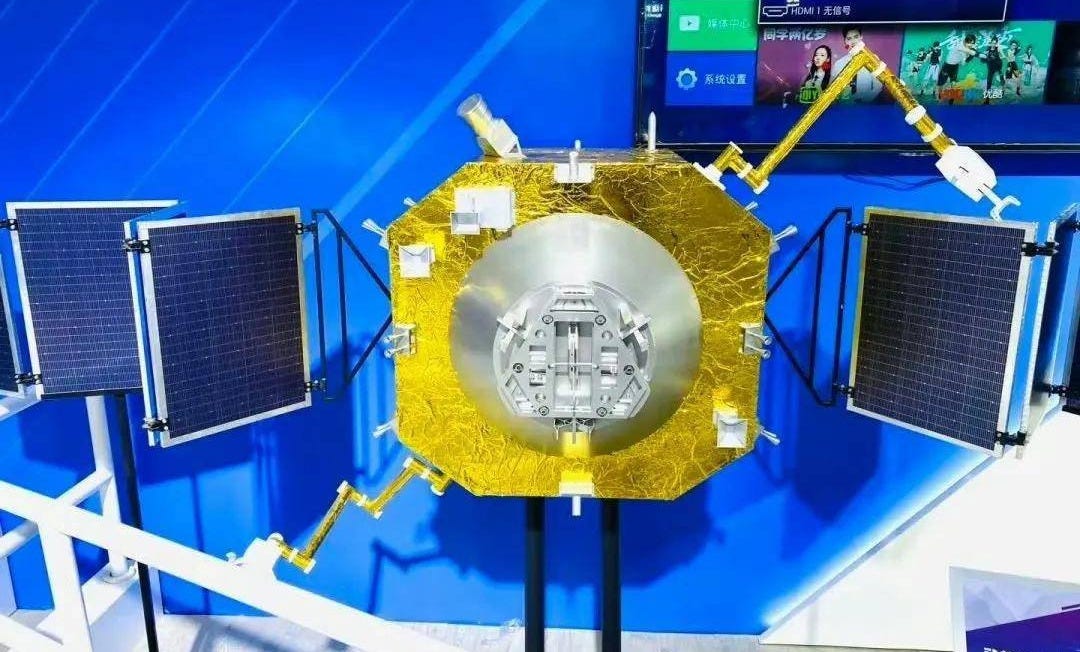
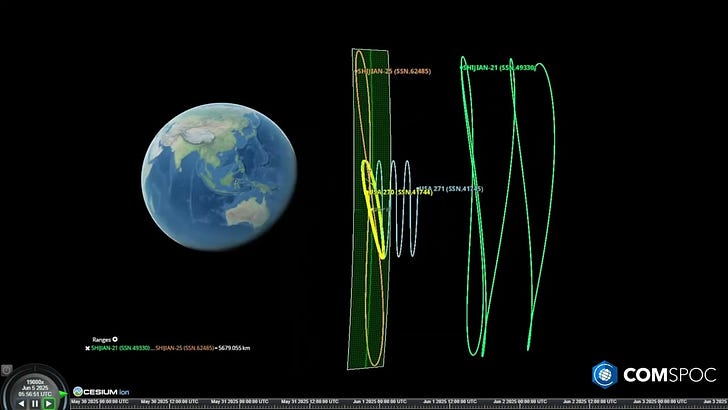
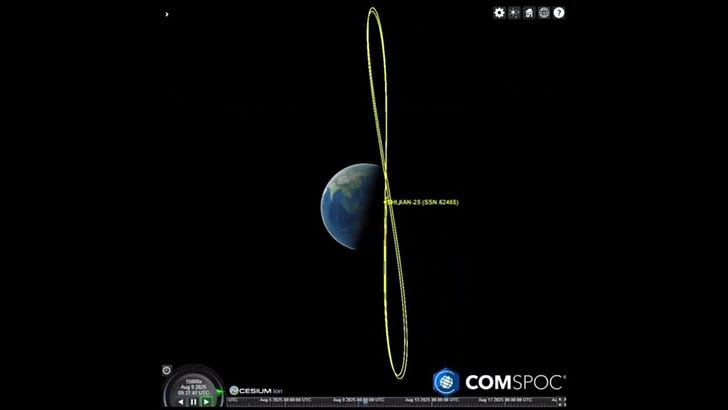
Having now launched over a year ago and likely having concluded its demonstration last month, the Shijian-25 (实践二十五号) refueling technology verification spacecraft is now loitering in geostationary space, while its target, the Shijian-21 (实践二十一号) space debris mitigation satellite, has been manoeuvring around.
Recent activity during this month has been fairly little, with a significant burn occurring in mid-January. As the U.S. and NATO supporting ISR Universities’ newsletter notes:
“[Shijian-25] and [Shijian-21] may have exited RPO conditions in mid-January. … [The] two spacecraft were [within 2 kilometers] of one another [approximately] 7-8 times from 1-15 January 2026. … [After] 15 Jan China conducted in-track maneuvers and as of 16 Jan 2026 the two objects were 130 [kilometers] apart. In their current orbits, [Shijian-25] is separating 50 [kilometers a] day from [Shijian-21].”
After January 15th, Shijian-25 resided in a 35,994.8 by 35,575.5 kilometer orbit, while Shijian-21 moved to a 36,004.5 by 35,575.8 kilometer orbit. Burns to separate appear to have been conducted by both satellites, based on activity seen from the ground.
Around a week later, between January 22nd and 23rd, Shijian-25 continued to float around geostationary space, as Shijian-21 performed maneuvers to shift its orbit. That resulted in an orbit of 35,984.5 by 35,589.2 kilometers. Despite the burns, both satellites’ orbital periods (how long they take to circle the Earth) are only a few seconds different while remaining in line with an expected drift apart.
With the burns performed by Shijian-25 and Shijian-21 this month and late last year, following months being docked together, it can be safely assumed that a satellite-to-satellite refueling demonstration took place. That will have topped up Shijian-21 with an unknown amount of propellant to prolong its operational life.
As for what’s next with the satellites, it’s entirely unknown outside of the spacecraft operations room. Shijian-25 may refuel another satellite (maybe Shijian-23, Shiyan-12-01, Shiyan-12-02, or TJSW-3), while Shijian-21 could perform another debris mitigation demonstration following its first in late 2021. Alternatively, they could dock to each other again, as doing so is relatively fuel-efficient but would take some time due to their separation.
Like I have written many times now in covering the Shijian-25 and Shijian-21 saga, for details regarding the technology demonstration, we will have to wait for official word from one of China’s space agencies or enterprises, which may announce the success of the test anywhere from a few days to several weeks afterward. Confirmation may come in the form of an extensive technical recap document or as a passing mention in a work report.
![China Launches Experimental Refueling Satellite! [Long March 3B/E Y104]](https://substackcdn.com/image/fetch/$s_!rJ3h!,w_140,h_140,c_fill,f_webp,q_auto:good,fl_progressive:steep,g_auto/https%3A%2F%2Fsubstack-post-media.s3.amazonaws.com%2Fpublic%2Fimages%2F2f988ab0-5963-48d4-8736-f13f077f8ea3_1280x821.jpeg)