


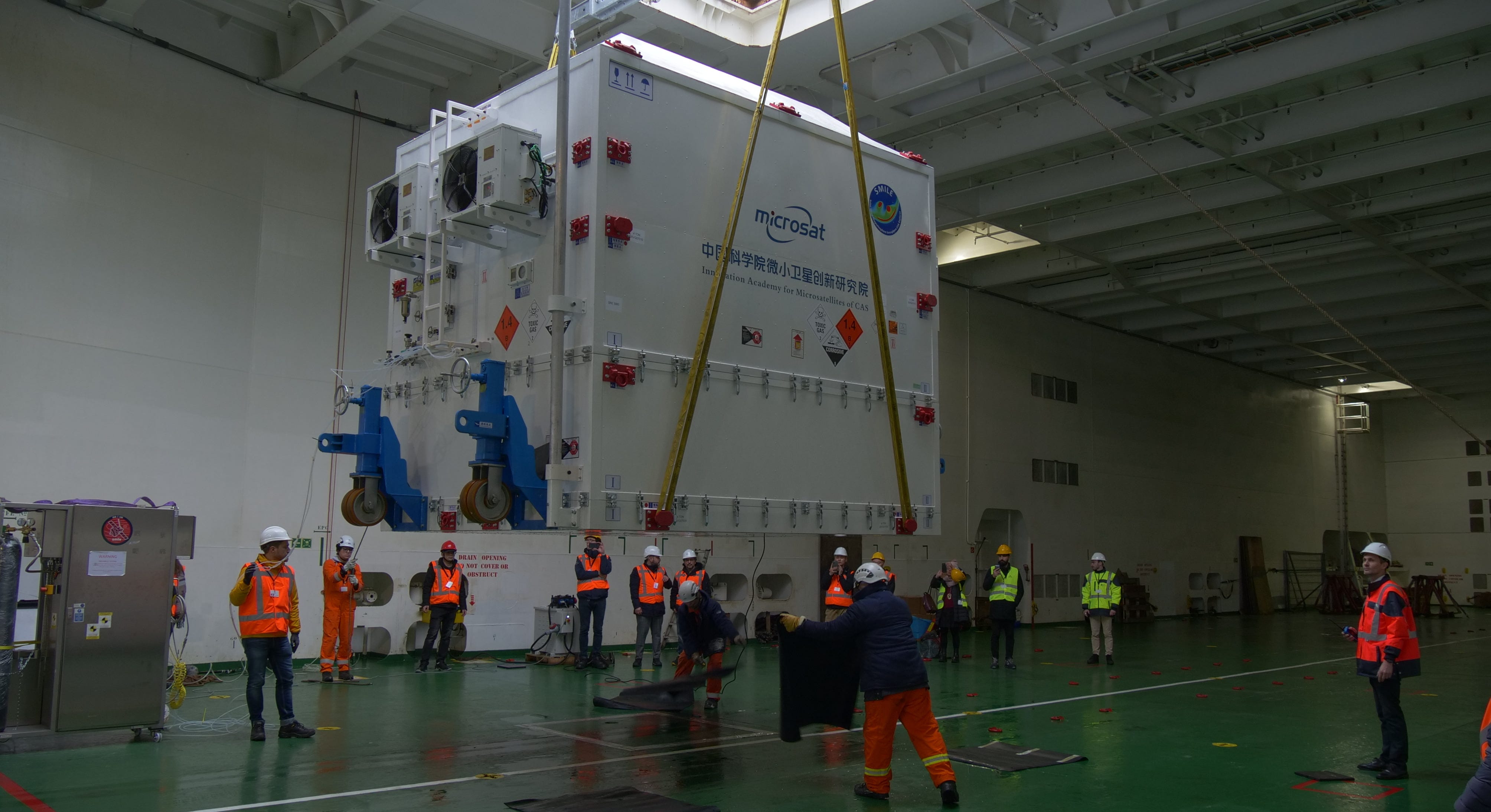
On February 20th, the European Space Agency shared that the Sino-European SMILE1 space weather satellite had been loaded onto the rocket and spacecraft transporting cargo ship MN Colibri a week and a half earlier, on the 11th, and departing the Port of Amsterdam, in the Netherlands, shortly after.
For transportation at sea, the 2,300-kilogram SMILE spacecraft is stored in a specialized transportation container that regularly flushes nitrogen through to keep moisture and oxygen away. The spacecraft is also accompanied by various pieces of necessary equipment, as well as two Chinese and two European mission team members, at sea.
Via MN Colibri, SMILE is heading to French Guiana, in South America, for final pre-launch preparations. That trip across the Atlantic is expected to take just over two weeks, arriving no earlier than February 25th. Part of the trip to South America saw a brief stop in Saint Nazaire, France, to pick up the upper-stage of the Vega-C rocket that will launch SMILE.
When the spacecraft arrives in French Guiana, it will be quickly taken to the European-owned Guiana Space Centre for around eight weeks of testing and integration with a Vega-C rocket. From the launch pad known as Ensemble de Lancement Vega between April 8th and May 7th, the European Space Agency plans to deliver SMILE into orbit.

The shipping of SMILE is almost the end of a long journey to space, which saw spacecraft development in China wrapping toward the end of 2024 and extensive testing in the Netherlands through 2025. From concept to the end of its operational life in several years, SMILE has been jointly worked on by European and Chinese teams, as detailed by the series ‘Let’s Smile’.
With the shipping to South America, the soon-to-be-scrapped2 UK Space Agency was keen to point out its involvement in the mission with the spacecraft’s Soft-X-ray Imager, worked on by the country’s University of Leicester and The Open University. Speaking about the instrument, the UK Space Agency’s Head of Space Science, Caroline Harper, shared:
“SMILE is a landmark mission for UK space science. By leading the soft X-ray imager instrument and co-leading the overall mission science, British researchers will be at the forefront of the discoveries this mission delivers, drawing on our world-leading expertise in solar physics, space plasma and planetary science. SMILE data will help improve space weather forecasting, protecting critical systems like satellite navigation, communications and power infrastructure.”
Other instruments, and their contributors, onboard SMILE are:
UltraViolet Imager: A joint venture between the University of Calgary in Canada, the Chinese National Space Science Centre, the Chinese Academy of Sciences, the Polar Research Institute of China, and Centre Spatial de Liège, Belgium.
Light Ion Analyser: A joint venture between the Chinese National Space Science Centre, the Chinese Academy of Sciences, University College London’s Mullard Space Science Laboratory, UK, and the Laboratoire de Physique des Plasmas, France.
A Magnetometer: A joint venture between the Chinese National Space Science Centre, the Chinese Academy of Sciences, and the Space Research Institute, Austrian Academy of Sciences.
Three of the four instruments are attached to the European-made payload module, while one remains on the Chinese service module. The service module will also propel the spacecraft from its initial orbit into a 121,000 kilometer science orbit to monitor solar winds and improve our understanding of space weather.
Solar wind Magnetosphere Ionosphere Link Explorer.
The European island nation’s space agency will be scrapped in April, a week before the earliest possible launch.