

State-Owned Launch Provider Eyeing Wenchang Commercial Launch Pads for New Rocket
New variants of the Long March 10 launch vehicle were named along with their launch aims, plus a debut target in early 2026.


Between December 21st and 23rd, the 2025 Wenchang International Aviation & Aerospace Forum (2025文昌国际航空航天论坛) was held in Wenchang (文昌市) and gathered China’s state-owned and commercial space enterprises to discuss the nation’s space industry, with a focus on the island province’s two launch sites.
The biggest news from the event related to the Long March 10 series of launch vehicles, with the introduction of new members of the series beyond the triple-core Long March 10 Moon rocket1 and the single-stick Long March 10A2. For many months, China Long March Rocket Co Ltd (中国长征火箭有限公司)3, commonly known as China Rocket, has been talking of a commercially-focused variant of the series, and at the event named it the Long March 10B. On the surface, the Long March 10B seems highly similar to the government-mission-focused Long March 10A, as both are two-stage partially reusable launch vehicles with seven YF-100K engines powering a 5-meter-wide first-stage, with a 5.2-meter diameter fairing. But that is where similarities end.
According to slides presented by China Rocket, the launch vehicle features an elongated second-stage, bringing it to 69.67 meters tall, and utilizes liquid methane, rather than rocket-grade kerosene, and liquid oxygen as propellant, while being powered by a new and unnamed YF series engine. Due to the switch to methane on the second-stage while retaining a similar first-stage, the Long March 10B can place up to 16,000 kilograms into low Earth orbit when reused, compared to the Long March 10A’s 14,000 kilograms.

Alongside launch vehicle performance information, it was detailed that production of propellant tanks is progressing smoothly alongside tests of the unnamed second-stage engine. For hardware remaining on Earth, China Rocket says that tests with the Wenchang Commercial Space Launch Sites systems have gone well, while tests of sea recovery assets to catch the first-stage on tensioned steel wires, like ‘Linghangzhe (领航者)’ but scaled down, have been completed.
At present, China Rocket expects to have the first Long March 10B ready to fly in April 2026 from the Wenchang Commercial Space Launch Sites’ Commercial Launch Pad 2, which has so far only supported the Long March 12.
A second new member of the Long March 10 series was also name-dropped by China Rocket, being the Long March 10C. No details on the launch vehicle were shared, but the China Academy of Launch Vehicle Technology has previously referred to a ‘5-meter reusable launch vehicle’ fuelled solely by liquid methane and liquid oxygen, using new engines. The Long March 10C may be that vehicle.
Both the Long March 10B and Long March 10C are planned to fly from the Wenchang Commercial Launch Site, using its ‘universal’ launch pads, of which one is operational and two are under construction for first use in 2026. China Rocket is looking to have the two launch vehicles jointly flying fifty times per year. As part of that, the company and the Launch Vehicle Academy are said to be in talks with Hainan International Commercial Aerospace Launch Co Ltd (海南国际商业航天发射有限公司) for exclusive use or priority access to Commercial Launch Pad’s 3 and 4.
A short mention was also made of the Long March 8A, which has been flying basically exclusively from the commercial launch site4. It was noted that with current facilities, the rocket could launch sixteen times per year from Commercial Launch Pad 1, dedicated to the vehicle, with expansion efforts at the site looking to bring that up to twenty-four times.
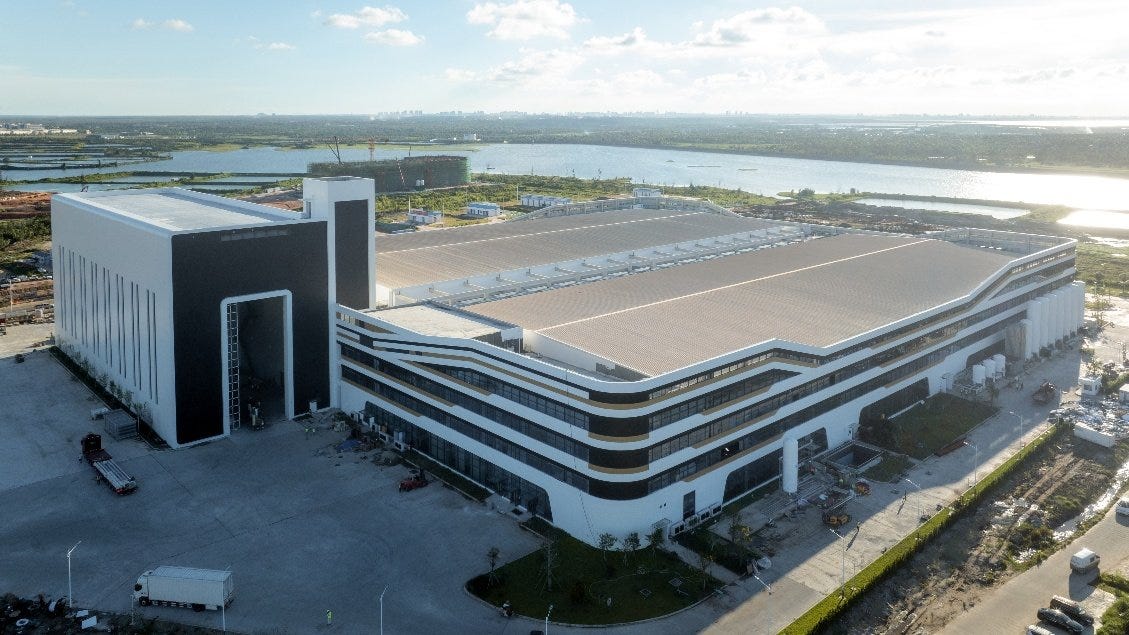
As for what all of those launches will be delivering, they will likely be spacecraft for China’s mega-constellations, as since late 2024, a ‘super factory’ for satellite production neighbouring the commercial launch site has been under construction. That ‘super factory’ is nearing completion and will ramp up operations in two phases; the first will see five hundred satellites produced each year, followed by scaling up to one thousand annually. Each of the satellites made will be of a stackable design, with three configurations available:
Type A: single stack, no more than 550 kilograms, 3.3 meters in diameter.
Type B: dual stack, no more than 600 kilograms, measuring 3.6 by 2.1 meters5.
Type C: single stack, around 1,500 kilograms, 4.5 meters in diameter6.
The state-backed GuoWang (国网) and the Shanghai-supported Qianfan (千帆) constellations are planned to have some of their satellite groups produced in the ‘super factory’. Those satellite groups will also be encapsulated within a launch vehicle’s fairing in the factory, then heading straight to a launch pad.
Ahead of the forum in late December, progress on expanding the commercial launch site continued smoothly, with work on mission support facilities as well as Commercial Launch Pad 3 and 4. Ge Lixin (葛立新), Deputy Director of the launch sites Engineering Equipment Department, shared that work on underground structures for the two launch pads has been completed, with efforts moving to systems installation and construction of above-ground sections of the two pads (like lighting diversion towers and their launch service-water tank towers).
Dedicated to the crewed lunar landing program and able to send up to 27,000 kilograms on a trans-lunar trajectory.
Dedicated to low Earth orbit tests of lunar mission hardware, the Tiangong Space Station, and government missions. The rocket is able to lift up to 18,000 kilograms into low Earth orbit.
A subsidiary of the dominant state-owned space contractor, China Aerospace Science and Technology Corporation, and a partner of the China Academy of Launch Vehicle Technology (also a subsidiary).
Other than its debut flight, flown from the Wenchang Space Launch Site, the Long March 8A has flown from Commercial Launch Pad 1 in July, August, October, and December.
This is the current design of Qianfan (千帆) mega-constellation satellites.
This is a planned upgraded design for Qianfan (千帆) mega-constellation satellites.