

Sustain Space Successfully Completes First Robotic Refueling Arm Test
In space, Xiyuan-0’s arm has been freed for the past week to conduct verifications of its systems and control.

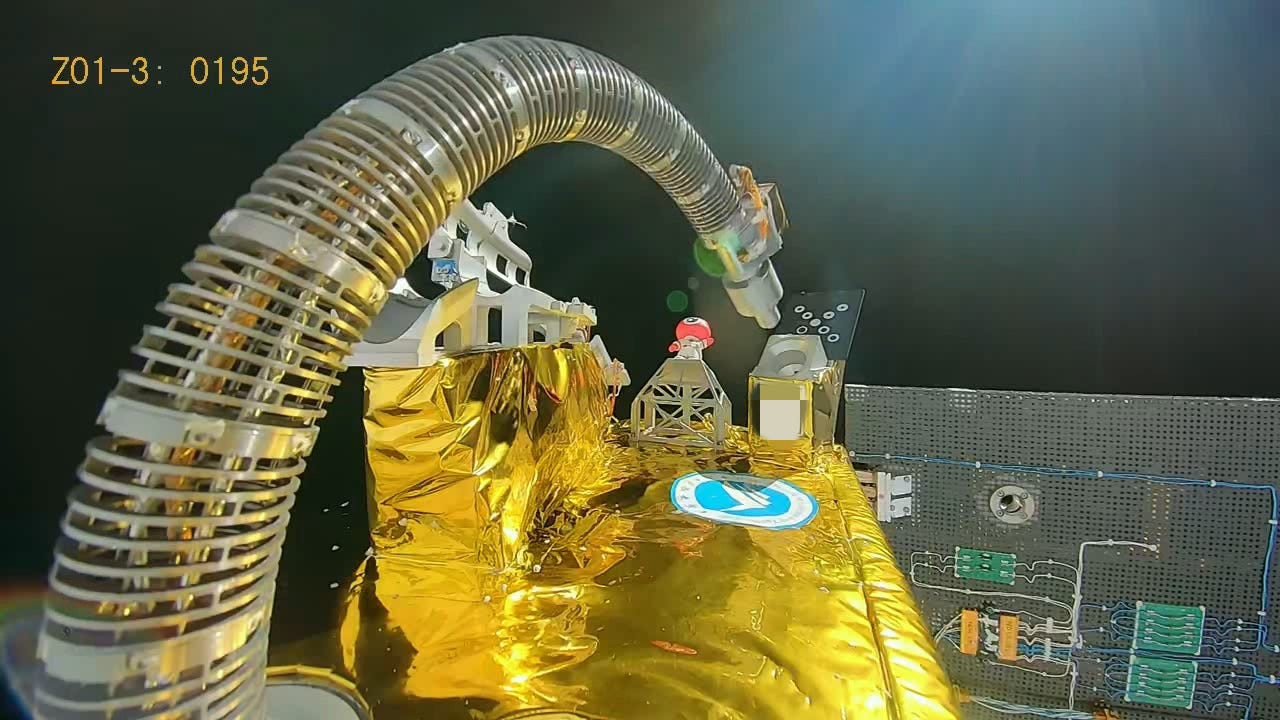
Sustain Space (三垣航天), and its parent enterprise Emposat (航天驭星) announced on March 25th that the Xiyuan-0 (西垣0号)1 satellite has successfully completed its first test with its robotic arm onboard, which is planned to be evolved into a refueling arm on later satellites.
According to the two companies, since the satellites’ launch on March 16th, Xiyuan-0 released its robotic arm from its launch clamp to undergo initial checks and small movements. Once the arms systems were confirmed to be operational, teams on Earth and the satellite computers continued with testing. That had the arm translate across to a target rectangle and docking port, before gradually moving into the port, holding position inside2, then exiting.
Through the test, Sustain Space says they have demonstrated the basics of in-space servicing and refueling operations while verifying their design choices for the robotic arm as well as its automatic and human-commanded control systems. That design has protected electrical, and eventually propellant, lines within what the company calls a ‘hollow arm in a flexible continuum combined with a rear-driven cable transmission system’.
During tests of the arm, four innovations for a commercial enterprise were highlighted, as Xiyuan-0’s is the first developed outside of a state-owned enterprise, by Sustain Space:
Programmed Simulated Refueling: After receiving the mission command, the robotic arm autonomously plans its motion path, moving from the safe configuration to the docking configuration to complete the docking action, and then returning to the safe configuration. The entire process is achieved through on-board autonomous control without ground intervention, verifying the reliability and accuracy of on-board autonomous planning.
Teleoperation-based simulated refueling: Guided by the teleoperation system, ground operators generate real-time control commands via a joystick based on first-person view camera footage to remotely manipulate the robotic arm and complete the docking maneuver. This mode implements a ‘human-in-the-loop’ control process spanning space and ground, accumulating valuable experience for future operations involving non-cooperative targets.
Vision-based Simulated Docking: Guided by the vision-based system, ground personnel used visual target information captured by the first-person view camera at the end of the flexible arm to identify the end-effector’s pose in real time, plan a motion path, and generate control commands, thereby guiding the robotic arm to complete the docking maneuver. This mode validated the closed-loop control capability of the space-ground loop based on vision.
Force-Compliant Drawing: Based on force feedback data from the end-effector, the robotic arm autonomously controlled the docking connector to successfully draw circles, triangles, and straight lines on a drawing board3. This validated the precision of end-effector force control and force-compliant control capabilities, providing critical technological support for future in-orbit precision assembly, component replacement, and other fine-motor operations.
If there are any problems with this translation please reach out and correct me.
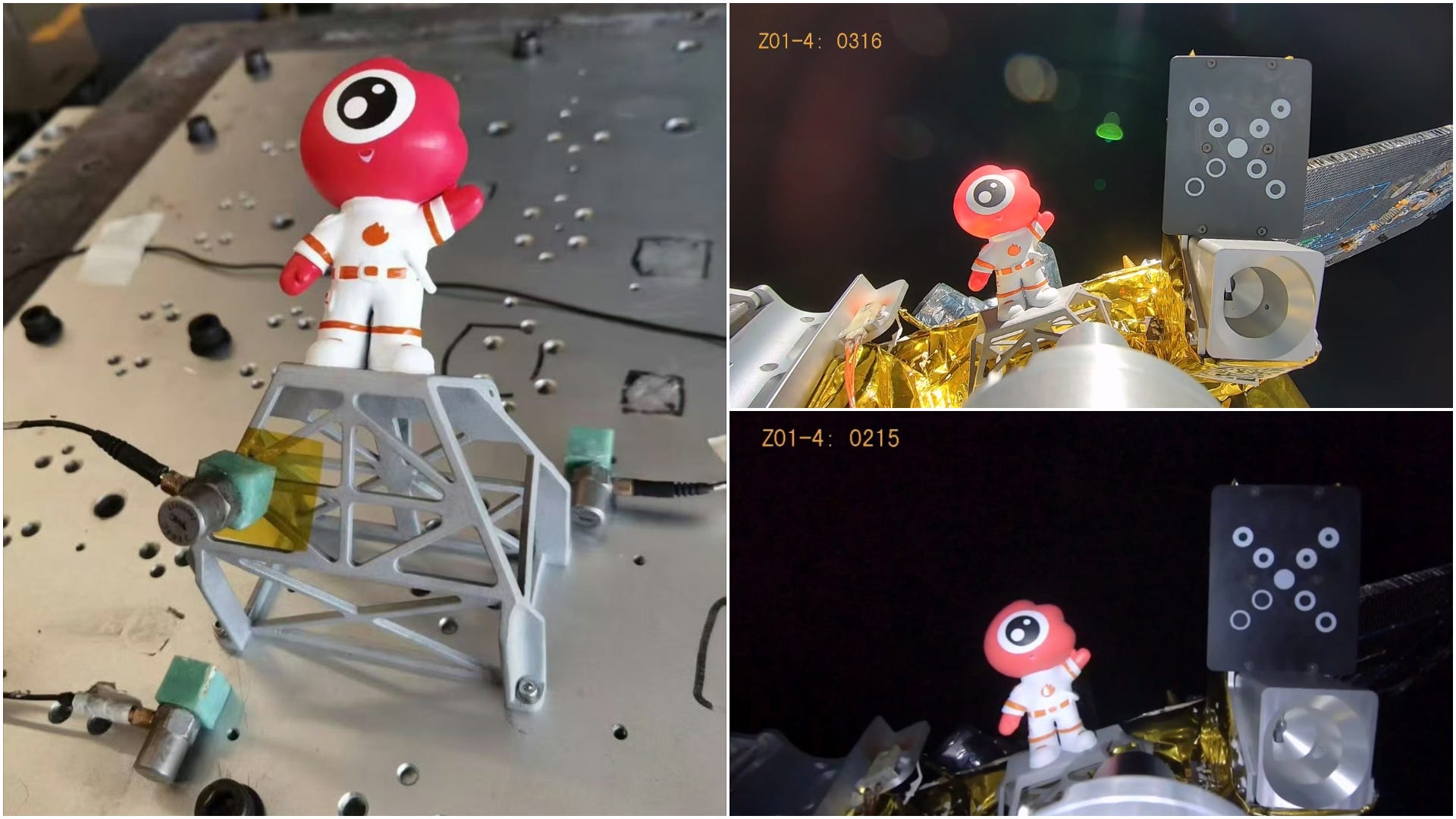
The small movements mentioned earlier occurred around March 19th, revealing a stowaway onboard Xiyuan-0 in the form of a mascot from the social media platform Weibo (微博). The mascot, included as part of space outreach efforts, joined the satellite for its pre-launch environment and vibration testing, proving the passenger to be flight worthy. Weibo has previously sponsored a launch of Galactic Energy’s Ceres-1 too.
With the first test of Xiyuan-0’s robotic arm complete, Sustain Space may try to understand the limits of the arm’s movements. Once all tests are completed, the satellite will inflate a 2.5-meter-wide drag sphere from the Hunan University of Science and Technology (湖南科技大学) to accelerate its decay out of orbit and into Earth’s atmosphere.
At the moment, plans for a refueling demonstration mission from Sustain Space are yet to be announced. In the past year, the Shanghai Academy of Spaceflight Technology, a state-owned enterprise, concluded a world-leading test of the technology between Shijian-25 (实践二十五号)4 and Shijian-21 (实践二十一号)5 in geostationary space, topping up storeable propellants on Shijian-21.
Xiyuan-0 is also designated Yuxing-3-06 (驭星三号06星) or Hunan University of Science and Technology-2 (湖科大二号卫星) due to involvement from the Hunan University of Science and Technology.
No hardware for a ‘hard’ docking was stated to have been tested.
Digitally, not a physical one.
Dedicated to proving in-space refueling technology demonstration.
Launched to prove space debris mitigation technologies by taking a dead BeiDou satellite away from geostationary space.