

Tianwen-3 International Instruments Revealed, Xihe-2 Open for Cooperation
Global partners will help search for signs of life on Mars, and are invited to join in the study of space weather.

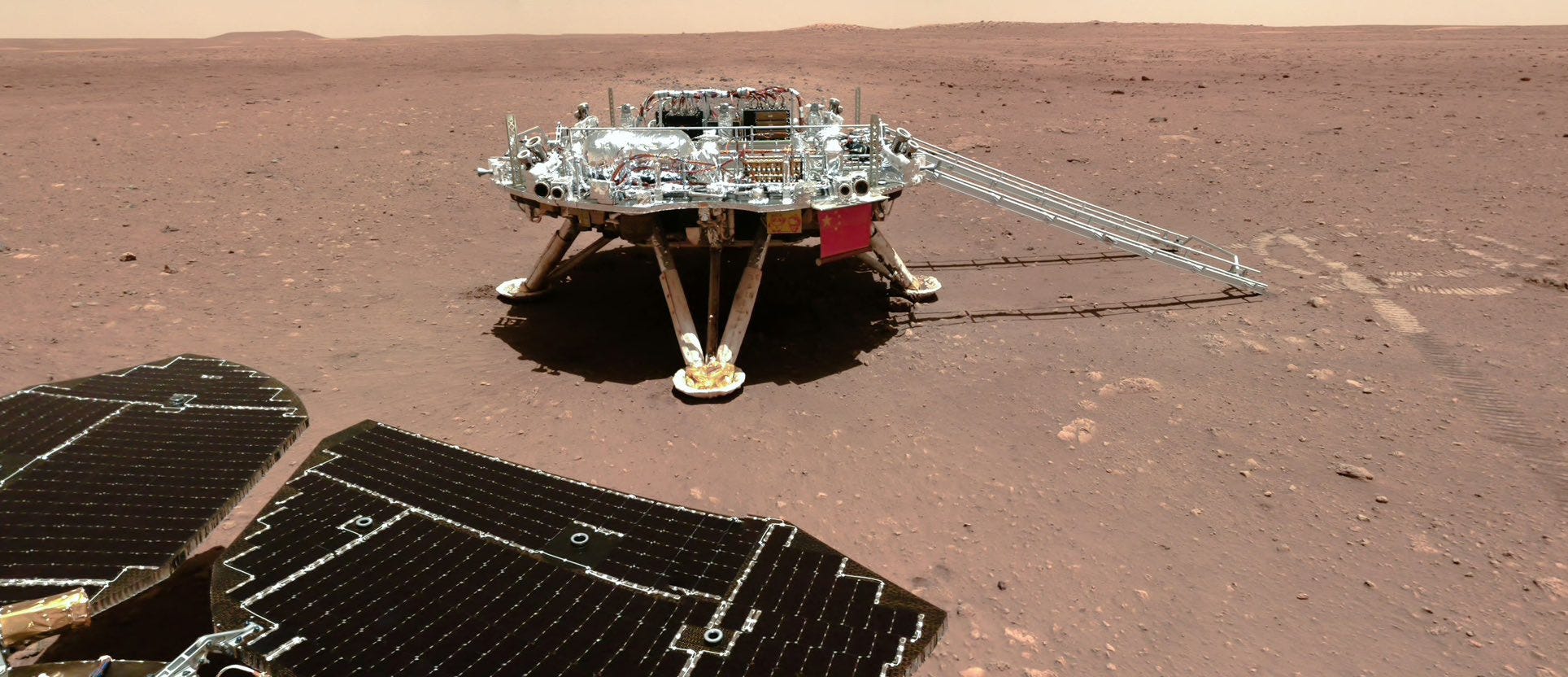
Having announced thirteen months ago that the Tianwen-3 (天问三号) Mars sample return mission is open to international instruments, the China National Space Administration shared which participants had been selected, with five in total.
Three of those instruments will be onboard Tianwen-3’s orbiter-Earth return spacecraft, residing in a 350-kilometer orbit of Mars. Of interest for the mission’s aim of searching for life, the France-headquartered Committee on Space Research1 has its ‘Mars PEX Spectrometer’, which will look for possible biosignatures across the red planet, while also analyzing the composition of surface materials.
With it in orbit is the ‘Mars Molecular Ion Composition Analyzer’ from the Macao University of Science and Technology (澳门科技大学), in the Macao (澳门) Special Administrative Region2. That instrument will study how the planet’s atmosphere is lost due to pressures in the solar environment, originating from the Sun.
Macao is not the only Special Administrative Region on the orbiter-Earth return spacecraft, as Hong Kong’s (香港) Chinese University of Hong Kong (香港中文大学)3 has a ‘Laser Heterodyne Spectrometer’ for the mission. The spectrometer will be used to measure the distribution of water in the Martian atmosphere as well as wind.
Elsewhere in space above Mars, with the lander-ascent vehicle combination’s service module in a highly elliptical orbit, the University of Hong Kong (香港大学) has its ‘Short-Wavelength Infrared Spectrometer’ for conducting a resource survey of the planet, hoping to find potential biosignatures and hydrous materials, and forecasting dust storms that can kill spacecraft. Speaking on the inclusion of the instrument aboard Tianwen-3, Professor Li Yiliang (李一良) of the university’s Department of Earth and Planetary Sciences shared:
“This mission marks a significant contribution from Hong Kong’s scientific community to the nation’s deep space exploration programme. Using hyperspectral imaging technology, we will directly search for biosignatures and hydrous minerals on Mars, which is fundamentally important for understanding the distribution of life in the universe.”
Lastly, Italy’s Laboratori Nazionali di Frascati has produced a ‘Laser Retroreflector Array’ to establish a second reference point on the Martian surface for accurate distance measurements by being onboard the lander. Retroreflectors have been sent to the Moon for over fifty years, including on the far side, but only started reaching Mars this decade. Talking to China Daily, Yu Guang (余光) detailed why sending the arrays to the red planet is important for Tianwen-3:
“[The] array is used for high-precision laser ranging to realize accurate positioning. […] The placement of such a device on Mars allows orbiters to conduct laser ranging and precise positioning. It will help to establish a unified time and geodetic reference frame between Earth and Mars, and will provide strong technical support for Mars orbital rendezvous and docking — the most challenging step in the Mars sample-return mission.”
With those instruments onboard, as well as ones from Chinese institutions, Tianwen-3 will launch towards Mars atop of two Long March 5’s4, within about a month of each other, from the Wenchang Space Launch Site in 2028. Assuming the mission proceeds as planned, samples of the surface of Mars will be collected and then returned to Earth in 2031, likely making China the first nation to do so. Those samples will be shared with global scientists, like those collected by Chang’e 5 and Chang’e 6.
Come aboard Xihe-2
Also announced on April 24th is that the Xihe-2 (羲和二号) mission, formally known as Lagrange-V solar observatory (LAVSO), is open to a handful of international instruments. The mission, set to launch in 2028 or 2029 towards the L5 Sun-Earth Lagrange point5, is planned to improve space weather predictions and early warnings for ejections from the Sun, alongside the generation and evolution of solar magnetic fields.
According to a statement from the China National Space Administration, letters of intent to outline foreign instruments must be submitted by the end of June6, with a narrowing down of candidates by September, with complete proposals to be detailed by the end of that month. Confirmation of what instruments will be onboard Xihe-2 will then be chosen in December.
As for how large instruments can be, the mass limit was shared to be no more than 15 kilograms while occupying a 200 by 200 by 120 millimeter space. Those instruments must also draw no more than 30 watts of power while surviving at a temperature regularly between -50 and 70 degrees Celsius.
To maintain launch opportunities via a Long March 3C from the Xichang Satellite Launch Center in late 2028 or early 2029, the China National Space Administration outlined that instruments must be delivered by April 2028 for integrated testing and launch preparations. Useful data from Xihe-2 is expected to start being beamed back after around 140 days, with it reaching the L5 point about 790 days post-launch.
With fifty national-level members and several international scientific organisations.
Technically, this instrument could be classified as quasi-international under the One Country, Two Systems (一国两制) framework for China’s Special Administrative Regions. Under One Country, Two Systems, regions continue to have autonomy in their own governmental system, legal, economic, scientific, financial affairs, and trade relations with other countries. Defense and major foreign policy is managed by the People’s Republic of China, as well as human spaceflight.
Footnote two could also be considered here.
One Long March 5 will carry the orbiter-Earth return spacecraft, and a second will bring the lander-ascent vehicle combination.
Via NASA’s ‘What is a Lagrange Point?’:
“Lagrange points are positions in space where objects sent there tend to stay put. At Lagrange points, the gravitational pull of two large masses precisely equals the centripetal force required for a small object to move with them. These points in space can be used by spacecraft to reduce fuel consumption needed to remain in position.”
In a PDF format, written in either English or Chinese.