

Wenchang Prepares for up to Thirty Long March 8 Missions per Year
Efforts to support more flights of other existing and new launch vehicles are underway as well.

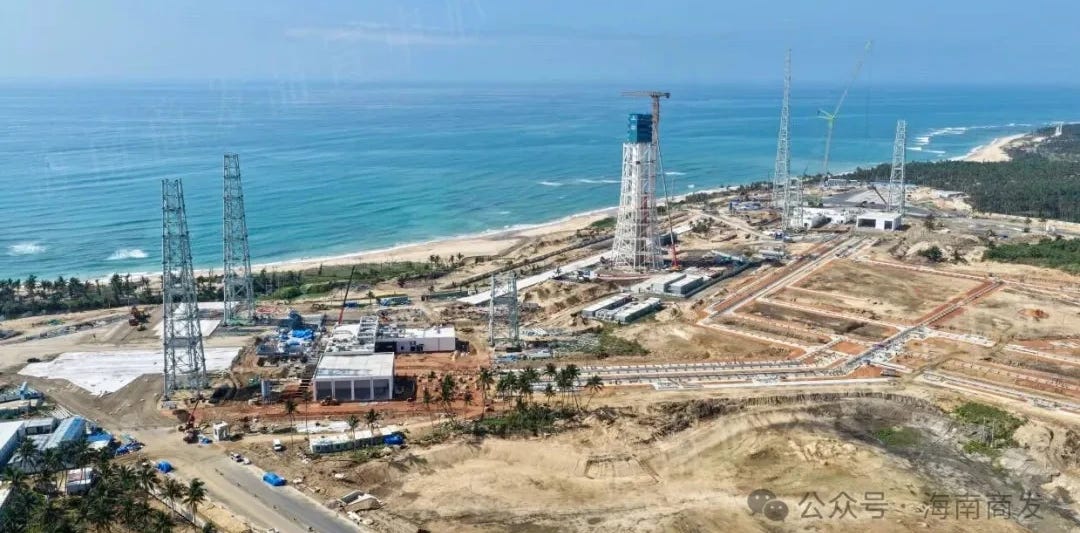
Having entered space with a first launch back in November 2024, the Wenchang Commercial Space Launch Site has gone on to enable a total of sixteen launch missions to date. In an effort to support aims of more launches into the future, the operator of the launch site, Hainan International Commercial Aerospace Launch Co Ltd (海南国际商业航天发射有限公司), and other invested enterprises, have been working diligently to do so.
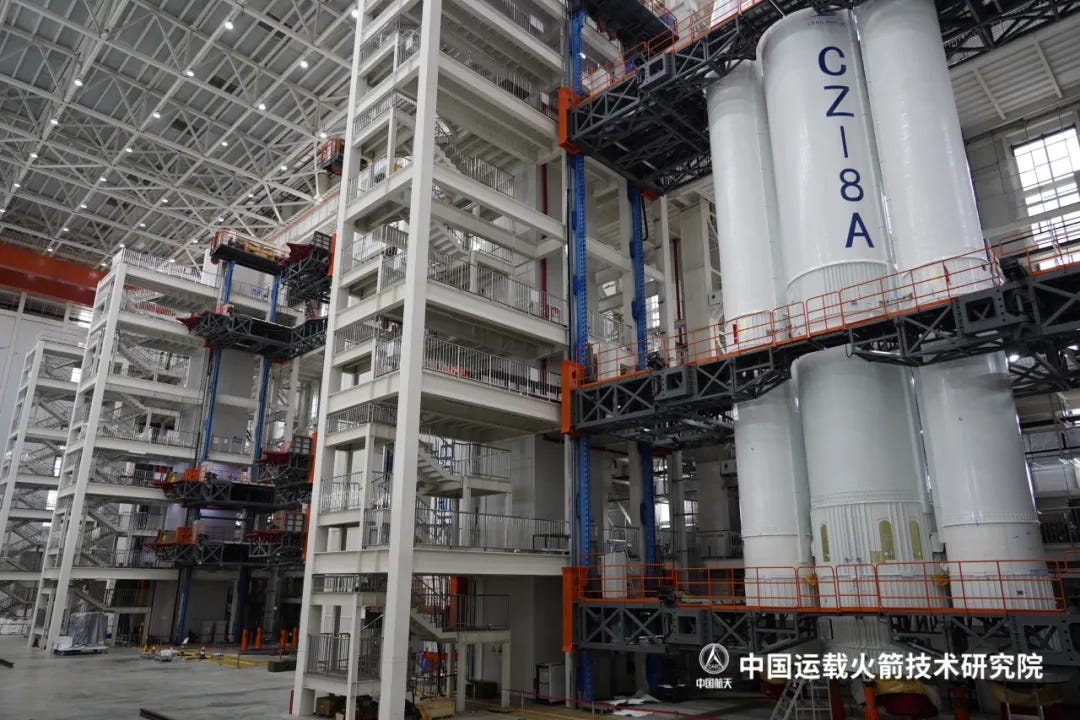
Recently, on June 9th, the China Academy of Launch Vehicle Technology announced that work to establish a second Long March 8 series1 preparation bay, inside of a state-owned integration facility at the commercial launch sites technical area, has wrapped up. With the second bay, preparations for Long March 8 series missions can fully move to parallel efforts, no longer limited to the bottleneck of just one. According to the Launch Vehicle Academy, the two bays will allow for around thirty launches of the rocket series per year.
Seeing the Long March 8 series fly that much in a single year is still a ways away, as in March, China Central Television (中国中央电视台) reported that the Long March 8 series of launch vehicles, including the Long March 8 and 8A, is set to fly fifteen times in total this year. So far five flights have taken place this year.
Also revealed on June 9th, via a Weibo post from the Aviation Industry Corporation of China (中国航空工业集团), was that the partially reusable Long March 9’s Wenchang factory has had its construction work officially commence. Contracted to the Aviation Industry Corporation of China’s Planning and Design Institute (中国航空规划设计研究总院有限公司), the massive 71.8 square kilometer facility had early ground-breaking work begin in April. Per the Weibo post, foundations are currently being driven into the ground.
In support of other existing launch vehicles, such as the Long March 12 series2, work on Commercial Launch Pad 3 and 4, multi-user ones able to support many rockets so long as they have a transporter-erector, has continued at a steady pace since the start eighteen months ago and below-surface efforts six months ago. In brief progress updates over the past two months, it was detailed that most primary work has been wrapped up as teams focus on installing smaller, but necessary, items across the two pads. Six lightning diversion towers, three for each, are also being built section by section. Items still needing to be finished are launch vehicle transporter-erector mounts and uprighting pistons alongside deluge systems aimed at the base of a rocket, as well as reinforcing of the flame trench and flattening surrounding land to enable smooth vehicle transportation.
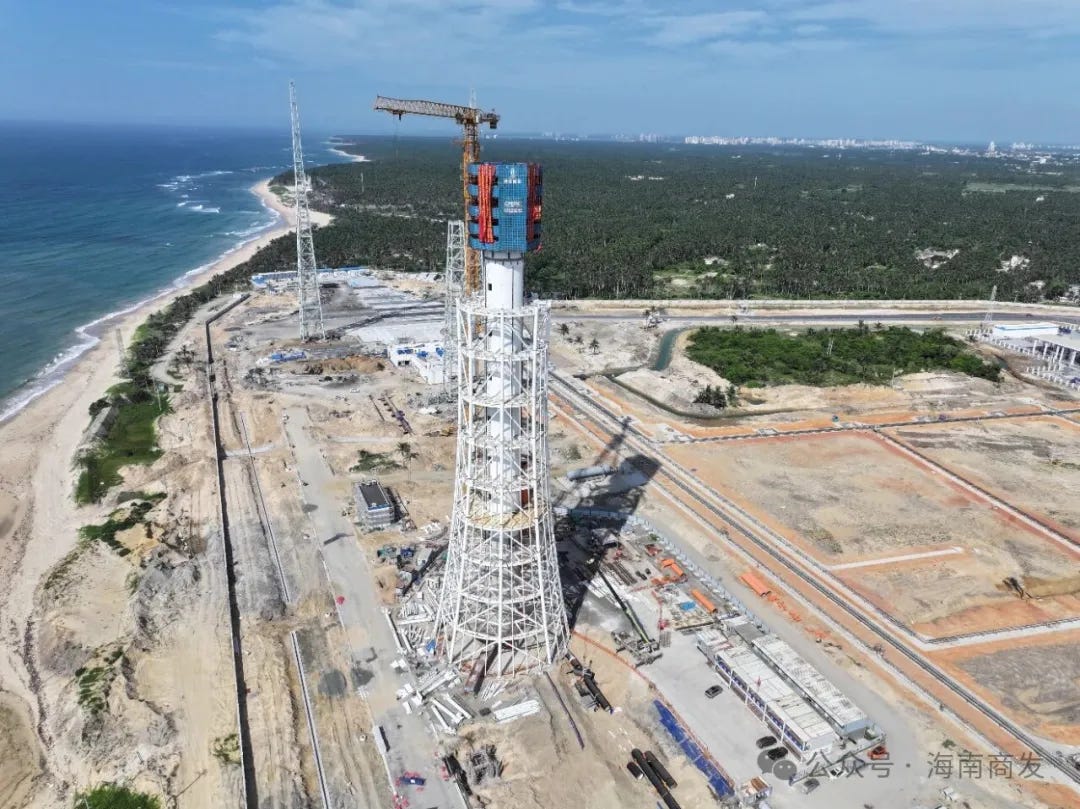
In the area between the launch pads, their shared water storage tower for their deluge system has rapidly risen since emerging in February. As of June 4th, that tower has reached a height of one hundred meters, capping construction efforts of its central core. In the coming weeks, necessary plumbing and a water storage tank will be installed atop of the tower, along with a steel support structure that already runs up most of it.
To supply the new launch pads with needed commodities for launch missions, workers have built up a propellant farm for storing liquid oxygen, rocket-grade kerosene, and liquid methane over April and May. Liquid nitrogen systems were also installed in May to ensure propellants remain cold during launch attempts.
With current progress, it is expected that a mission from one of the two launch pads will take place in the fourth quarter (October, November, December) of the year.
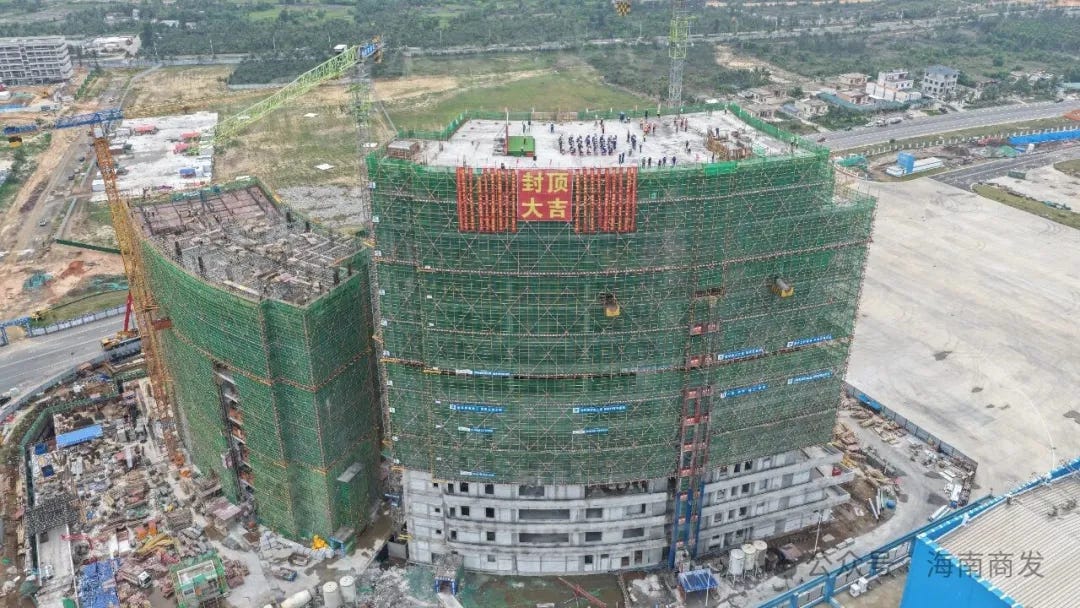
Meanwhile, back over at the technical area, a new fourteen-floor Command and Control Center for the entire commercial site has been under construction, reaching its top floor in early May after work began in August 2025. At present, work on the building has shifted indoors, installing electrical, plumbing, and network connections, and wrapping up external work on the shorter other half. Once completed around September, the center will have the responsibilities of running the launch site transferred to it, alongside having the ability to test some satellites before they are placed on launch vehicles being prepared in neighbouring facilities.
Away from the launch site, plans for a multi-user first-stage recovery ship are progressing, having announced intent to do so late last year. Tasked to an enterprise in Shanghai (上海市), work has been quietly underway since March with the main hull completing production at the end of May. The vessel is expected to be similar to iSpace’s drone ship, rather than the Long March 10 series booster catching ship ‘Linghangzhe (领航者)’.
Throughout all of the above construction efforts, provincial and local political support has been sustained, with government officials seeing China’s space industry as a driver of future growth. The latest visit by a government official took place in April, when Wenchang Municipal Committee Secretary Wang Peng (王鹏) inspected the new launch pads to understand their construction schedule.
Consisting of two different but similar launch vehicles. The Long March 8 with a 3-meter diameter second-stage, and the Long March 8A with its 3.35 meter diamter second-stage. Both burn liquid hydrogen and liquid oxygen.
Made up of the expendable Long March 12, the partially reusable Long March 12A, and the also partially reusable Long March 12B. The Long March 12 and 12B burn rocket-grade kerosene and liquid oxygen, while the Long March 12A uses liquid methane and liquid oxygen.