

Zenk Space's Zhihang-1 Aiming for June Debut Flight in Rapid Push
Newly secured funding will enable the first flight of the rapidly developed launch vehicle, which is looking to recover its first-stage engines to save costs.

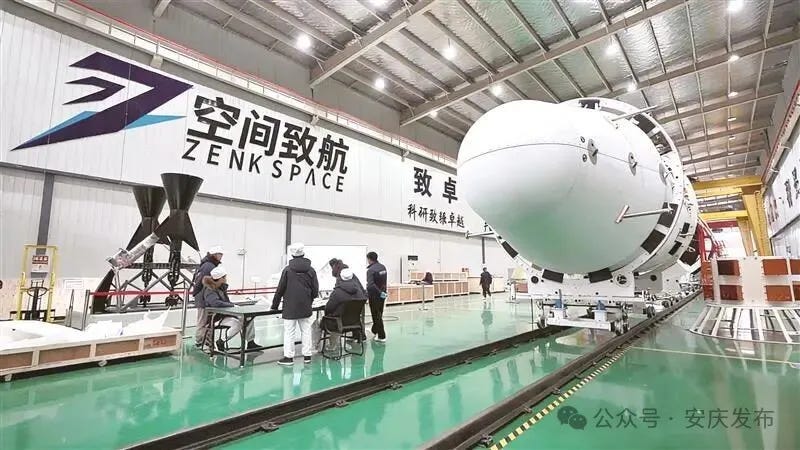
Rapidly progressing launch startup Zenk Space (空间致航) is another step closer to flying its Zhihang-1 (致航一号) launch vehicle for the first time this year, with intensive pre-flight work underway at the company. As part of a new funding round on May 14th, it was revealed:
“[Preparations] for the maiden flight are proceeding at a rapid pace, with the first flight test scheduled for June 2026. This round of financing will provide solid financial backing for the Zhihang-1’s inaugural mission, ensuring the smooth execution of all pre-launch activities.”
If there are any problems with this translation please reach out and correct me.
That funding round has provided the company with 180 million Yuan (26.5 million United States Dollars, as of May 14th) for the above stated activies. Investors included the local government-controlled Wenzhou Bay New Area Investment Group (温州湾新区投资集团), Wenzhou Municipal State Investment Co Ltd (温州市国投公司), Eastern New City Group (东部新城集团), and the private Yarong Venture Capital (雅榕创投). Before this round, the company had secured over one billion Yuan (147.3 million United States Dollars) in capital.
Previously, the city government of Anqing (安庆市), in Anhui (安徽) province, expected the first Zhihang-1 launch vehicle to leave Zenk Space’s manufacturing facility, located in the city, and be sent to a launch site within May. At the launch site, the vehicle will undergo rehearsals, possibly including propellant loading.
Based on the size of Zhihang-1 and the hardware that exists, the Jiuquan Satellite Launch Center will likely host the launch vehicle for its debut flight off of a multi-user launch pad, potentially the same one that Space Pioneer used for Tianlong-2’s sole flight to date.
Regarding what hardware exists for the launch vehicle, imagery from Zenk Space shared for the May Day holiday shows all key parts of Zhihang-1 undergoing hardware installations. Additionally, a launch pad system was shown off, consisting of a vehicle erector, raised pad, and a flame diverter being tested with a basic mockup of Zhihang-1’s dimensions.
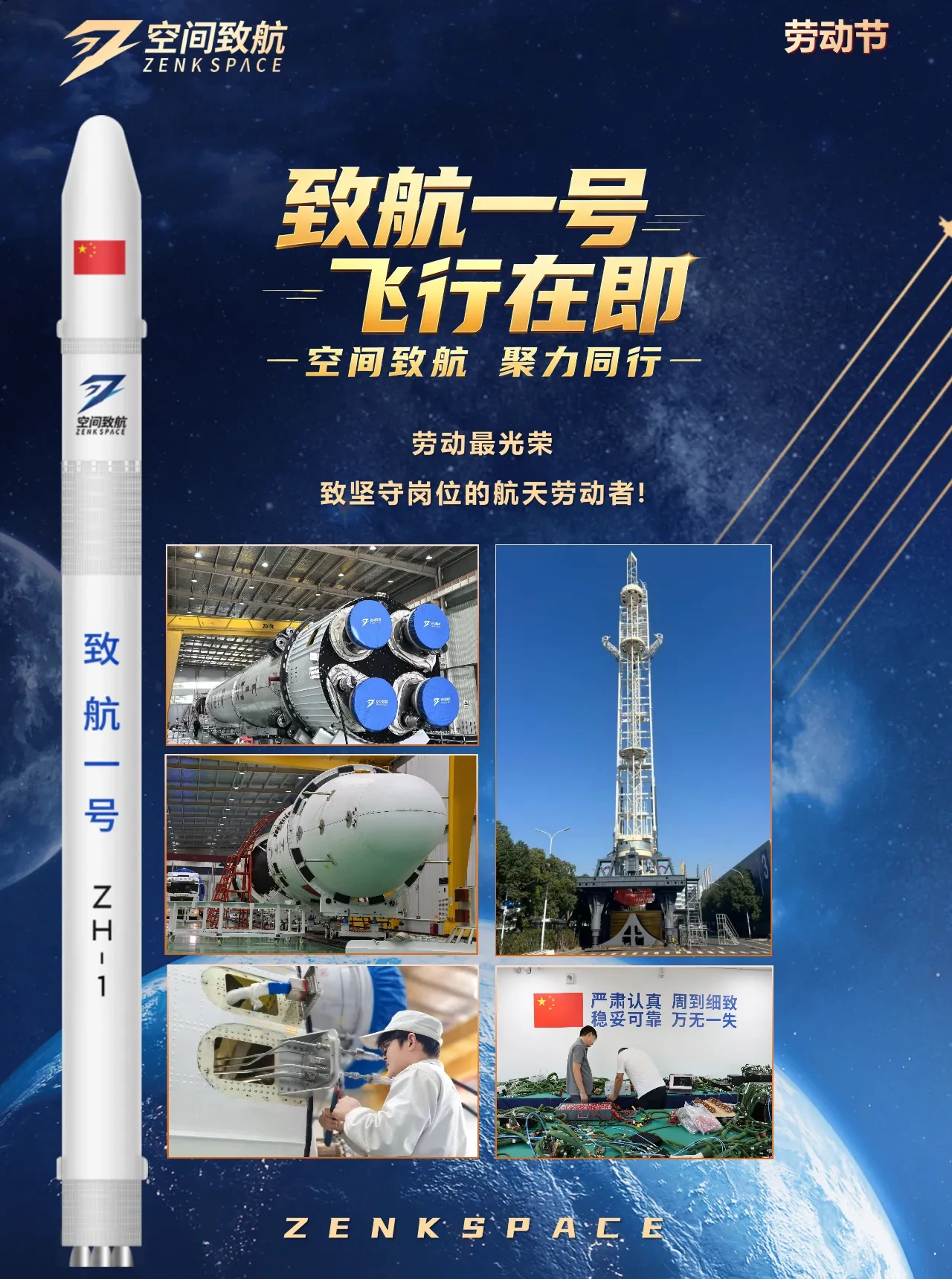
Additionally, this week Zhihang-1 and its launch pad systems have undergone basic joint testing, just outside of their Anqing manufacturing facility, to ensure that both systems are compatible. Hardware used in the test appears to be the first flight launch vehicle, partially wrapped up ready for delivery to Jiuquan, and an unmoving erector1.
A few months ago in early February, the launch vehicle’s first-stage completed a static fire of its four YF-102 engines, producing 336 tons of thrust, on a floating platform near Haiyang (海阳市), in Shandong (山东) province. That provided an overall verification of the stage and its systems, allowing the company to move ahead with its debut flight efforts.
Compared to other launch vehicles in China and the rest of the world, Zhihang-1’s development has been remarkably fast, reportedly having taken just over a year. That fast development has been enabled by the sourcing of propellant tanks from RSPACE (九天行歌) and YF-102 engines from the state-owned Academy of Aerospace Liquid Propulsion Technology’s (航天推进技术研究院), among other systems.
Once Zhihang-1 is ready to perform its debut flight, it is expected to stand 49.8 meters tall and 3.35 meters wide with three stages, massing around 280,000 kilograms fully fuelled. Via a four YF-102 powered first-stage, a single vacuum-optimized YF-102V second-stage generating 85 tons of thrust, and a third-stage probably similar to the European RFA One, the launch vehicle is claimed to be able to carry 4,000 kilograms into a 500-kilometer sun-synchronous orbit2.
Zhihang-1 is also slightly reusable, through the planned recovery of its first-stage’s engine section that houses four YF-102’s. Plans from Zenk Space have the engine separating from the rest of the stage after using all of the available propellant, then inflating a heat shield to decelerate back through the atmosphere before softly landing under parachute for recovery. Once on the ground, the engine section will be collected, inspected, and installed on another first-stage to fly again.3
It’s unknown if engine section recovery hardware will be installed or trialled during Zhihang-1’s debut flight.
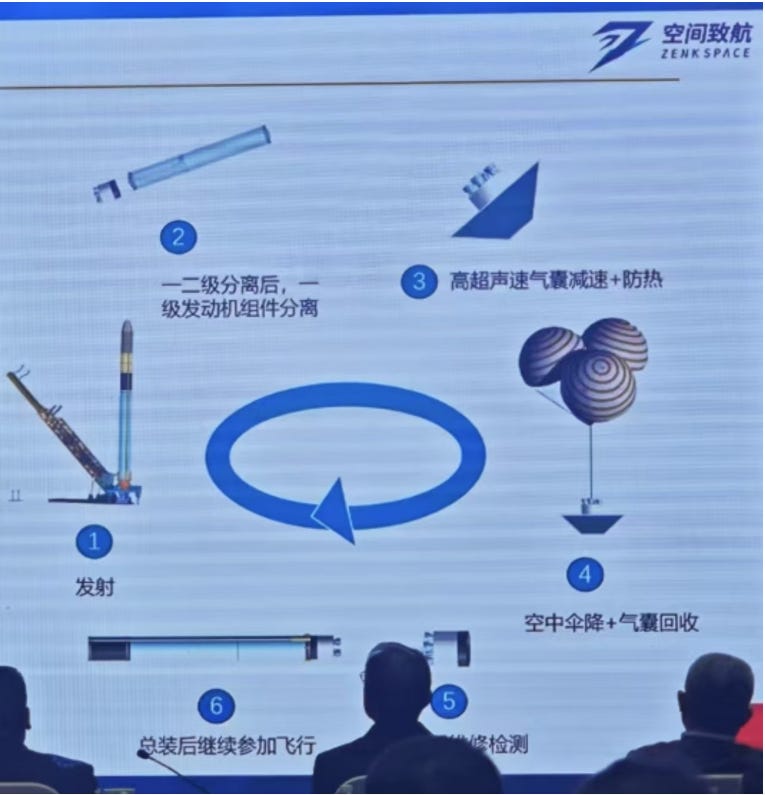
Either out of safety precautions or legally not being allowed to with Zhihang-1. The system has been tested in Anqing before.
Comparable to the China Academy of Launch Vehicle Technology’s Long March 2C and the Shanghai Academy of Spaceflight Technology’s Long March 2D. While aiming for similar launch costs for customers too.
Zhihang-1’s engine section recovery scheme is similar to an existing idea from the American enterprise United Launch Alliance, which it calls SMART (Sensible Modular Autonomous Return Technology) reuse and is claimed to be a planned addition to the Vulcan rocket. Since the scheme’s announcement in 2015, the most recent progress towards SMART reuse was the recovery of an inflatable heat shield following reentry from orbital speeds. SMART reuse can be traced back to an approach experimented with by Boeing in the 1990s.