

Newcomer Zenk Space Fires Up Zhihang-1 First-Stage in Haiyang
The new commercial launch vehicle has had a fast path through development ahead of a debut flight in the near future.

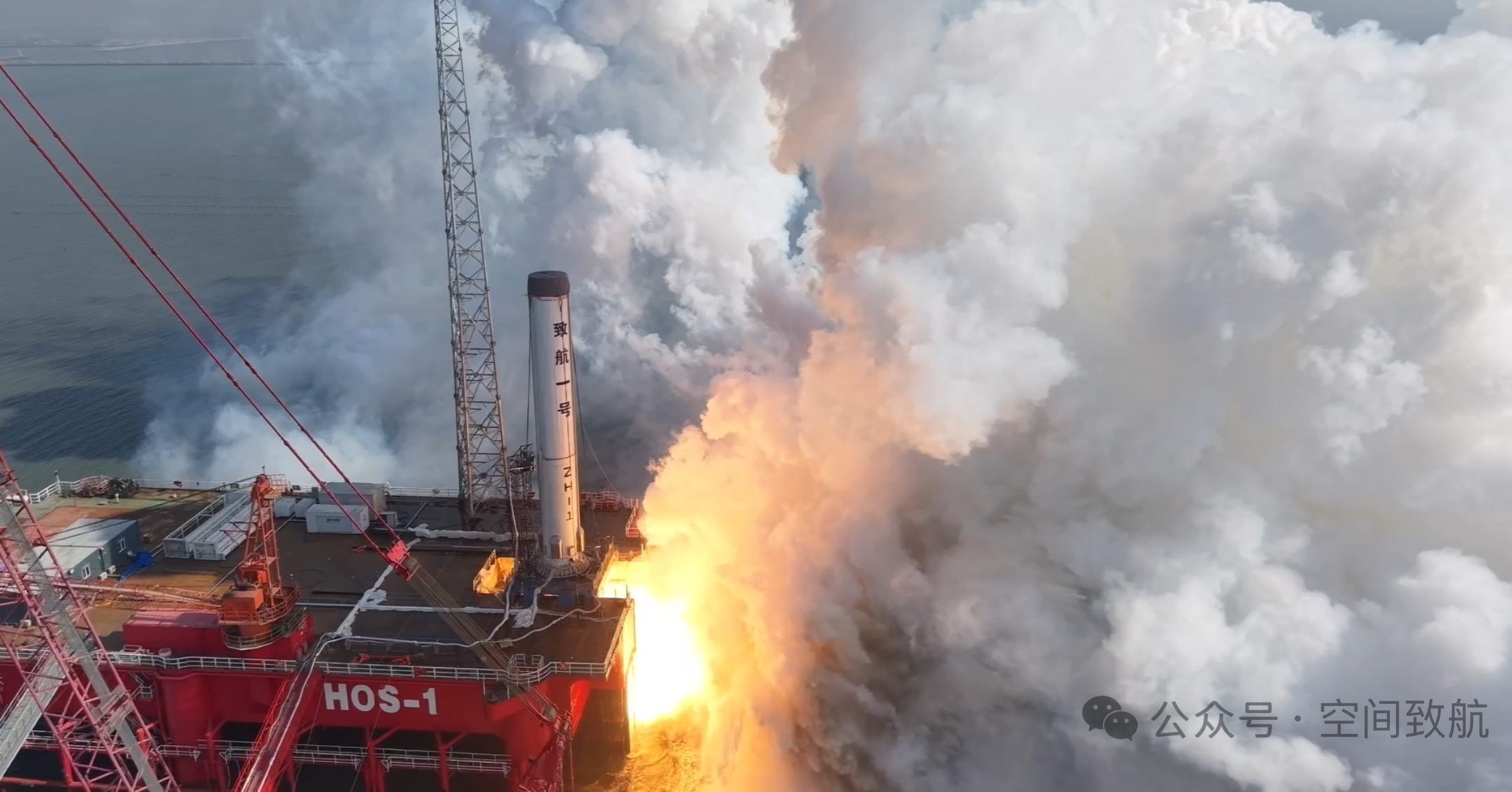
Earlier this week, February 11th, Zenk Space (空间致航) fired up its Zhihang-1 (致航一号) launch vehicle’s first-stage for the first time through a static fire to test its systems. That test took place on a floating platform near Haiyang (海阳市), in Shandong (山东) province, becoming the third static fire to utilize it.
Zhihang-1’s static fire was the first time its four YF-102 engines have fired together while installed on the vehicle, generating up to 336 tons of thrust, with the first-stages tanks being loaded with rocket-grade kerosene and liquid oxygen to power them. According to Zenk Space’s blog post about the test, several systems were jointly verified:
“This full-system test of the first-stage validated the correctness of the Zhihang-1 launch vehicle’s pressurization system design and its compatibility with engine operations; verified the accuracy of the launch control system and coordination among all systems; assessed the operational performance of onboard systems during ignition and their environmental adaptability; It integrated the propellant loading procedures, pre-launch test and control processes, venting procedures, and post-processing workflows; validated the coordination and support capabilities of the mobile launch ground systems and equipment; rehearsed post-shutdown procedures and assurance capabilities; and tested emergency response protocols. The test concluded with complete success.”
If there are any problems with this translation please reach out and correct me.
All of those systems tests are believed to have been conducted for the first time due to Zenk Space’s aggressive path toward flying for the first time. The company’s blog post ended with a statement of thanks to relevant provincial and state authorities for their guidance, support, and confidence in their launch vehicle tests.
At present, Zhihang-1’s first flight is expected to take place from the Jiuquan Satellite Launch Center, off of a multi-user launch pad1, toward the end of the month after the Spring Festival (春节), which takes place in a few days. Reports from Chinese media about the rocket have shown off a full launch vehicle’s worth of hardware undergoing assembly in their Anqing (安庆市)2 manufacturing facility.
When Zhihang-1 is prepared for its debut flight, it is expected to stand 49.8 meters tall and 3.35 meters wide with three stages, massing around 280,000 kilograms fully fuelled. Via a four YF-102 powered first-stage, a single vacuum-optimized YF-102V second-stage generating 85 tons of thrust, and a third-stage likely similar to the European RFA One, the launch vehicle is said to be able to carry 4,000 kilograms into a 500-kilometer sun-synchronous orbit.
Zhihang-1 is also slightly reusable, through the planned recovery of its first-stage’s engine section that houses four YF-102’s. Plans from Zenk Space have the engine separating from the rest of the stage after using all of the available propellant, then inflating a heat shield to decelerate back through the atmosphere before softly landing under parachute for recovery. Once on the ground, the engine section will be collected, inspected, and installed on another first-stage to fly again.
A fast path to flight
The efforts of Zenk Space in public view went largely unnoticed until October 2025, when significant amounts of launch vehicle progress was shown off. Despite that, the company has existed in Beijing (北京) since January 2019 and established a Suzhou (苏州市)3 subsidiary in September 2023.
In late January, Zenk Space’s Zhihang-1 was praised by media from Anqing as an example of the speed possible for high-tech enterprises in the Anqing Economic Development Zone (安庆经开区), due to its development being claimed to have only taken ten months at the time of their report. Attached with the claimed speed was an image of the launch vehicle under assembly as seen from its fairing, with the second-stage visible in the distance4.
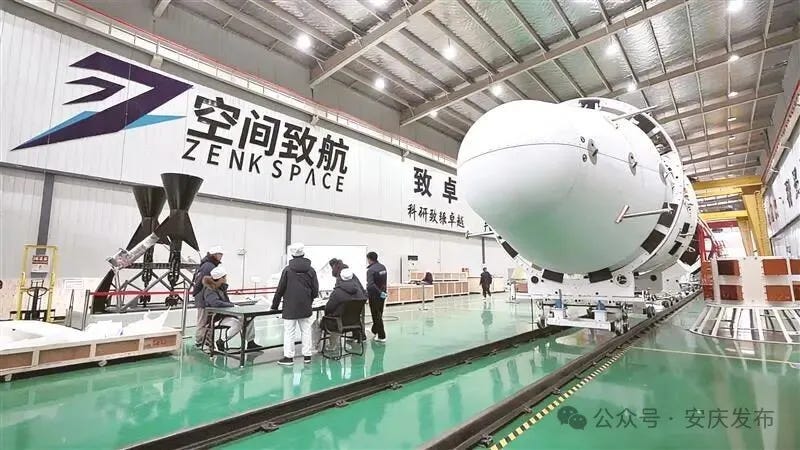
Zhihang-1’s aggressive development time, compared to other liquid propellant launch vehicles, has been enabled by an outsourcing of components to existing suppliers in China’s space sector. One key part outsourced is the rocket’s propellant tanks, contracted to RSPACE (九天行歌)5, who used their expertise to make the rocket-grade kerosene and liquid oxygen tanks with a common dome, eliminating the need to attach the tanks at the launch site6.
Zenk Space has also bought the YF-102 engines from the state-owned Academy of Aerospace Liquid Propulsion Technology’s (航天推进技术研究院). The engine has become a popular choice for enterprises looking for a reliable solution to power new launch vehicles. Other vehicles using the YF-102 include CAS Space’s Kinetica-1, Space Pioneer’s Tianlong-2, and the China Aerospace Science and Technology Commercial Launch Vehicle Group Co Ltd’s (中国航天科技集团商业火箭有限公司) soon-to-debut Long March 12B. OrienSpace has also been testing YF-102’s for use on an early version of its Gravity-2 launch vehicle.
Possibly from the same launch pad (a flame diverter on reinforced concrete) that Space Pioneer used for Tianlong-2’s sole flight to date.
In Anhui (安徽) province.
In Jiangsu (江苏) province.
It’s unclear if the first-stage was still at the facility at the time of the photo. It may have been shipped to Haiyang for testing when reporters visited.
They have also made the interstage of LandSpace’s Zhuque-3. On their website, RSPACE says they can make rocket strucutres between 2.25 and 10 meters in diamter.
Like LandSpace’s Zhuque-3 and Space Pioneer’s Tianlong-3 have to do due to their length and transportation via China’s road networks.