

CAS Space Outlines Path to Reusing Tri-Core Kinetica-2 Rocket by 2028
A step-by-step approach over ten missions may fulfill lofty flight rate aims and aggressive cost goals.

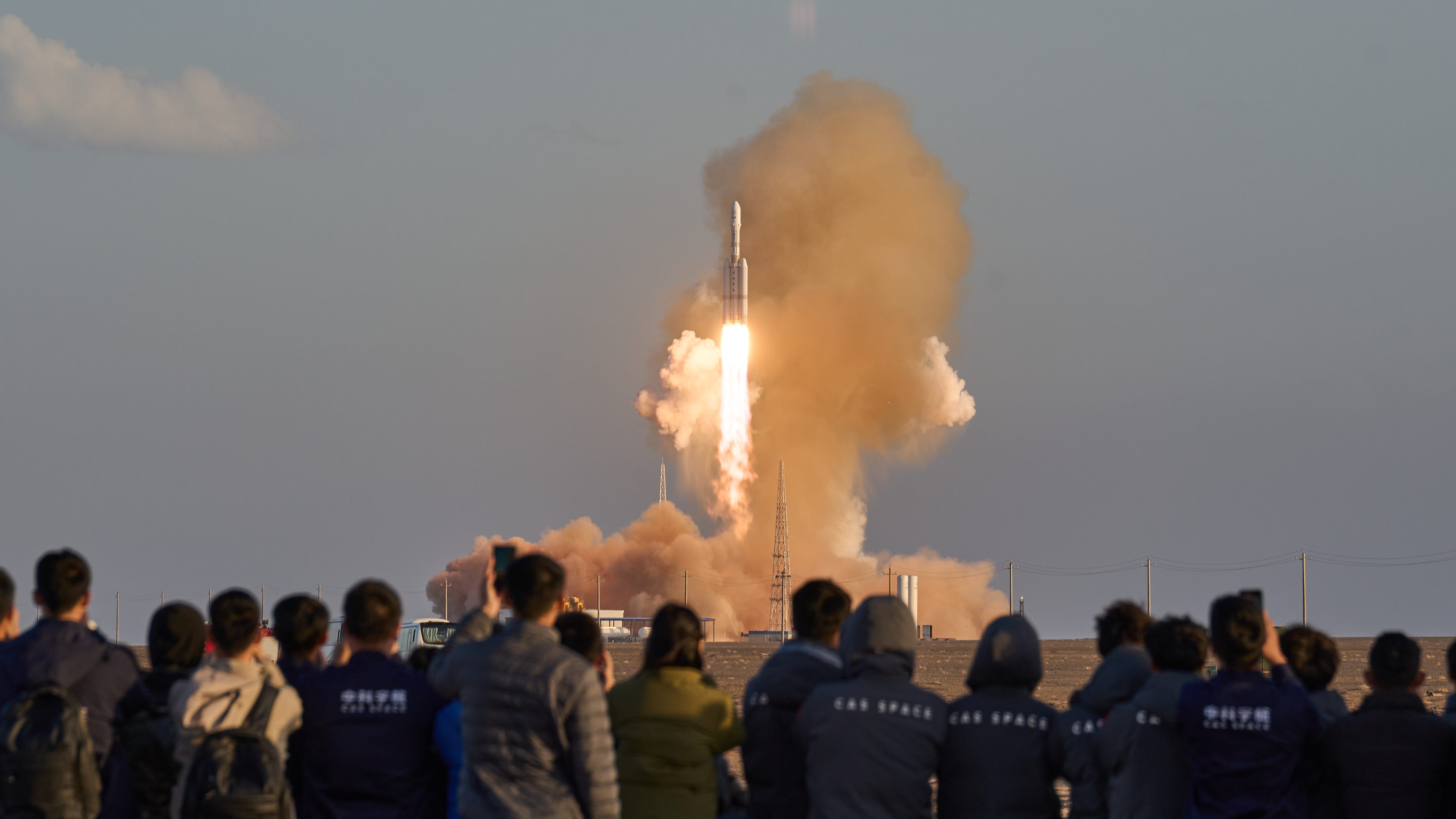
Two weeks ago, CAS Space successfully debuted its tri-core Kinetica-2 launch vehicle, with a mission departing the Jiuquan Satellite Launch Center to place a prototype Qingzhou (轻舟) cargo spacecraft into orbit. Following the flight, Chinese media have been keen to talk to engineers and executives at the company, with insightful reports coming as a result.
A day after the successful launch, China Internet Information Center (中国互联网新闻中心) spoke with Yang Haoliang (楊浩亮), Kinetica-2’s General Commander, and Lian Jie (廉潔), Kinetica-2’s Deputy Chief Designer, to understand the launch vehicle’s path to obtaining reusable first-stages, something CAS Space aims to have by 2028. Yang was quick to highlight that Kinetica-2 will have an ‘iterative’ approach to integrating and proving reusable rocket technologies, telling the outlet:
“On the third launch, we will install our full grid-fin system to control our aerodynamic reentry. Over subsequent missions, the fourth, fifth, sixth, and seventh launches, we will integrate our [Kinecore] technologies, including multiple engine firings, thrust control, and overall cluster recovery. We are striving to achieve complete first-stage recovery in our tenth mission.”
If there are any problems with this translation please reach out and correct me.
That statement is absent of dates, but the company has previously said that Kinetica-2 launch vehicles produced within the first two years of operation (2026 and 2027) won’t be recovered, but will have a gradual introduction of reusable rocket technologies1. Characterizing and some testing of relevant technologies will be assisted by the suborbital Lihong (力鸿) rockets.
Assuming that the tenth flight would occur around two years from Kinetica-2’s debut mission, as the company has hoped, CAS Space will need to have a vehicle ready to fly every two and a half months on average2. So long as enough vehicles are produced, company launch teams have proven fast turnarounds between flights already3.
Kinetica-2’s production and flight rate is an area Lian Jie is especially focused on, telling China Internet Information Center:
“In the future, we will focus on two key areas: first, the production cycle [of Kinetica-2] and the supporting systems cycle [(launch pad and integration facilities)]; second, the key focus is on the reliability and stability of our rocket products. … [Once there is routine production of Kinetica-2, work] in the technical area can be reduced to ten to fifteen days, and the overall launch cycle, including the time spent in the launch area, can be shortened to less than a week.”
In the near future, CAS Space says it will be able to produce twenty Kinetica-2 launch vehicles per year, once its new ‘super factory’ opens in Shaoxing (绍兴市), Zhejiang (浙江) province, to complement existing sites around Guangzhou (广州市), Guangdong (广东) province.
In another interview, with China Daily (中国日报), Lian repeated that Kinetica-2’s first-stage’s common booster cores land as a single unit when flying in a tri or penta core configuration, claimed to reduce needed parts, vehicle complexity, and costs. With that approach, the Deputy Chief Designer shared that Kinetica-2 missions could cost half of that of SpaceX’s partially reusable Falcon 9, at 252.5 million Yuan (37 million United States Dollars)4, once first-stage reuse is understood. A CGTN report states that Kinetica-2’s costs to customers are already comparable to Falcon 9. If so, the launch vehicle would already be competing with the state-run Long March series on costs too.
This would be in a sort of similar approach that SpaceX took with Falcon 9 in the mid-2010s.
If flight ten were to be in March 2028.
As of February 2026, the cost of a Falcon 9 launch to customers was reportedly 74 million United States Dollars.