


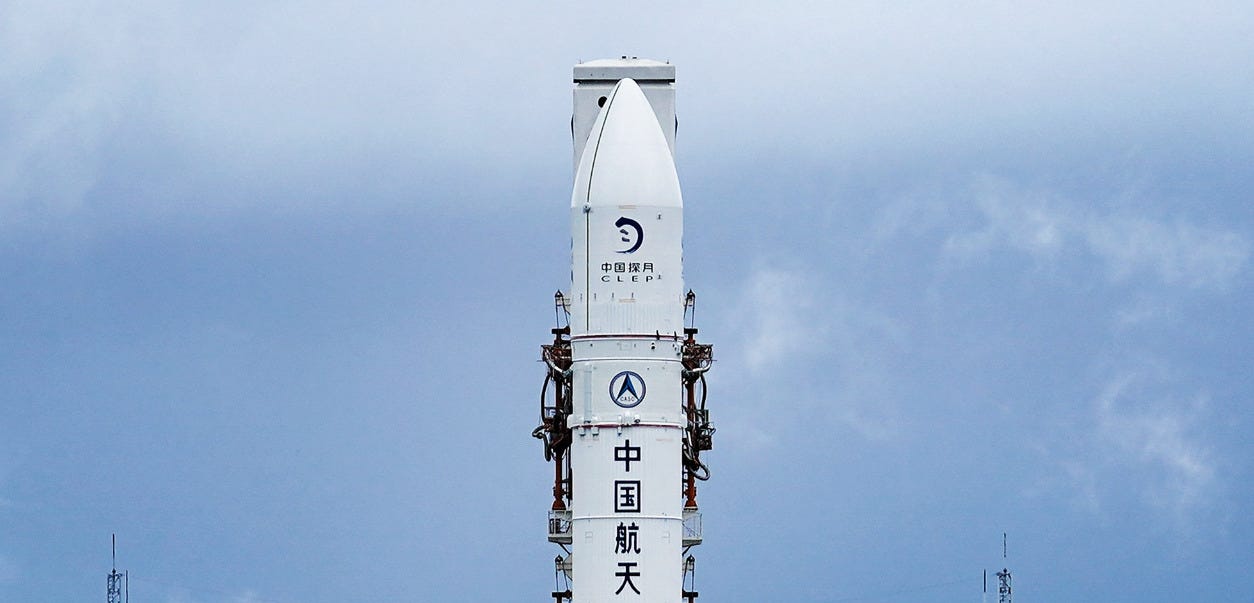
Atop of a Long March 5 on August 19th, the lunar south pole targeting, lunar water ice searching Chang’e 7 mission was rolled out to the launch pad at the Wenchang Space Launch Site for a launch no earlier than August 24th. However, following recent weather developments, the mission is delayed.
At a meeting with international partners1 near the launch site today, August 23rd, officials from the Chinese side informed their counterparts that the launch will be postponed by about a month, into September. The National Astronomical Research Institute of Thailand was the first to share a press release about the delay.
The China Manned Space Agency, who manage the mission and the Chinese Lunar Exploration Program (中国探月工程) now, has yet to issue a statement. It will be released alongside those from involved enterprises under the China Aerospace Science and Technology Corporation.2
That delay is caused by a limitation of the orbital mechanics to send Chang’e 7 to its target orbit (more on that in a moment) in the current launch window, which expires on August 25th. No launches will be allowed to occur from Wenchang by then due to the growth of Tropical Depression Narra in the Gulf of Tonkin, on the East coast of Hainan (海南) province.
Narra started to form in the Gulf around the 19th and has spent a few days winding back and forth from northern Vietnam. Now it is on a path towards Hainan before it heads north to Guangxi (广西) and Guangdong (广东) provinces by the 26th to make landfall.
In the coming days, the Long March 5 launch vehicle will return to its vehicle assembly building, so it and Chang’e 7 will not spend almost a month at Launch Complex 101. In that building, both the launch vehicle and spacecraft can be kept far safer than they would be surrounded by the launch pads’ access platforms. It also allows for a greater ability to inspect both.
Finding a path to the South Pole
To get Chang’e 7 to its desired landing site on the Moon is an immensely complex task when compared to previous Chang’e missions. Because the last four landings did not target a polar site, they had launch windows with comparatively high repeating regularity, constrained only by whether a landing attempt would occur in the lunar night.
As the upcoming mission is aiming for a permanently illuminated site near Shackleton Crater at 123.4 degrees East and 88.8 degrees South, it has to be launched onto a flight path that will allow for an efficient braking burn into a lunar orbit of the Moon. From Wenchang, those paths are only available for around a week at a time, with the performance of the Long March 5 able to expand the duration of day-to-day windows.
In discussion with some of my peers who are more knowledgeable on orbital mechanics, a few future launch windows would be available in:
the second half of September 20263
mid-October 2026
mid-November 2026
early December 2026
early January 2027
early February 2027
early March 2027
the end of March 2027
and the end of April 2027
Each of those windows also requires a tweaking of the ascent path for the Long March 5 to perform in the day-to-day windows, due to the 18.6-year lunar nodal cycle decreasing the Moon’s orbital inclination4 relative to the Wenchang Space Launch Site. At the current point in the cycle, the inclination is dropping and will continue to for a few years.
Of course, getting into orbit of the Moon is only part of the Chang’e 7 mission, although all parts of it will remain up there for about ninety days ahead of a landing attempt to scout preferred pre-selected sites. That landing attempt will require the Sun to illuminate the favored landing site and backup areas during descent towards it, else the guidance systems would not function properly.
Considering that, researchers at the Chinese Academy of Sciences published a paper back in March 2025 going over favorable periods to attempt landings between the second half of 2026 and mid-20345. It discloses that November and December 2026 would be the most well-illuminated opportunities, decreasing until the Sun is too low between early March and late June 2027. From then onward, illuminated opportunities rise up to a peak in November 2027.6

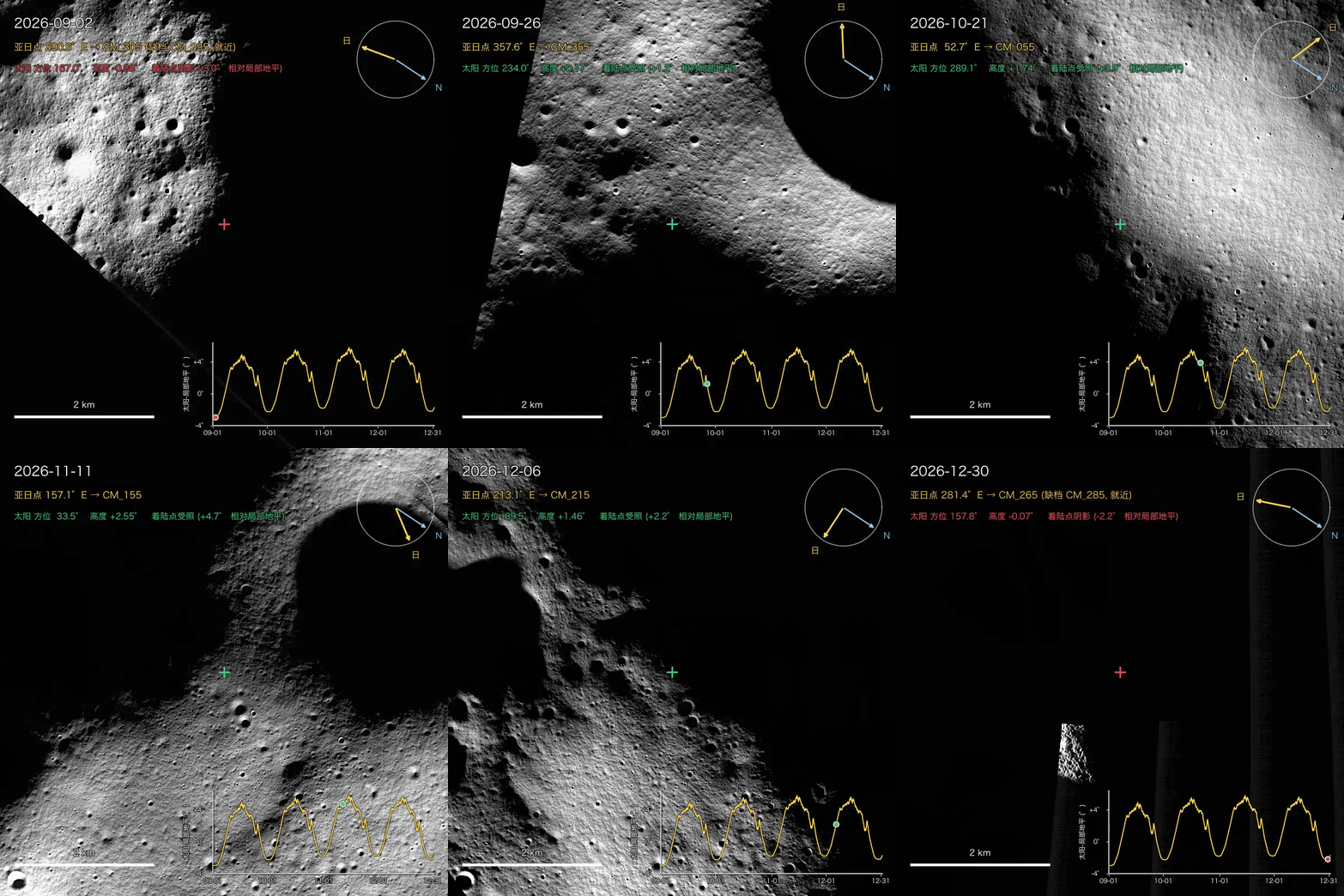

In the years following, a trend occurs with an ‘on’ for about seven months, followed by an ‘off’ for almost five, shifting around a month earlier each year. Each landing opportunity also has to account for the three-month wait in orbit to observe the landing site in a handful of lighting conditions7 for hazards and geological changes.
Considering that, if Chang’e 7 were to hypothetically launch in mid-October, it would land past the end of the illumination peak in mid-January. Whereas if it launched in early February, it would not be able to land due to the poor illumination conditions in early May.
What we haven’t discussed, and largely don’t need to, is line of sight to Earth for communications. The Queqiao-2 (鹊桥二号中继卫星) lunar relay satellite should maintain a communications link between mission control and Chang’e 7 the majority of the time Earth is out of view of the landing mission.


Prior to international partner announcements, China in Space has been informed about the meeting and causes of the delay by several sources, and is confident in skipping the days-to-hours wait from those entities.
This window is now the target.
How many degrees above and below the equator an object or celestial body travels.
The end of Chang’e 7’s eight-year design life.
Some dates within illuminated windows may not be available due to the Earth passing in front of the Sun from the Moon’s point of view.
Illumination angles caused by the rotation of the Moon and its travel around the Sun with the Earth.