


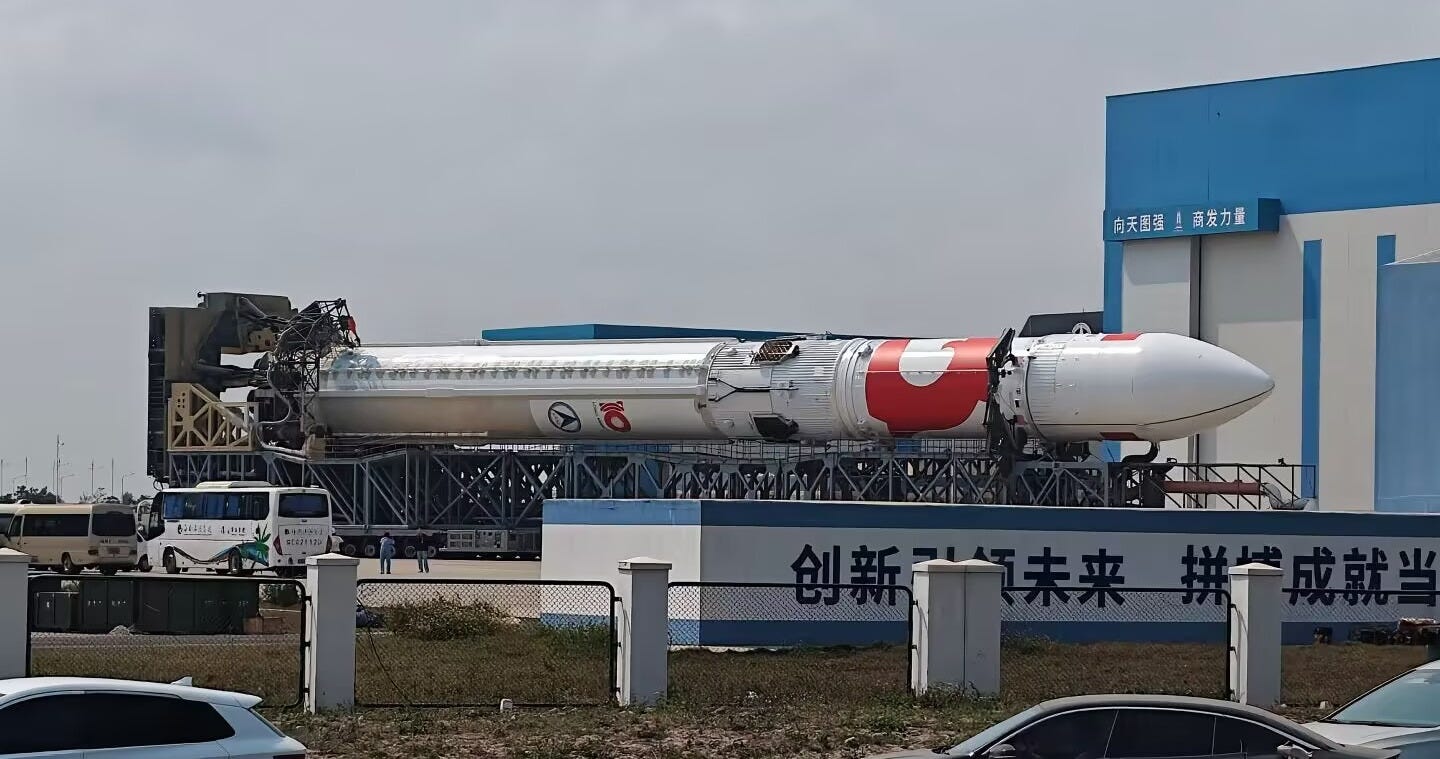
At the Wenchang Commercial Space Launch Site, China Long March Rocket Co Ltd (中国长征火箭有限公司)1, commonly known as China Rocket, has rolled out its first Long March 10B launch vehicle to Commercial Launch Pad 2 for final tests ahead of a debut flight, rumoured to come before the end of the month.
While the launch vehicle was being taken to the launch pad, those lining the roads noticed, and photographed, the first-stages four grid fins and recovery hooks installed on the interstage. The hooks will be used to ‘catch’ the first-stage on the autonomous Long March 10 series booster catching ship ‘Linghangzhe (领航者)’, should it be ready in a recovery zone.
In the lead-up to bringing the Long March 10B to the launch pad, Hainan International Commercial Aerospace Launch Co Ltd (海南国际商业航天发射有限公司) has installed liquid methane systems at its existing vehicle commodity sites. The end of October 2025 saw the liquid methane system initially tested following installation, with a vehicle-less test of Commercial Launch Pad 2 occurring in early March. The launch pad also had its deluge system upgraded, verified in February, to support the launch vehicle’s 892 tons of thrust at liftoff.
Away from the launch pad, the Long March 10B’s transporter-erector was assembled next to its integration facility, later being taken to the launch pad for fit checks and testing with and without a dimensional mockup. Delivery of the Long March 10B’s second-stage and fairing was spotted being trucked into the commercial launch site, under covers, at the end of February.
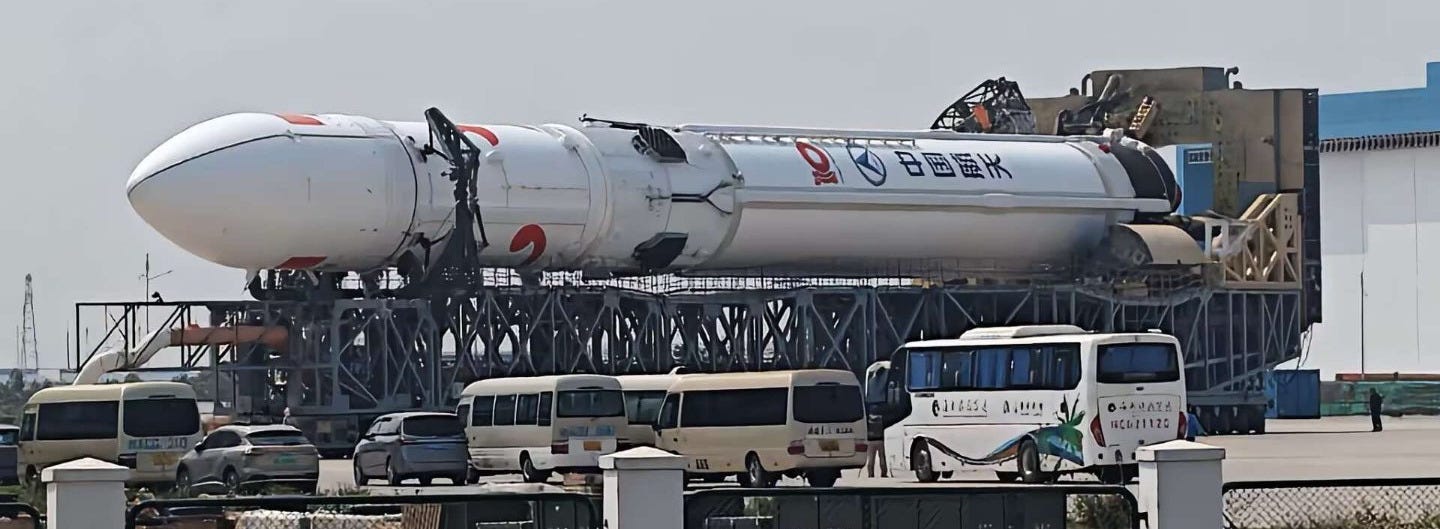
With today’s rollout, keen-eyed readers may have noticed a red design painted on the second-stage. That design appears to be replicating that of a carved jade C-shaped dragon from the Neolithic Hongshang Culture (红山文化), originating about six thousand years ago. In Chinese culture, red dragons2 can symbolize good fortune and luck, or a pioneering spirit more generally.
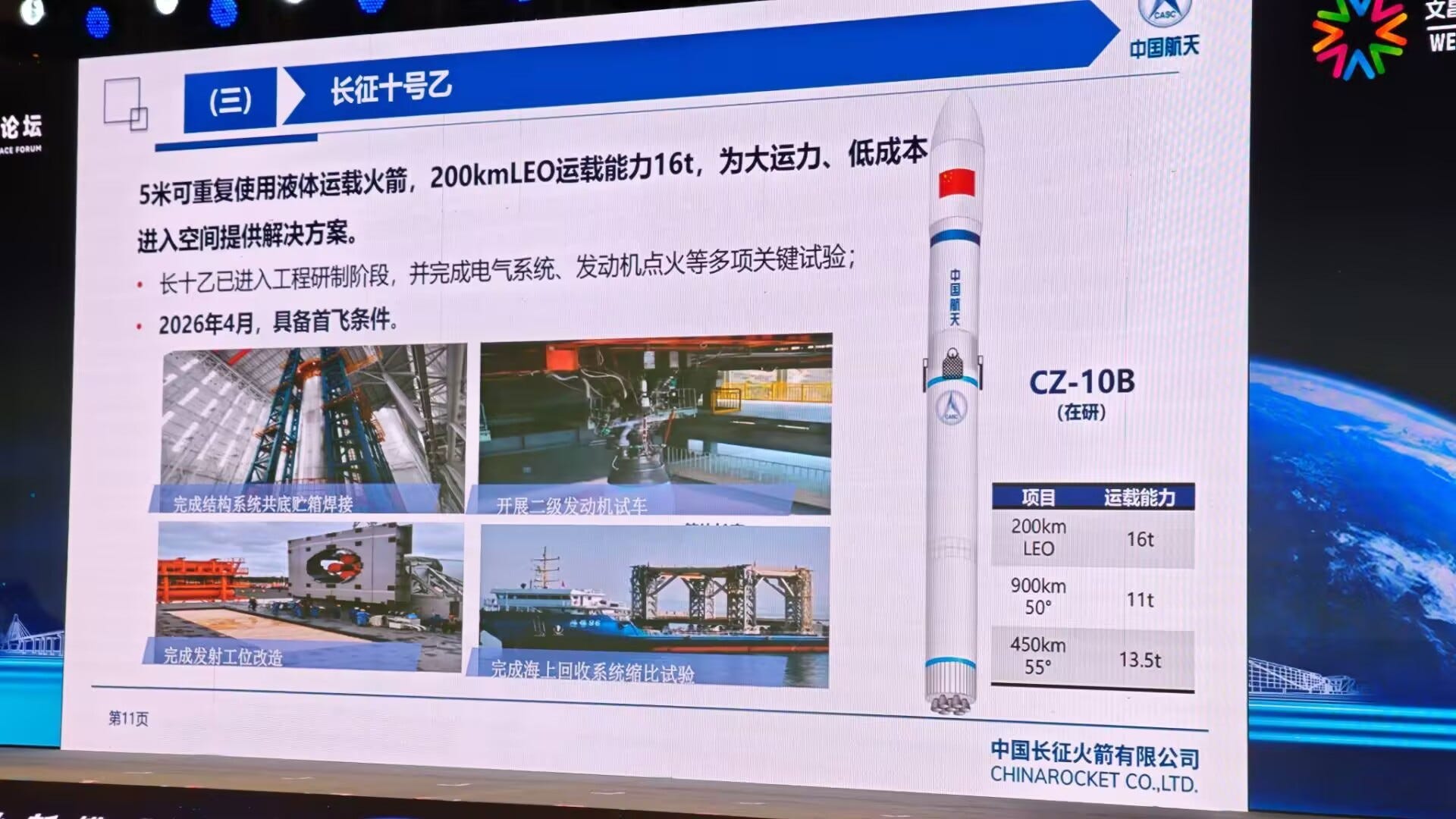
Back in December 2025, China Rocket detailed that the horizontally integrated Long March 10B stands 70 meters tall, with a rocket-grade kerosene and liquid oxygen first-stage and a liquid methane and liquid oxygen second-stage, both five meters in diameter. That first stage is common to the Long March 10 series, powered by seven YF-100K engines, while the second-stage introduces a single gas generator cycle utilizing YF-219 engine, generating 140 tons of thrust. Through using those stages, China Rocket claims that the Long March 10B can deliver up to 16,000 kilograms to low Earth orbit.
Once the Long March 10B is ready to fly from Commercial Launch Pad 2, it will start a major debut year for the Long March 10 series. In the weeks after the Long March 10B’s flight, a Long March 10A may deliver an experimental lunar satellite on its maiden outing, followed by the Mengzhou-1 mission to the Tiangong Space Station as soon as September. Those three flights, if not more, will all be using near identical first-stages, building flight data ahead of the tri-core Long March 10 Moon rockets’ introduction next year.
Through flying the Long March 10B first, some risk is being ‘bought’ down relative to China’s crewed lunar exploration program. That has already been done previously via flying engines and systems on seperate vehicles prior to their use on their lunar-critical vehicles. To some extent, that has already been done for the Long March 10 series by flying guidance and recovery systems on the Long March 10A test booster for Mengzhou’s in-flight abort test.
A subsidiary of the dominant state-owned space contractor, China Aerospace Science and Technology Corporation, and a partner of the China Academy of Launch Vehicle Technology (also a subsidiary).
Dragons are known as Loongs (龙) in Chinese.