

LandSpace Delivers Experimental Connectivity Satellites Into Orbit [Zhuque-2E Y6]
In the remaining months of the year, the expendable liquid methane-burning launch vehicle is planned to fly several more times this year, alongside its operators’ partially reusable offering.

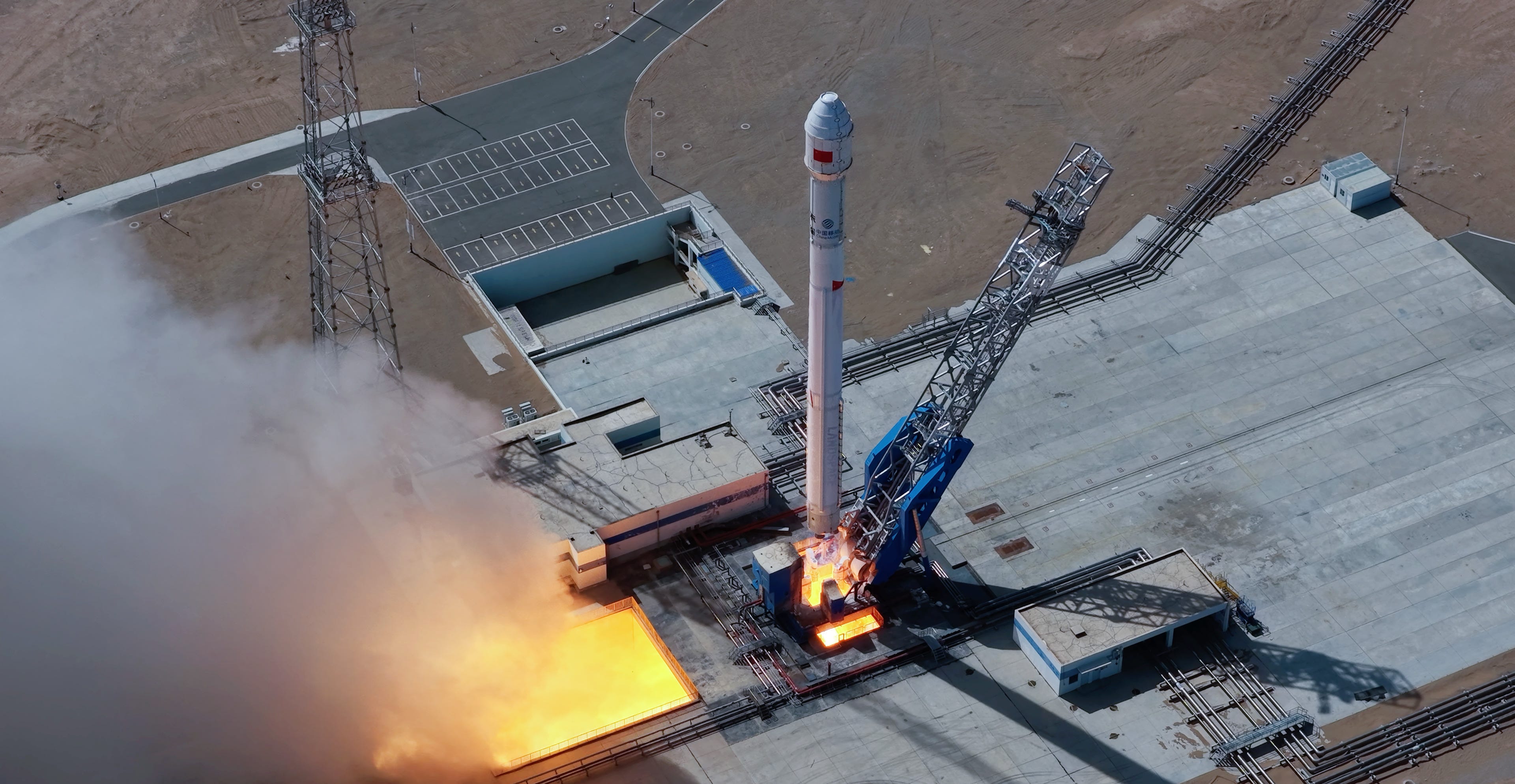
On June 9th at 16:23 China Standard Time (08:23 Universal Coordinated Time), LandSpace’s Zhuque-2E departed from Launch Area 96A at the Jiuquan Satellite Launch Center, heading into low Earth orbit with two experimental connectivity satellites.
One of those was revealed to be China Mobile Satellite 02 (中国移动02星) from, as its name suggests, telecom provider China Mobile (中国移动), which filed for 2,664 satellites in December 2025. That demonstration satellite is, built by GalaxySpace (银河航天), expected to prove space-based mobile broadband services, which the state-owned enterprise was authorized to start in September 2025. It joins another test satellite launched back in February 2024.
The other satellite belonged to Shanghai Spacesail Technologies Co Ltd (上海垣信卫星科技有限公司), of the Qianfan (千帆) constellation, with their payload being ‘Qianfan Direct-To-Cell-01 Satellite (千帆DTC01星)’, tasked with demonstrating systems and services needed for providing connectivity to handheld mobile devices. Made by the Innovation Academy for Microsatellites, Chinese Academy of Sciences (中国科学院微小卫星创新研究院), its design is slightly larger than that of existing Qianfan satellites, still featuring a single solar panel, swapping its usual antennas for a sizeable, several-square-meter phased-array antenna. It is theorized that the experimental satellite may be a test for a second-generation of satellites that will be launched in the near future.
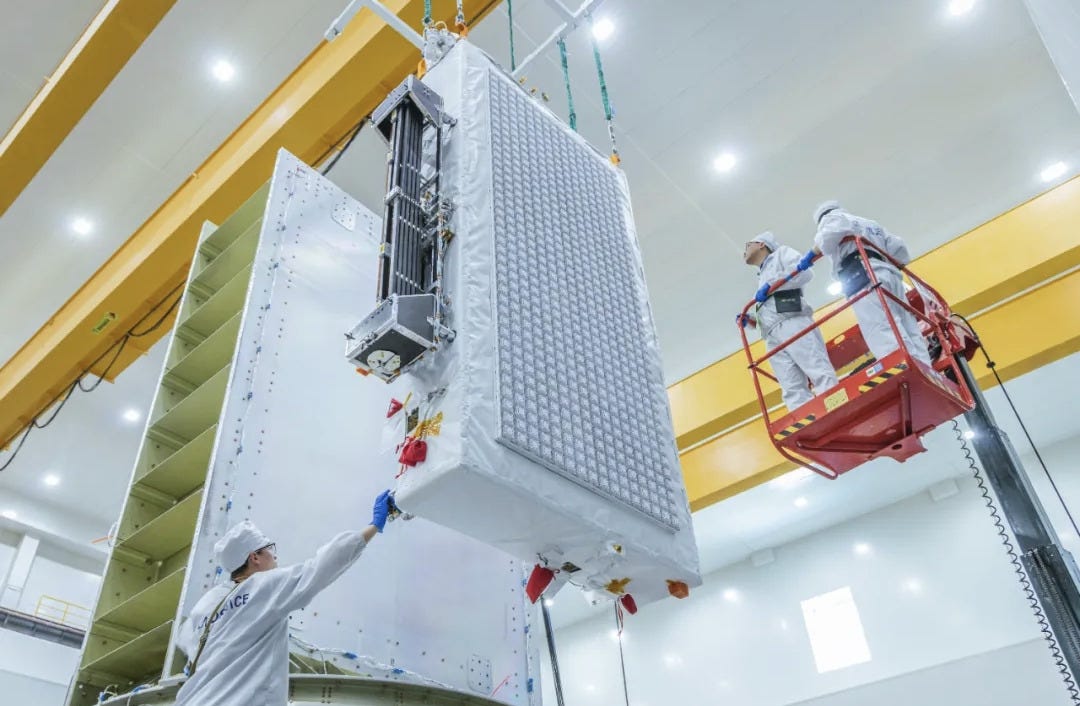
As part of a continual upgrade process to improve the launch vehicles' capabilities, today’s Zhuque-2E has ditched its stage separation motors for a piston that pushes on the second-stage TQ-15A engine ahead of ignition, while removing tank pressurization gas bottles from the interstage. The TQ-15A engine mount has also been optimized and had its mass reduced thanks to 3D printing.
Additionally, this year LandSpace aims to perform six to ten launch missions, with today being its second, and a few weeks before the second partially reusable Zhuque-3. In support of that goal, Zhuque-2E’s design has been ‘locked’ for about the next ten flights, enabling batch production.
Today’s mission was the 5th flight of Zhuque-2E, and the 8th flight of LandSpace’s Zhuque-2 series. This was also the 38th launch from China in 2026.
Zhuque-2E Y6 mission recap via LandSpace on Twitter.
Liftoff video via 大漠问天 and 我们的太空 on WeChat.
Check out the previous Zhuque-2E launch
LandSpace Successfully Proves Stretched Zhuque-2E Launch Vehicle [Zhuque-2E Y5]
![LandSpace Successfully Proves Stretched Zhuque-2E Launch Vehicle [Zhuque-2E Y5]](https://substackcdn.com/image/fetch/$s_!jUgo!,w_1300,h_650,c_fill,f_webp,q_auto:good,fl_progressive:steep,g_auto/https%3A%2F%2Fsubstack-post-media.s3.amazonaws.com%2Fpublic%2Fimages%2F4480c56c-5952-4e7d-b87d-cee425637d08_3648x1823.jpeg)
Lifting off from Launch Area 96A at the Jiuquan Satellite Launch Center at 11:00 am China Standard Time (03:00 am Universal Coordinated Time) on May 14th, LandSpace’s Zhuque-2E performed its latest test mission with a f…
What is Zhuque-2E?
This section is for those less familiar with China’s various commercial launch vehicles.
Zhuque-2E is LandSpace’s privately-developed commercial launch vehicle, and is largely based on the company’s Zhuque-2 vehicle. The vehicle consists of two stages both burning liquid methane and liquid oxygen.
The payload capacity of the launch vehicle is currently as follows:
6,000 kilograms to low Earth orbit
4,000 kilograms to a 500-kilometer sun-synchronous orbit
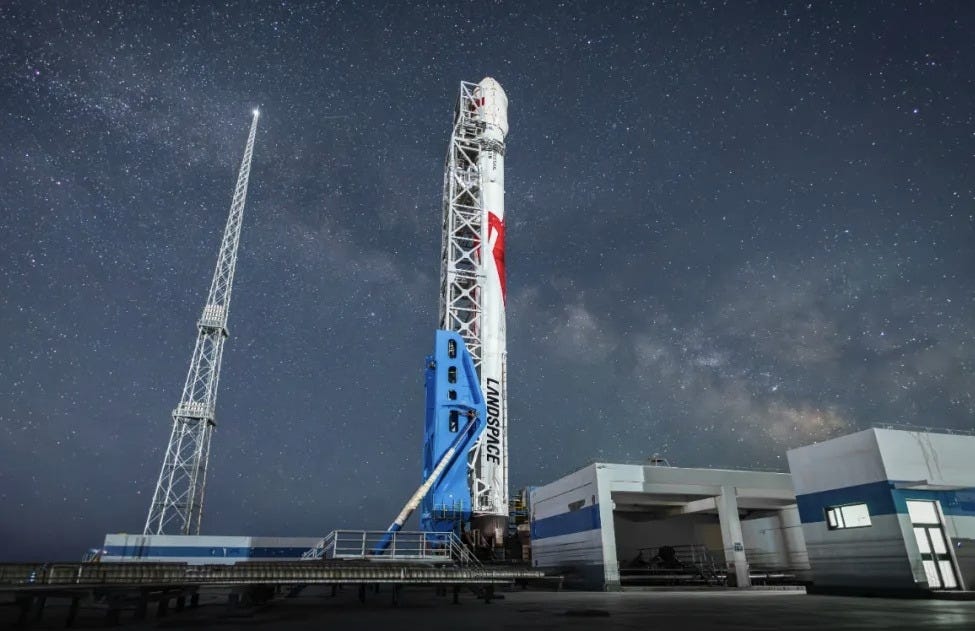
Four TQ-12A engines power the first stage to generate 338 tons of thrust while burning liquid methane and liquid oxygen. The second-stage is powered by a single TQ-15A engine, also burning liquid methane and liquid oxygen, to produce 85 tons of thrust.
On the launch pad, Zhuque-2E is 55.9 meters tall and weighs 267,000 kilograms when fully fuelled. The first-stage and second-stage, have a diameter of 3.35 meters, while the fairing has a diameter of 4.2 meters.

