

Chinese Constellation Operators Submit Plans for Almost 200,000 New Satellites
The vast majority of the proposed satellites would come from just one new institute.

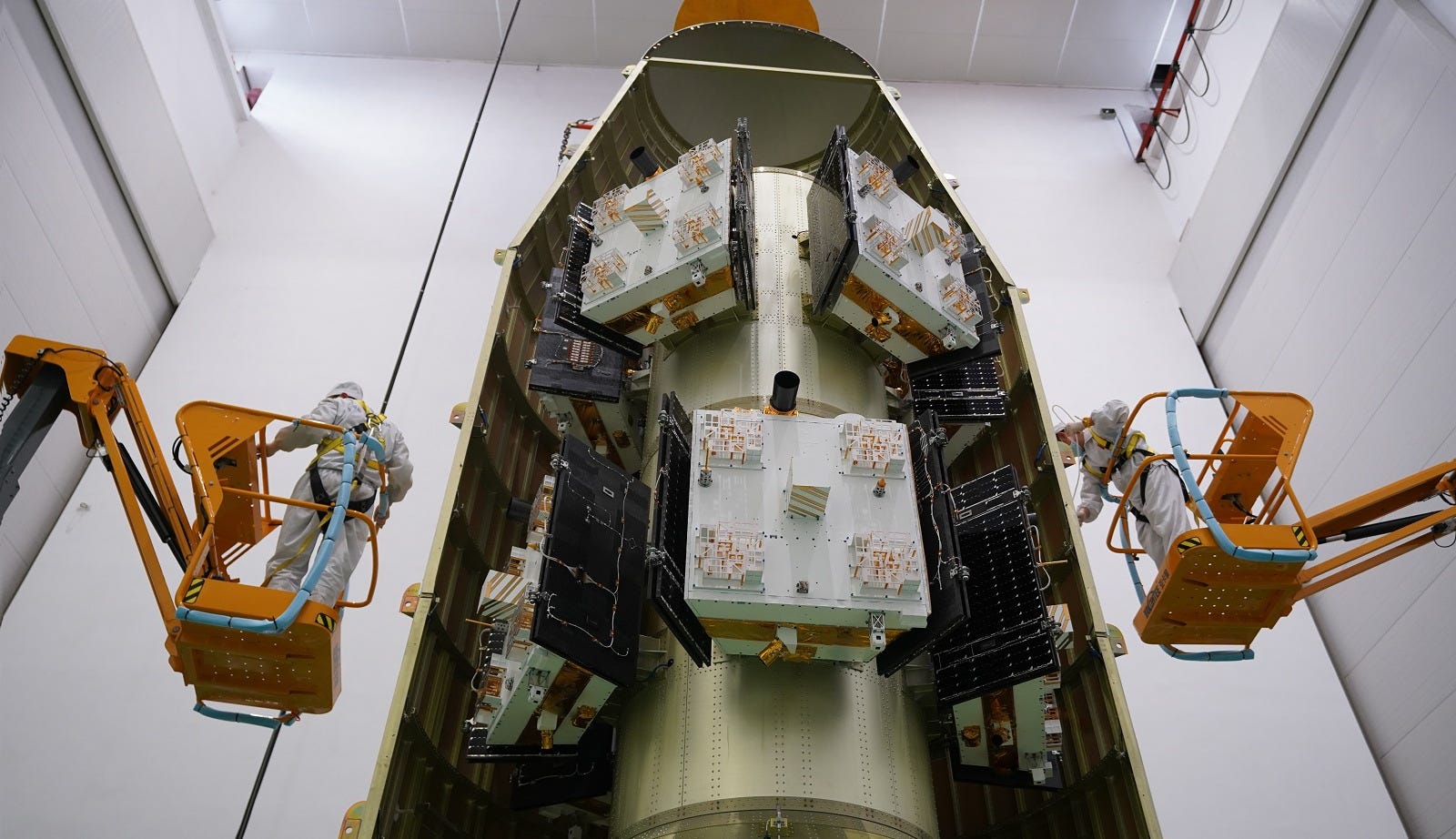
At the very end of December 2025, a handful of established and new Chinese spacecraft operators submitted new filings to the International Telecommunication Union for expanding or establishing new constellations in non-geostationary Earth orbit1.
Starting at the smaller end, GalaxySpace (银河航天), contractor for GuoWang (国网), filed for two new constellations across twenty-six orbits. The larger of the two, with 96 spacecraft, is called Galaxy-SAR-2, and based on its name, will be used for synthetic aperture radar all-day, any weather imaging from a wide variety of orbits. Meanwhile, with more limited orbits is BlackSpider-3 with 81 satellites and an unknown purpose. Both filings are categorized as ‘advance publication information’ for informing other satellite operators of intended frequency usage and feedback regarding that.
Under Emposat’s (航天驭星) old name, SatelliteHerd, plans for a 106 spacecraft constellation known as YX-5 were submitted, with it being set to use eighteen orbits. With Emposat’s focus on launch vehicle telemetry, tracking, and command, this network may be used to build out a relay network for China’s increasing number of commercial launch enterprises, allowing them to remain in contact with launch missions when beyond the range of the company’s ground stations across the southern hemisphere.
Meanwhile, Guodian Gaoke (国电高科), with its Tianqi (天启) Internet-of-Things constellation, resubmitted near identical ‘coordination request‘ plans (except for frequencies) for a nine-satellite addition to its network. Additionally, the company filed ‘advance publication information’ for a 1,132 spacecraft expansion of its constellation, following 2024’s proposed 3,240 spacecraft expansion. It is unclear whether the smaller, newer submission overrides 2024’s.
Alongside the new and renewed filings, Shanghai Spacesail Technologies Co Ltd (上海垣信卫星科技有限公司) submitted an ‘advance publication information’ likely relating to the Qianfan (千帆) connectivity mega-constellation. That filing lists 1,296 satellites planned to be launched into thirty-six different orbits, either for deploying a new generation of satellites or gradually meeting deployment eventual goals of 13,000 spacecraft based on actual deployment rates through 2024 and 2025.
Having received a license for satellite mobile services, also called direct-to-cell (abbreviated as D2C), in September 2025, China Mobile (中国移动) has appeared in an International Telecommunication Union filing for the first time, according to their database. The state-owned telecommunications company appears to be planning two constellations, likely to use that license, with one called ChinaMobile-L1 with 2,520 satellites and the other known as ChinaMobile-M1 with just 144 spacecraft.
Lastly, the largest of the filings was from the newly established Institute of Radio Spectrum Utilization and Technological Innovation (无线电频谱开发利用和技术创新研究院), based out of Xiong’an New Area (雄安新区)2. The new institute’s submissions were for two constellations, the first dubbed CTC-1 with 96,714 satellites (‘advance publication information’ and ‘coordination request‘ were filed) alongside a second, creatively called CTC-2, having 96,714 spacecraft too, for an insane total of 193,428 satellites across the two networks (far more than Starlink’s proposed 42,000). Regarding what the two CTC constellations could be for the Nanjing University of Aeronautics and Astronautics (南京航空航天大学) claims to be involved with the new institute’s plans, and lists cooperative areas as:
“[Focusing] on technologies such as detection and inspection in the field of low-altitude electromagnetic space security, integrated security defense systems, electromagnetic space security assessment of airspace, and low-altitude airspace safety supervision services. They will also establish an elite training program for space spectrum intelligence innovation to cultivate reserve talent.”
If there are any problems with this translation please reach out and correct me.
With that vague description, it may be that the CTC constellations could have a similar purpose to SpaceX’s government-focused Starshield constellation. Other involved partners listed by the university were the State Radio Regulation of China (国家无线电监测中心), Hebei Xiong’an New Area Management Committee (河北雄安新区管理委员会), Hebei Provincial Department of Industry and Information Technology (河北省工业和信息化厅), China Satellite Network Group Co., Ltd. (中国卫星网络集团有限公司)3, Beijing Jiaotong University (北京交通大学), and China Electronics Technology Group Corporation (中国电子科技集团有限公司).
Through those operators December 2025’s filings, China’s proposed mega-constellation satellite counts would skyrocket. As of December 26th 2025, six serious mega-constellation efforts, through a mixture of commercial and government-backed enterprises, plan to deploy 50,730 spacecraft for providing space-based connectivity. With the new filings for possibly expanding the Qianfan and Tianqi constellations and building out ChinaMobile’s networks alongside CTC-1 and CTC-2, the number jumps up to 249,250 satellites.
Whether those constellations’ spacecraft actually manage to reach space, as only two hundred did last year, is a different consideration, especially for the CTC networks. Notably in 2021, Rwanda filed for a 327,230 satellite network that is yet to be launched. Current international regulations require constellations to launch ten percent of their planned satellites within two years, fifty percent within five, and one hundred percent by the seventh year after the filing or risk losing access to their desired frequencies.
Within China, those writing on the International Telecommunication Union filings have suggested that the massive CTC constellations submission is potentially meant to trigger a global conversation on the Union’s first-come first-serve model for frequency allocation or to secure frequency viewed as necessary to have over competitors. Recently at the United Nations, China’s representative lodged an informal complaint about SpaceX’s almost 10,000-satellite Starlink constellation gobbling up frequency and orbital resources.
Low Earth orbit (from 160 to 2,000 kilometers) and medium Earth orbit (from 2,000 up to 35,786 kilometers).
Located in Baoding (保定市), in Hebei (河北) province.
Of the GuoWang (国网) mega-constellation.
Looks like a big big miscalualation and let me explain why . First of all , all those Chinese companies which want sattelites need to first hugely invest in the R and D of the reusable rockets. China still has not a SINGLE reusable rocket that is as effective as SpaceX' Falcon 9 horse ,so how can China even think of 10000 sattelites let alone 200,000 sattelites . Secodly , China should start building space situational awareness infrastucture like that of US NRO because as the sattelites will increase so will the collision and already China's Tiangong Space Station has faced those scenarios multiple times. Lastly , capturing of space debris and moving them to the graveyard orbits should be the priority to mitigate the effects of space junks.
Without those tasks , China's dream of 200, 000 sattelites , according to my observation and analysis is far from reality .