

Long March 10B To Be Basis of Bigger Reusable Rocket
One member of the Long March 10 series has flown so far, but a larger relative is already in development.

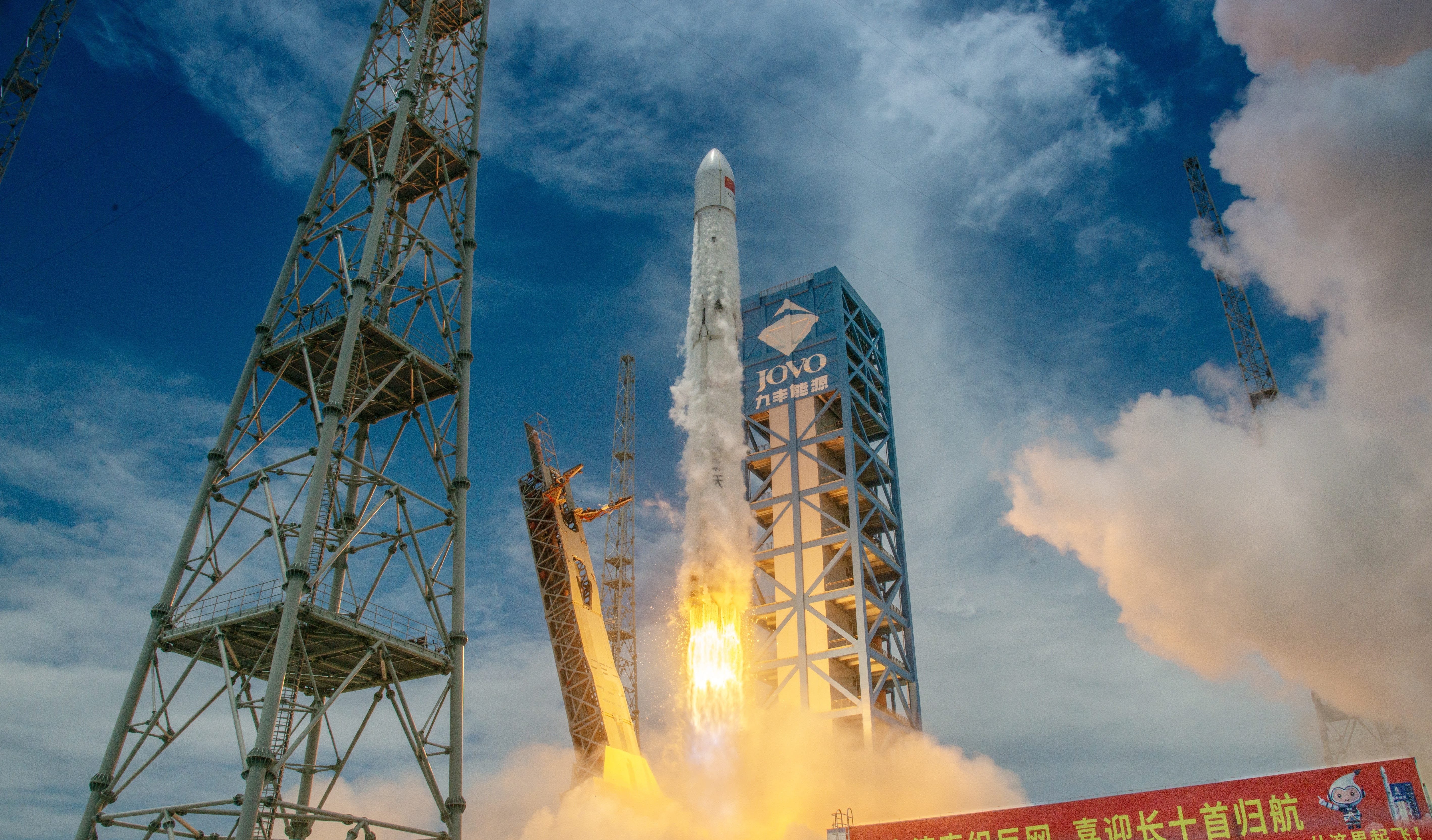
In a major first for the Long March 10 series of launch vehicles, the Long March 10B performed its debut flight on July 10th, flying under the power of seven YF-100K engines before being caught a few hundred kilometers away at sea. That mission has been a major confidence boon at the China Academy of Launch Vehicle Technology, who are looking to build upon the vehicle already.
In a piece from China Central Television (中国中央电视台), not long after the debut mission, it was detailed that the bigger commercially-focused Long March 10C launch vehicle is already well into development and has been sufficiently designed to proceed with work, with involved space expert Qian Hang (钱航) sharing:
“[Adopting] the same ‘three-horizontal’ operational mode1 as the Long March 10B, the Long March 10C launch vehicle is under intensive development and will strongly drive the industrialization of China’s space transportation sector in the future.”
Alongside that, it was added that the Long March 10C will utilize the YF-219 engine in both its first and second stages. That means that those stages will use the less dense and lighter liquid methane and liquid oxygen, as expected when hints of the launch vehicle were first emerging. The second-stage used by the Long March 10B is expected to be minorly modified to work with the larger vehicle too.
Previous weeks have also seen a promotional placard leaked online, providing further details about the launch vehicle. That detailed that the Long March 10C will generate 1,260 tons of thrust at liftoff, which would come from nine YF-219 engines, to bring its 940,000-kilogram mass off of Earth. Like other members of the Long March 10 series, it will be 5 meters in diameter and up to 91 meters tall2 due to its propellant choices, meaning it will have a significantly tall first-stage.
At present with those design choices, insiders and bloggers of the SpaceLens team believe that the Long March 10C could be able to bring 22,000 kilograms into low Earth orbit when reusing the first-stage, or 27,000 kilograms if expending it.
Formal approval for the Long March 10C appears to have come in March through the China Long March Rocket Co Ltd (中国长征火箭有限公司), which will commercialize the launch vehicle while the China Academy of Launch Vehicle Technology manufactures it. The former is a subsidiary of the latter.
As for recovery of the Long March 10C’s first-stages, the significant increase in length compared to the Long March 10B will be a challenge in catching them aboard ‘Linghangzhe (领航者)’, as they could easily collide with the drone ship’s deck3 unless the tensioned wires are made to give less slack. Doing that would result in ‘harder’ catches and more structural stress, as well as requiring more propellant to slow down4. However, nothing prevents the Long March 10C from gaining landing legs and utilizing the Wenchang Commercial Space Launch Site’s multi-user drone ship, with neither expected to be ready until well into 2027.


Long March 10A to unify Tiangong launches
The China Central Television piece also repeated that the Long March 10A is planned to launch Tianzhou cargo resupply spacecraft to the Tiangong Space Station once the launch vehicle is flying a sufficient number of times per year. That would see the spacecraft moved off of the Long March 7, which is its only payload, and see three launch missions for the orbiting laboratory taking place on the same vehicle, as Mengzhou (梦舟) will carry taikonauts via the Long March 10A twice per year. Effectively unifying all Tiangong launch efforts to one launch site and one launch vehicle, instead of the current split between the Wenchang Space Launch Site and the Jiuquan Satellite Launch Center.
Each Long March 10A mission is set to use new but reusable first-stage boosters5, according to Qian Hang. Once recovered for the first time, those boosters will then be given to Long March 10B teams for further flights, planned for up to ten uses with as little as ten days between missions via recovery and reuse.
While juggling a few variants that use different propellants, the China Academy of Launch Vehicle Technology is confident that the shared use of 5-meter-diameter propellant tanks and structures will enable efficient and timely production. Select parts, like engine sections and interstages, of each variant were also said to be modular too.
Horizontal assembly (during production and pre-flight), horizontal testing (pre-flight at the launch site), and horizontal transport (atop of a transporter-erector to a launch pad).
Like the Long March 10B, determined by the use of either a short or a long fairing, depending on customer needs.
Watch how far the Long March 10B Y1 first-stage drops with the tensioned wires after its engine is shut off:

To prevent the metal catch hooks from being sheared off.
SpaceX formerly did this for contracted NASA missions until reused boosters were deemed safe enough, citing dozens of satellite-carrying flights.