

Long March 3B/E Triumphantly Returns to Flight With Shijian Spacecraft [Long March 3B/E]
China’s common route of delivering satellites to high orbits has returned to operational missions, carrying Shijian-31 atop of it.

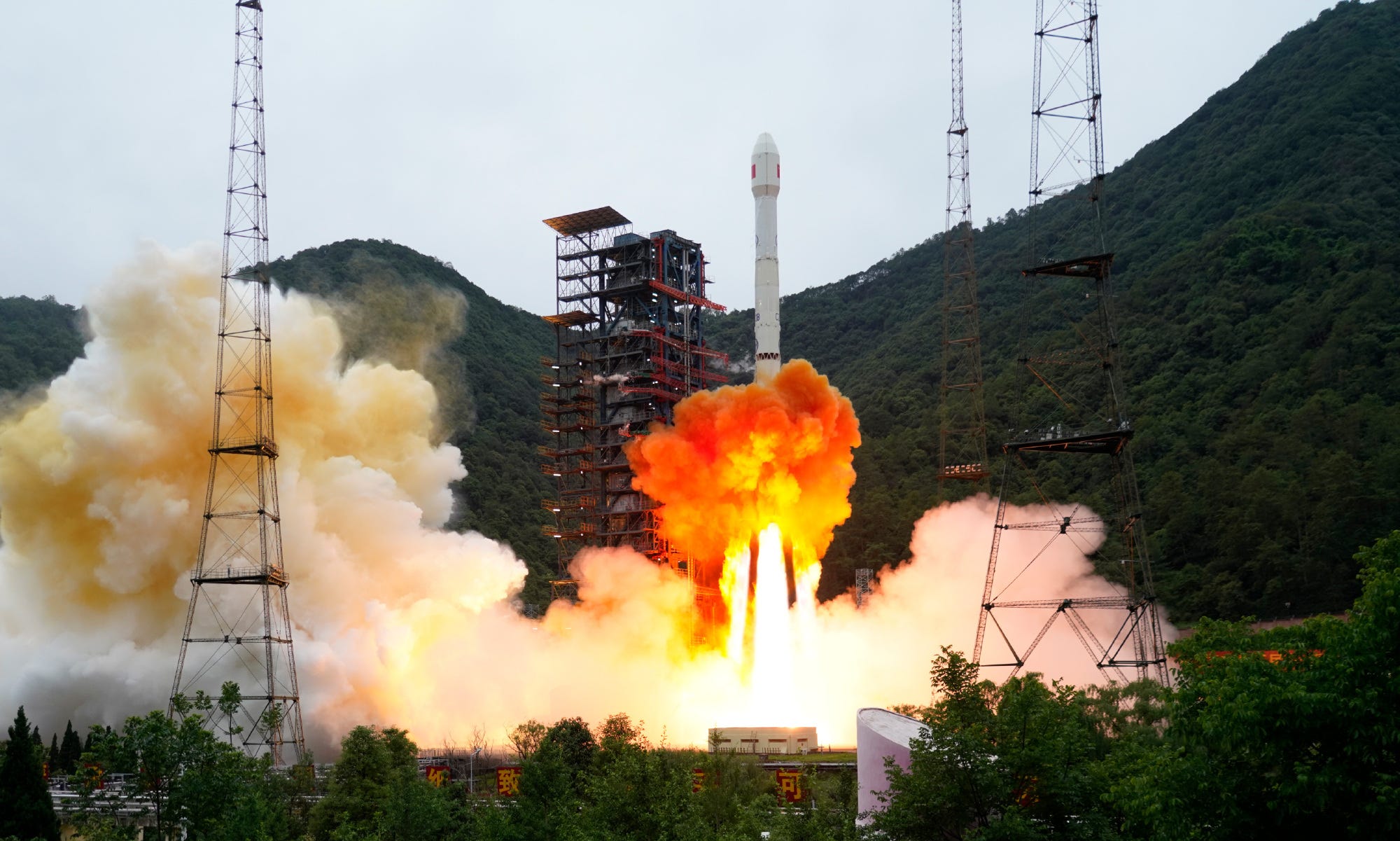
For the first time in five months, a Long March 3B/E returned to flight from Launch Complex 2 at the Xichang Satellite Launch Center at 17:45 pm China Standard Time (09:45 am Universal Coordinated Time) on June 16th, heading beyond low Earth orbit on a Southeastern path.
Trusting the return to flight mission for orbital delivery was the Shanghai Academy of Spaceflight Technology-made Shijian-31 (实践三十一号卫星), stated to be for space environment exploration. It joins several demonstrative and experimental spacecraft with space environment tasks, like the monitoring Shijian-29 duo and the researching Shiyan-33.
Shijian (实践) designated spacecraft are flown to figure out best operational practices for new technologies, with the name literally translating to Practice in English. Shiyan (实验) is a similar satellite designation used for technology development spacecraft, and the name literally translates to Experiment.

Back in January, the Long March 3B/E had a rare failure, given its flight history, due to a third-stage issue during a burn towards geostationary space. Ahead of today’s mission, the 3-meter-diameter liquid hydrogen and liquid oxygen stage was flown via the Long March 8, with which it shares, three times with low Earth orbit missions in April, May, and June. The stage also flew towards geostationary space via its use on the Long March 7A in May.
In writing on today’s return to flight, the launch vehicle designer and operator, the China Academy of Launch Vehicle Technology, shared:
“This mission marks the second flight of the Long March 3B/E rocket in 2026. Following the previous mission, the project team rose from setbacks and forged ahead amidst challenges. Over the past several months, faced with the deep-rooted causes and complex mechanisms of the malfunction, the team undertook technical research involving multi-system integration, interdisciplinary collaboration, and multiple rounds of iteration. They conducted extensive simulation analyses and ground tests to thoroughly understand the underlying principles and master the technology, while strictly implementing measures to prevent similar issues from recurring.”
“For this mission, the team further tightened process quality control by implementing tiered and categorized management of launch site operations and conducting independent verification of test data. By strictly controlling quality and mitigating risks with a rigorous, cautious, meticulous, and pragmatic work ethic, they have laid a solid foundation of quality for the mission.”
“In addition, this mission implemented five technical improvements to enhance reliability. Going forward, teams will continue to strengthen full-process quality control, further improve rocket reliability, and fully guarantee the smooth progress of subsequent launch missions as planned.”
If there are any problems with this translation please reach out and correct me.
Capital Aerospace Machinery Co Ltd, the state-owned manufacturer of the launch vehicle, echoed the Launch Vehicle Academy’s statement.
Before the January failure, Long March 3B/E’s were expected to fly about every half month after efforts through 2025 to optimize pre-flight processes and production methods. That has made the launch vehicle quite hardware-rich, requiring quality control to be split between Beijing (北京) for monitoring defects during manufacturing and Xichang (西昌市) for catching later incurred defects and swapping hardware, to keep pace with customer demand.
Today’s mission was the 116th launch of a Long March 3B vehicle, and the 651st launch of the Long March launch vehicle series. This was also the 41st launch from China in 2026.
Liftoff video via 我们的太空 on WeChat, also available in slow motion from Sichuan Daily News (川观新闻).
Check out the previous Long March 3B/E launch
Shijian Spacecraft Lost Due to Rare Long March Launch Failure [Long March 3B/E]
![Shijian Spacecraft Lost Due to Rare Long March Launch Failure [Long March 3B/E]](https://substackcdn.com/image/fetch/$s_!uSlW!,w_1300,h_650,c_fill,f_webp,q_auto:good,fl_progressive:steep,g_auto/https%3A%2F%2Fsubstack-post-media.s3.amazonaws.com%2Fpublic%2Fimages%2F9264f7b9-656d-494e-9d5c-b62f3e048233_1920x1080.png)
On January 17th at 00:55 am China Standard Time (January 16th at 16:55 pm Universal Coordinated Time), a Long March 3B/E lifted off from Launch Complex 3 at the Xichang Satellite Launch Center.
What is the Long March 3B/E?
This section is for those less familiar with China’s Long March series of launch vehicles.
The Long March 3B is an older-generation geostationary orbit workhorse of the China Academy of Launch Vehicle Technology. The first two stages and four boosters of the rocket burn Dinitrogen Tetroxide and Unsymmetrical Dimethylhydrazine, with liquid hydrogen and liquid oxygen in the third-stage.
Over the rocket’s almost twenty-eight-year launch history, two versions of the vehicle have flown, the 3B and 3B/E. Since 2012, only the 3B/E variant has flown due to its increased payload capacity. The payload capacity of the launch vehicle is currently as follows:
11,500 kilograms to low Earth orbit
7,100 kilograms to a sun-synchronous orbit
5,500 kilograms into a geostationary transfer orbit
2,000 kilograms into geostationary orbit
The first-stage is powered by four YF-21C engines that burn Dinitrogen Tetroxide and Unsymmetrical Dimethylhydrazine to generate 302 tons of thrust, while the boosters are powered by one YF-25 engine burning the same fuel to generate 72 tons of thrust each. Combined the four boosters and first stage generate a thrust of 590 tons. The second stage is powered by one YF-22E and four YF-23F vernier engines that also burn Dinitrogen Tetroxide and Unsymmetrical Dimethylhydrazine to generate 81 tons of thrust. The third-stage is powered by two YF-75 engines that burn liquid hydrogen and liquid oxygen to generate 17 tons of thrust.
On the launch pad, the Long March 3B/E is 56.3 meters tall and weighs 458,970 kilograms when fully fuelled. The first and second-stage have a diameter of 3.35 meters, while the third-stage has a diameter of 3 meters, along with the four boosters diameter of 2.25 meters, and the fairing has a diameter of 4.2 meters.
So far, every Long March 3B launch has occurred from the Xichang Satellite Launch Center, in the south of Sichuan province.