

Orienspace Preparing Fourth Flight in Accelerated Gravity-1 Cadence
Two flights within one calendar year would be an achievement for the company, but they are hoping for potentially four.

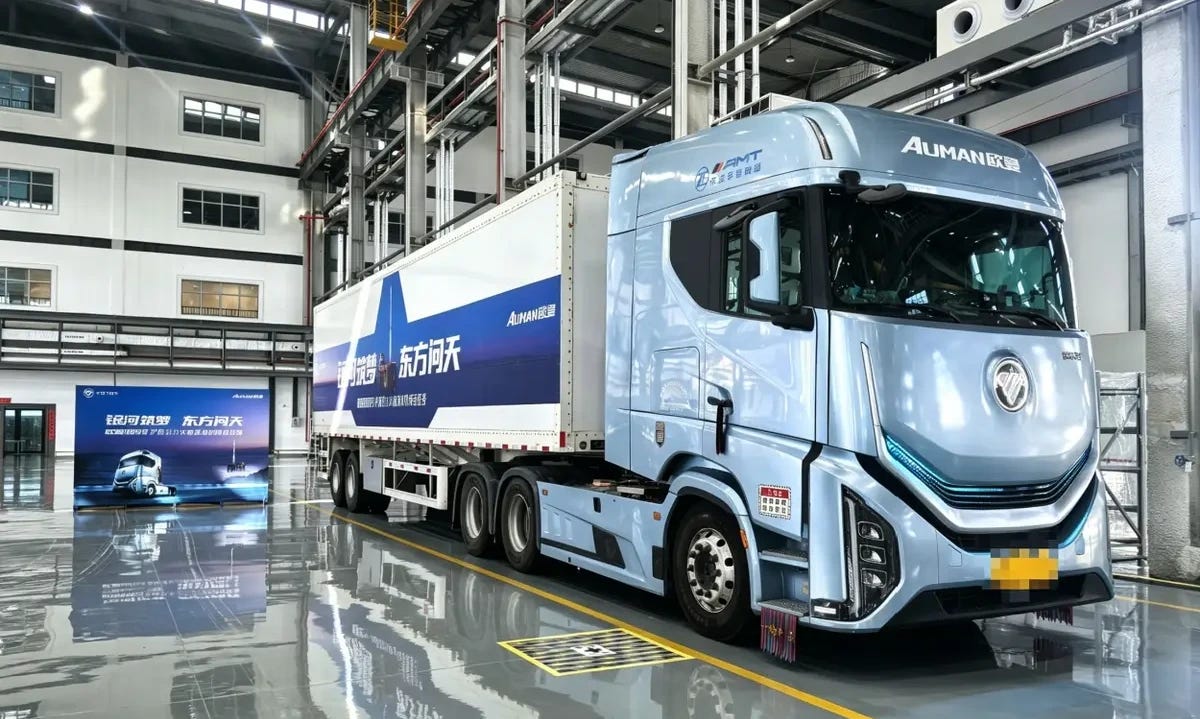
Hardware for Orienspace’s fourth Gravity-1 mission was moved to the company’s launch vehicle integration site at the Haiyang Oriental Spaceport (海阳东方航天港), according to Foton Motor (福田汽车), which manufactures various electric vehicles.
In an August 6th news release republished by various outlets, the electric vehicle maker’s Auman (欧曼) series Galaxy 9 (银河9) and Galaxy 7 (银河7) trucks were used to bring various components of the all-solid rocket motor vehicle together for a flight in the near future. Transportation has been split between the two truck types depending on what is loaded.
The seven multi-ton solid rocket motors1 were moved by Galaxy 7 trucks due to their ability to limit sideways loads within 0.1 g at a constant speed of 3 kilometers per hour (1.85 miles per hour), so as not to unsettle the solid propellant, between Orienspace’s factory, in convoy on public roads, and arriving at the spaceport. At the same time, a Galaxy 9 was used to shuttle less sensitive parts, like inter-stage and payload structures.
An interesting piece of information was added by Foton Motor at the end of their news release, with it stating:
“The transport operation is one of the most critical ground support phases prior to the launch of the ‘Gravity-1 Y32 launch vehicle’, and it directly impacts the smooth progress of Orienspace’s mission to deploy a nine-satellite low-Earth orbit internet constellation.”
If there are any problems with this translation please reach out and correct me.
Not mentioned was who those satellites were for. Orienspace has, in their typical fashion, said nothing while other firms detail how their next mission moves towards flight.
Considering China’s current space-based internet connectivity constellations in low Earth orbit, those satellites could be for expanding the 238-satellite Qianfan (千帆) or 186-spacecraft GuoWang (国网) constellations. Both of those would be able to fit nine satellites within Gravity-1’s 6,500-kilogram payload capacity, but GuoWang’s small satellite platform would be a very tight fit before factoring in a deployment structure3.
It is also possible that a different, less significant constellation is the customer for the fourth Gravity-1 mission.
While the customer remains unknown, Orienspace has informed China Central Television (中国中央电视台) that it is aiming to perform the fourth mission in this year’s third quarter (July, August, September), followed by two more hopeful missions before 2027 starts. It was previously expected, by company executives, that Gravity-1 would fly a total of three times in 2026.
If Gravity-1 manages to fly at least one more time before the end of the year, having last flown in July, it will represent an impressive acceleration of its flight cadence. Previously, the launch vehicle has spent twenty-one and nine months between flights, resulting in one launch a year since 2024.
‘Dongfang Hangtiangang (东方航天港)’, the ship used to bring Gravity-1 to a liftoff location, has recently demonstrated that it can be swapped between different launch providers’ hardware in only a few weeks.
Meanwhile on Orienspace’s financial front, the company has been reportedly raising capital throughout the year from various investors contributing unknown amounts, culminating in a ‘Pre-C’ round of hundreds of millions of Yuan (over 44.46 million United States Dollars). Additionally, the company is looking into an initial public offering on one of China’s stock exchanges.
Four power the first-stage, a single one propels the second-stage, another lone one for the third-stage, and a smaller one for inserting the fourth-stage into orbit with customer satellites.
Y3 is a serial number, like NASA had with STS during the Space Shuttle program, and serial numbers do not have to be sequential. Gravity-1 Y4 was flown in July 2026.
245 kilograms would be left for structures with GuoWang.