

Qingzhou Cargo Delivery Spacecrafts Maiden Flight Delayed to 2026
Production and systems testing are underway for the cargo spacecraft before it heads to space, and eventually to Tiangong.

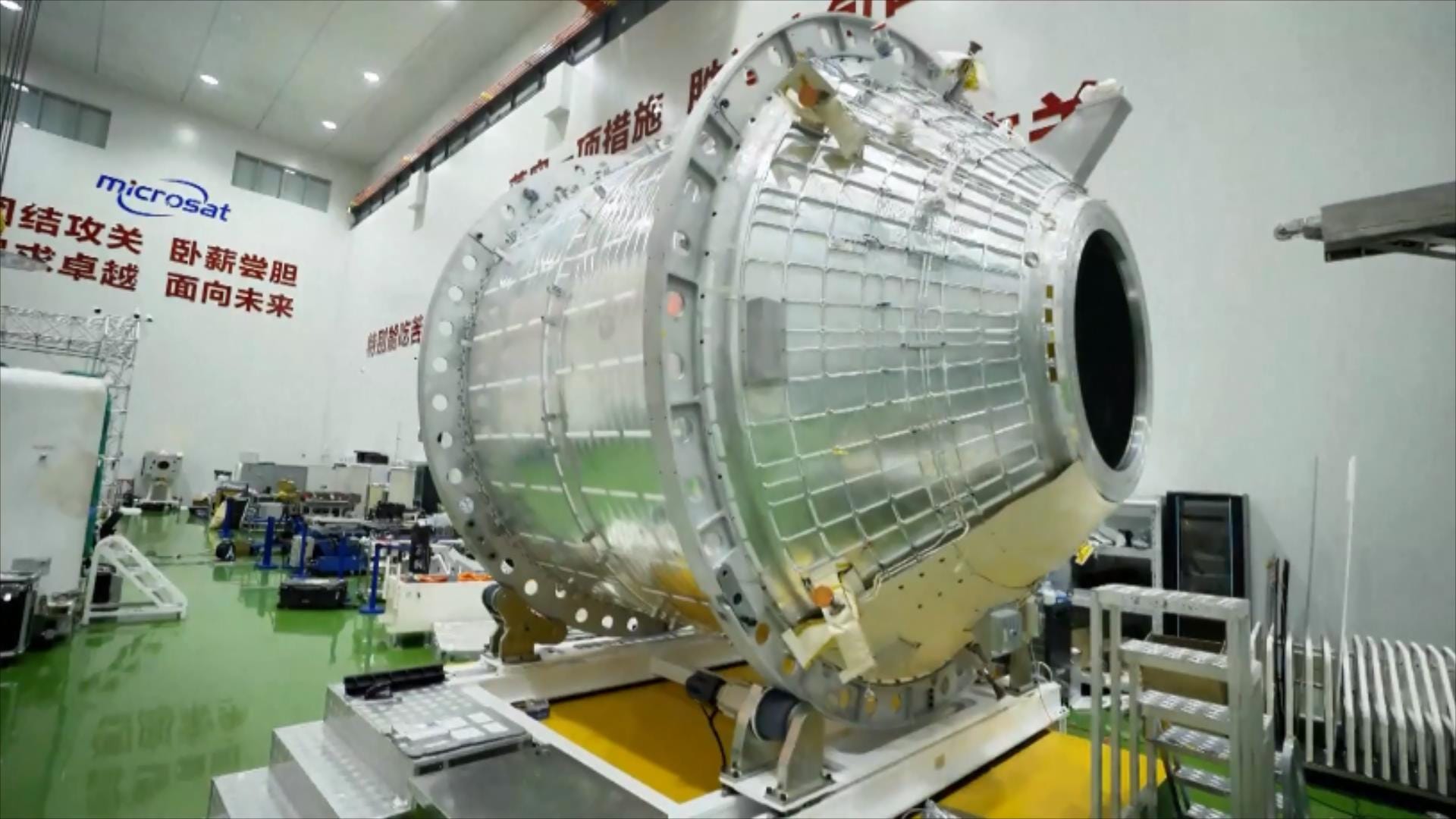
In early December, Chinese media were invited to visit the Innovation Academy for Microsatellites, Chinese Academy of Sciences (中国科学院微小卫星创新研究院) to report on progress for the Qingzhou (轻舟) cargo spacecraft, set to service the Tiangong Space Station.
According to China Central Television, the cargo spacecraft has completed a handful of necessary technical verifications, with work now shifting to overall systems testing, following launch vehicle separation tests in September. Images showed that Qingzhou’s pressure vessel, where cargo will be stored for taikonauts to access, and the service module have made good progress. In the factory, the service module has received its four propellant tanks for its storable fuel, a single engine for performing in-space burns, and necessary electrical systems.
Within the pressure vessel, four cargo storage racks are being installed to hold forty containers for various scientific experiments, crew items, and consumables (water and food). Up to 1,800 kilograms of cargo will be secured in those containers, with five 60-liter containers being climate-controlled for fresh goods and biological experiments. The available volume for cargo is 27-cubic-meters, with all of it allocated for cargo disposal (weighing as much as 2,900 kilograms) to burn up in Earth’s atmosphere at the end of a mission.
On the outside of Qingzhou, multi-layer insulative material is being installed with solar panels, around the whole spacecraft, being added on top to provide power.


Speaking to the media, Wu Huiying (吴会英), Deputy Chief Designer of Qingzhou, shared the following on the spacecraft testing progress:
“We have now conducted large-scale experiments and are currently conducting final testing, including the integration of remaining individual units and confirming status verification. The overall test results have been quite favorable.”
If there are any problems with this translation please reach out and correct me.
Six months ago in June, Qingzhou passed its design review, then its technical verification tests during the second half of the year, and now its current systems testing phase. CGTN reports that the spacecraft will begin production of several engineering units for the first few flights in early 2026. Xinhua added that a first flight is expected within 2026, a delay from a demonstration mission set for this year. Despite that, Qingzhou is still moving at a fast pace for a human spaceflight supporting spacecraft1.
Qingzhou is one of two cargo spacecraft part of the China Manned Space Agency’s program for low-cost alternative delivery solutions. The other was the Haolong (昊龙) cargo spaceplane from the Chengdu Aircraft Design and Research Institute (成都飞机设计研究所), which is under the Aviation Industry Corporation of China (中国航空工业集团公司). Targets of the program include Qingzhou and Haolong aiming for costs under 120 million Yuan (16.98 million United States Dollars, as of December 11th) per 1,000 kilograms of cargo delivered. At the moment, primary cargo delivery is performed by the Tianzhou spacecraft.
Changing flight plans
Just before the recent hardware development news, the Innovation Academy for Microsatellites announced a solicitation for launch services, on December 1st, to carry Qingzhou into orbit. Few details were shared by the Microsatellite Academy, beyond that a launch vehicle should be able to send around 5,000 kilograms into the orbit of the Tiangong Space Station with a fairing that can house a 5.3-meter-long and 3.78-meter-wide spacecraft. Potential launch timeframes were not stated.
Confusingly, CAS Space’s tri-core Kinetica-2 launch vehicle2 was selected as Qingzhou’s primary launch solution back in October 2024, slated to fly onboard and tested for the debut flight too. Compared to the development of other launch vehicles, Kinetica-2 has had a rather stable path toward flight, testing both stages with static fires this year, assembling the first vehicle, and shipping it to the launch site. A single fiscal quarter delay was announced in September for a December launch, ahead of Qingzhou’s 2026 first flight.
With Qingzhou likely now off of Kinetica-2’s debut flight, CAS Space will be finding a different payload, either a mass simulator representative of the cargo spacecraft or a customer satellite, drawing on industry confidence with Kinetica-1, to fulfill a demonstration for the Qianfan (千帆) mega-constellation.
Meanwhile, Qingzhou may be shifting its flight plans too. It was previously understood that the cargo spacecraft would fly as a ‘trimmed down’ version while free-flying in low Earth orbit for its first mission to prove its systems and various manoeuvres. Now, the first Qingzhou appears to have substantially more hardware for cargo deliveries installed, possibly indicating that its debut may head straight for Tiangong, like Northrop Grumman’s Cygnus did in 2013 with the International Space Station. That flight plan is not entirely out of the question as the Microsatellite Academy has worked on co-orbit systems for China’s human spaceflight program3 and has strong industry support via its Chinese Academy of Sciences attachment.
In 2006, NASA funded spacecraft to deliver cargo to the International Space Station via SpaceX’s Cargo Dragon and Northrop Grumman’s Cygnus. The two vehicles reached the space station in 2012 and 2013 respectively.
Capable of delivering 12,000 kilograms to low Earth orbit with its two-stage design and a tri-core first-stage, burning rocket-grade kerosene and liquid oxygen.
Alongside the BeiDou network and a joint mission with the European Space Agency.