

Reusable Rockets, Deep Space Exploration, Connectivity Constellations Discussed at 2026's Two Sessions
At the annual major political meeting in Beijing, the space sector has continued support signalled from national policy makers.

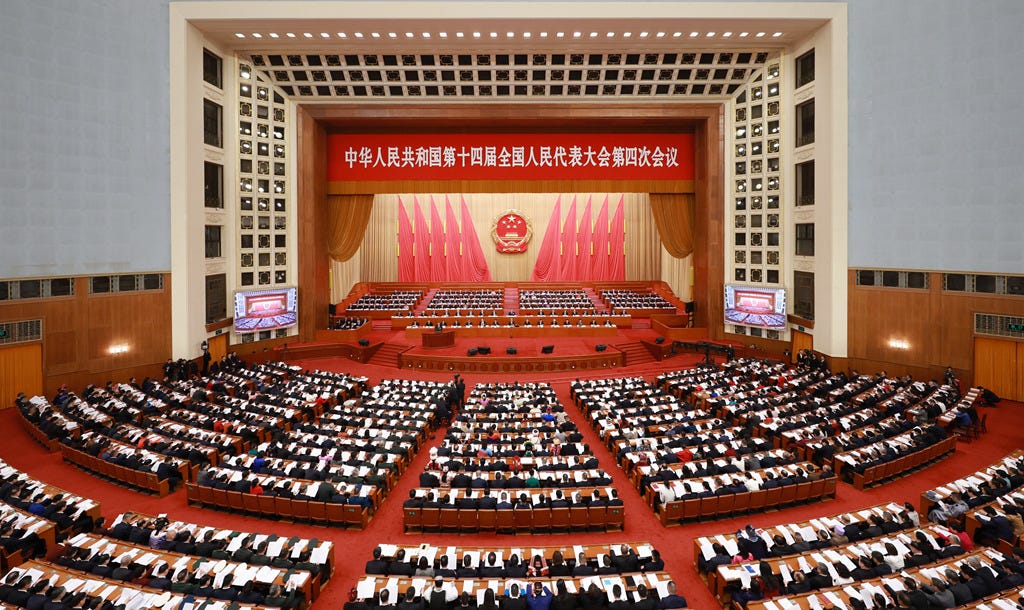
Between March 5th and 12th, the Two Sessions (两会) were held in Beijing (北京), where thousands of government members from the Chinese People’s Political Consultative Conference (中国人民政治协商会议) and representatives of the National People’s Congress (中华人民共和国全国人民代表大会) met to consider policies and plans for the next twelve months, and finalizing the 15th Five-Year Plan this year as it runs from 2026 to 2030.
Delegates attending the Two Sessions are also coming from state-owned space enterprises to represent the nation’s space sector. Those delegates suggested new exploration missions to undertake, ways to support current ones, and plans to bolster the sector.
In the annual work report, delivered by Premier Li Qiang (李强) on March 5th, space had a brief mention, likely due to Tianwen-2 asteroid sample return being the only flagship mission beginning in 2025 and the present geopolitical situation. The brief mention was in an overview of innovations, and was as follows:
“The Tianwen-2 probe embarked on an interplanetary exploration mission; large-scale application of the BeiDou Navigation Satellite System was extended across various sectors. . . . The development of satellite internet will be expedited, and an upgraded 5G Plus Industrial Internet Initiative will be introduced.”
If there are any problems with this article’s translations please reach out and correct me.
Despite the short mention, space enterprises were invigorated by it and vowed to make further breakthroughs in 2026 and during the 15th Five-Year Plan period.
Compared to the annual work report, space was deliberated on extensively at the remainder of the Two Sessions by relevant delegates, as shared below.
Major meeting news
Plans for space between 2026 and 2030
In current drafts for the to be released 15th Five-Year Plan, space and China’s space sector had many items included. Those items were:
“Advance technological breakthroughs in high-power energy systems, general-purpose spacecraft computers, lightweight rocket structures, integrated spacecraft-rocket design, and reusable launch vehicles to enhance mass production capabilities for spacecraft and rockets and boost commercial space launch capacity. Strengthen the research and application of technologies such as active space defense and swarm intelligence control to improve space security situational awareness and risk prevention capabilities.”
“Improve civil space infrastructure, coordinate the development of satellite communication, navigation, and remote sensing systems, and accelerate the deployment of low-Earth orbit satellite internet constellations. . . . Coordinate the construction of satellite internet constellations, enhance launch, tracking, and control capabilities and security protection, and accelerate the large-scale application and international promotion of satellite internet and BeiDou in key industries and mass consumer sectors. Strengthen the overall coordination of multi-user needs, promote the joint construction and data sharing of remote sensing satellites, and build a comprehensive service system integrating space, air, and ground, and combining communication, navigation, sensing, and computing.”
“Study and implement a second phase of the Planetary Exploration Program1, a Near-Earth Asteroid Defence Program2, and a Solar System Boundary Exploration Program3.4 Develop a reusable heavy-lift rocket5. Study and build an International Lunar Research Station; implement a Lunar Exploration Program6.”
The Wenchang Commercial Space Launch Site also had a passing mention, with the draft plan saying the launch site should be promoted to become a world-class commercial spaceport.
Update7: items in the draft remain effectively unchanged in the release of the full 15th-Five Year Plan.
Representatives at the Two Sessions who also work for the China Aerospace Science and Technology Corporation believe the 15th Five-Year Plan supports the space sector as a continued driver of high-quality growth.
Focus areas for the 15th Five-Year Plan
Just over a month before the Two Sessions, the China Aerospace Science and Technology Corporation shared a short overview of focus areas for the 15th Five-Year Plan period. The focus areas, and what they comprise, are:
Space Traffic Management: Advance key technologies for space debris monitoring, early warning, and removal to establish a solid foundation for China to take the initiative in formulating international space traffic management rules and ensure the safe operation of space infrastructure.
Space Resource Development: Conduct feasibility studies for the ‘Tiangong Kaiwu’ major project, establish comprehensive experimental and ground support systems for space resource development, and achieve breakthroughs in key technologies, including small celestial body resource exploration, intelligent autonomous mining, low-cost transfer and transportation, and in-orbit processing.8
Space Digital Infrastructure: Build gigawatt-scale space-based digital and intelligent infrastructure, establish a new space architecture integrating cloud, edge, and endpoint computing, achieve deep integration of computing power, storage capacity, and transport capabilities, and empower ‘space-based computing with terrestrial data’, ‘terrestrial computing with space-based data’, and ‘simultaneous space-ground computing’.9
Space Tourism: Accelerate the iteration and development of suborbital and orbital space tourism vehicle products, complete relevant unmanned or manned flight verifications, establish a sound space tourism operation system, realize the flight-based operation of suborbital space tourism, and gradually develop orbital space tourism.
Innovation to drive the future of China’s space sector
Liu Zheng (刘争), a member of the Chinese People’s Political Consultative Conference and a senior engineer at the China Aerospace Science and Technology Corporation, met the media on March 7th as part of a group interview in the Great Hall of the People (人民大会堂), where he declared:
“Twenty years ago, China could only launch five or six rockets annually. In the past year alone, we launched eighty to ninety times10. It took thirty-seven years to reach the first hundred launches since the founding of New China, while the most recent hundred launches were accomplished in just over a year.”
“In recent years, we have stepped up efforts in independent innovation and continued striving for key technological breakthroughs. Led by China Aerospace Science and Technology Corporation, we have pooled strengths from domestic universities, machine tool manufacturers, and other institutions to jointly develop new techniques and equipment.”
“We have successfully developed China's first special compound processing machine tool for rocket barrel sections, equipped with China's own numerical control system. This has doubled the efficiency and precision of rocket barrel section processing, while placing core technologies firmly in our own hands.”
“From following others to taking the lead, some of China’s space technological innovations have entered uncharted territory. With no ready path to follow, only independent innovation can secure the initiative in international competition in the new space era.”
In another interview on the same day, Yin Hejun (阴和俊), Minister of Science and Technology, detailed that China is accelerating efforts of acheive technolgical self-reliance, something almost entirely implemented in the space sector. Alongside that, he mentioned that coordination in innovation hubs11 will be strengthened to streamline technological advancements.
Qianfan constellation wants cheaper launch solutions
Shanghai Spacesail Technologies Co Ltd (上海垣信卫星科技有限公司), operator of the Qianfan (千帆) connectivity mega-constellation, sent one of its General Managers, Zhang Qi (张琦), who is also a member of the Chinese People’s Political Consultative Conference, to this year’s Two Sessions. Ahead of many meetings, Zhang Qi spoke with Shanghai Securities News (上海证券报) to detail items the mega-constellation operator is interested in.
The primary item Zhang Qi and his employer are pushing for is the development of more launch solutions that fly more frequently while being more affordable. To do that, it was stated that China should aim to accelerate the introduction of reusable launch vehicles, but it was recognised that routine flights are still some time away. As such, to continue deployment for now, it was proposed that a ‘dynamic adjustment mechanism’ for launch missions should be implemented to guarantee payload deployment into orbit.
Domestic and international competition was another item brought up, with Zhang Qi suggesting that respected Chinese firms operating globally should collaborate with constellation operators to prove their trustworthiness to other nations. He did, however, recognise that at present:
“China’s low-Earth orbit satellite internet remains in the early stages of ‘building and deploying simultaneously’. It needs to accelerate progress in establishing market presence and developing competitive advantages, while also advancing forward-looking planning in both the breadth and depth of development.”
In the 15th Five-Year Plan period, the government has signaled support for China-made connectivity mega-constellations, without detailing what support entailed. Zhang Qi said that the support should come in the form of assistance to reduce component supply chain costs and ways to improve operators’ financial stability as they deploy hundreds to thousands of satellites.
While speaking with Shanghai Securities News, Zhang Qi also confirmed that Shanghai Spacesail Technologies is aiming to have the Qianfan constellation providing global services before the year’s end, as he shared:
“China’s Qianfan constellation has launched 108 network satellites to date and has preliminarily established a ground-based measurement, operation, and control network. It is expected to achieve initial global coverage within the year.”
In reports about Qianfan’s approval for Brazil, it was learned that services should begin in the South American nation and China in the fourth quarter of the year (October, November, December).
Tianwen-3 Mars sample return mission to enter full development
Liu Jizhong (刘继忠), Chief Designer of the Tianwen-3 Mars sample return mission and representative to the National People’s Congress, spoke with Xinhua on March 12th, the last day of the Two Sessions, where he detailed that the mission has progressed smoothly through its prototype development stage and will enter full development soon.
Development progress so far has focused on surface sample collection and storage, launching in Martian gravity, and sample storage transfer in orbit. Meeting planetary protection standards was said to be a key part of the prototype phase of development for the Mars lander-ascent vehicle combination and the Mars orbiter-Earth return spacecraft. Speaking on the missions development, the Chief Designer shared:
“The Tianwen-3 mission is an exceptionally challenging, innovative, and pioneering major space project. It is poised to achieve humanity’s first Mars sample return, significantly advancing the high-quality integrated development of space science, technology, and applications, while fully demonstrating the creativity and international influence of the Chinese nation."
At present, the Tianwen-3 mission is set to begin in 2028 with two launches via the Long March 5. After sample collection and a launch from Mars, Martian rocks should return to Earth around 2031. Those samples are hoped to help understand if life was once present on Mars, the planet’s internal structure, and what’s left of the Martian atmospheric process.
As of January, China is the only country planning a Mars sample return mission, with Liu Jizhong inviting international scientists and partners to collaborate on the mission:
“We also warmly invite scientists from around the world to join us in conducting research, continuously advancing deep space exploration technology and engineering practices.”
Experts push for Neptune orbiter
China Space News (中国航天报) reported on the opening day of the Two Sessions that Wang Wei (王巍), a representative to the National People’s Congress and an academician at the Chinese Academy of Sciences, is proposing accelerating plans to send an orbiting science mission out to Neptune. In accelerating plans, Wang Wei hopes that a gap in planetary science can be filled, citing that other nations don’t plan to orbit the icy planet until the 2050s.
As for how the acceleration of a Neptune orbiter should be implemented, Wang Wei suggested:
Incorporate the Neptune orbiting mission as a priority major task into relevant national science and technology plans.
Initiate scientific research and key technology development for planetary exploration missions at the earliest opportunity.
Strengthen international cooperation with a focus on self-reliance, build international cooperation platforms, and expand China's international influence.
Establish a long-term multidisciplinary exchange mechanism to promote the development of China's team of scientists and engineers in the field of planetary science.
In current Chinese papers about an orbiting Neptune mission, it has been put forward that a potential spacecraft should use two nuclear-decay radioisotope thermoelectric generators to power a 3,100 kilogram that would be launched in 2033 on a direct path to the planet, arriving after about fifteen years. Instruments onboard the spacecraft would be an array of spectrometers, various cameras, particle detectors, and magnetometers to inspect the planet, its rings, and moons, possibly including a flyby of Triton.
Some brief news
Yang Liwei (杨利伟), the first Chinese person to be sent into space and Deputy Chief Designer at the China Manned Space Agency, revealed that the two taikonauts from the Hong Kong (香港) and Macao (澳门) Special Administrative Regions, one each, were the only ones selected, with no plans at present to recruit more. One of those taikonauts should fly this year. He also stated that taikonauts selected for lunar missions will have previously flown to the Tiangong Space Station.
Rong Yi (容易), an Expert Rocket Designer leading development of the Long March 10A while serving as the Long March 2F’s Chief Designer and member of the Chinese People’s Political Consultative Conference, proclaimed that China is close to obtaining operational reusable launch vehicles, while the China Aerospace Science and Technology Corporation will have at least two that were pursued through different development paths12.
Jiang Jie (姜杰), Senior Researcher at the China Academy of Launch Vehicle Technology and representative to the National People's Congress, told the media that China is going all out to accelerate breakthroughs for reusable launch vehicles, with the first recovery of a Long March 10 series first-stage13 being set for this year. She also detailed:
“[We are] actively advancing the research and development of two models of reusable rockets with different technical characteristics. The major difference between them lies in the recovery methods: one of them adopts ground-based recovery, and that means its first-stage booster will make a vertical landing on a designated site and then stand on its landing legs; the other uses sea-based net-assisted recovery, meaning the first-stage booster will be captured by a special net on the recovery ship14. Having and operating reusable rockets will not only substantially strengthen China’s capability and efficiency in reaching orbit, but will also serve to verify sophisticated technologies and accumulate engineering experience for the development of next-generation heavy-lift vehicles.”
Wang Yaping (王亚平), taikonaut of the Shenzhou-10 and Shenzhou-13 missions, shared that the Astronaut Center of China (中国航天员中心) is looking into solving the problem regarding long-term survival on other celestial bodies and planets. That will cover the Moon, for the International Lunar Research Station, and eventually Mars.
In a report about government support for the space sector in the 15th Five-Year Plan, ADA Space’s Wang Jian (王坚) detailed that the Three-Body Computing Constellation will have 50 computing satellites launched this year, with plans to deploy a total of 1,000 by 2032. For at least the past month, a second and third group of satellites have been undergoing pre-launch preparations.
While the Two Sessions were happening, on the sidelines, the Shanghai Academy of Spaceflight Technology has agreed to deepen cooperation with China Great Wall Industry Corporation, to better internationalize the former’s products. Products included will be satellites and their space systems, as well as launch solutions15.
The China Aerospace Science and Technology Corporation had several delegates at the Two Sessions. Listed below are items16 they were pushing for, as highlighted by the corporation.
National People’s Congress representatives.
Xu Liping (徐立平) proposed strengthening integrated policies for attracting, developing, and deploying digital and intelligent talent to build a solid digital foundation for China’s space ambitions.
Li Lin (李林) suggested improving foundational components and materials supply for commercial space development, with three directions: expanding markets, strengthening coordination, and optimizing supply chains to build a modernized industry ecosystem; establishing standards and systems to support increased production; and improving efficiency, accelerating iteration, and reducing costs to create a low-cost, high-efficiency, sustainable commercial space industrialization mechanism.
Wang Lin (王林) proposed improving the quality of publicity and recognition work for model workers and craftspeople, aiming to strengthen the sense of honor and pride among worker groups, having supported apprentices in career growth.
Hou Jingbin (侯景滨) suggested that national ministries take the lead in systematically organizing national-level new materials innovation consortiums to combine industry leaders with diverse stakeholders, citing a disconnect between innovation chains and industrial chains, poor linkage between education, science, and talent pipelines, and the underutilized potential of enterprises as innovators.
Chinese People’s Political Consultative Conference members.
Rong Yi also proposed the construction of a China Space Museum, arguing it should serve not only as a landmark showcasing China's space achievements, but additionally as a core venue for immersive patriotic education and for promoting the spirit of space, with plans to submit more forward-looking and actionable proposals this year to help build the museum into a spiritual landmark that inspires national pride and nurtures innovative talent.
Liu Zheng (刘争) suggests forming a collaborative talent cultivation mechanism guided by industry, led by enterprises, and supported by schools, having identified a talent gap in intelligent manufacturing, noting a clear mismatch between talent supply and industry demand.
Zhao Xiaojin (赵小津) proposed that the government should coordinate space-based data centers at the national level to advance infrastructure construction, key technology breakthroughs, and relevant innovations, envisioning that space-based data centers could become a strategic pillar supporting both the development of China as a space power, Digital China, and providing core support for the digital economy.
Wang Runfu (王润福) suggested that space-based nuclear energy and nuclear propulsion are key items of new productive forces in space, calling for accelerated technology breakthroughs.
Effectively saying that the Tianwen-3 Mars sample return mission and the Tianwen-4 Jupiter and Callisto orbiting mission will be started within the 15th Five-Year Plan period.
This is formalizing a previously announced planetary defense mission and wider initiative.
Meaning exploration of the solar system’s heliosphere. Depending on how this is pursued, that may be via an interstellar probe.
These items excited the Deep Space Exploration Laboratory (深空探测实验室).
The Long March 9.
Continuing the current robotic exploration of the Moon via Chang’e missions, and starting crewed exploration with taikonauts via the Mengzhou capsule and Lanyue lunar lander.
As of March 15th 2026.
This is about mining and processing minerals in space, likely originating from captured asteroids.
This is about space-based data centers and orbiting compute.
In 2025, China attempted to launch 93 times, with three failures occurring.
Those are in:
The Beijing (北京) Tianjin (天津) Hebei (河北) region, or Jing-Jin-Ji (京津冀城市群).
The Yangtze River Delta (长江三角洲), or the region surrounding Shanghai (上海市).
The Guangdong (广东) Hong Kong (香港) Macao (澳门) Greater Bay Area (粤港澳大湾区).
As in one dictated by the China Academy of Launch Vehicle Technology and the other by the Shanghai Academy of Spaceflight Technology, both subsidiaries of the China Aerospace Science and Technology Corporation.
That of the Long March 10B as soon as April.
That would be the autonomous Long March 10 series booster catching ship ‘Linghangzhe (领航者)’.
Via the Long March 2D, Long March 4B, Long March 4C, Long March 6, Long March 6A, Long March 6C, Long March 12, and Long March 12A.
Limited to the ones just relevant to space.