

Shenzhou-21 Trio Conduct Emergency Drills, Support Battery and Brain Research
Tiangong TV: January 11th 2026.

Another week has passed in orbit onboard the Tiangong Space Station, with Shenzhou-21’s Zhang Lu (张陆)1, Wu Fei (武飞)2, and Zhang Hongzhang (张洪章)3 supporting more experiments onboard and participating in drills. In a new episode of ‘Tiangong TV’, released after a collection of views looking down on Earth a few days before, the activities the crew performed were shared.
Attached below is a translated transcript of the episode:
The Shenzhou-21 crew celebrated New Year’s Day aboard the Tiangong space station. Their space schedule remains busy and fulfilling in the new year. Let’s take a look at their daily life aboard Tiangong.
Last week, the rendezvous and docking training exercises proceeded as scheduled. The Taikonauts conducted operational skill training for velocity control and attitude control using the translational joystick and attitude control joystick.
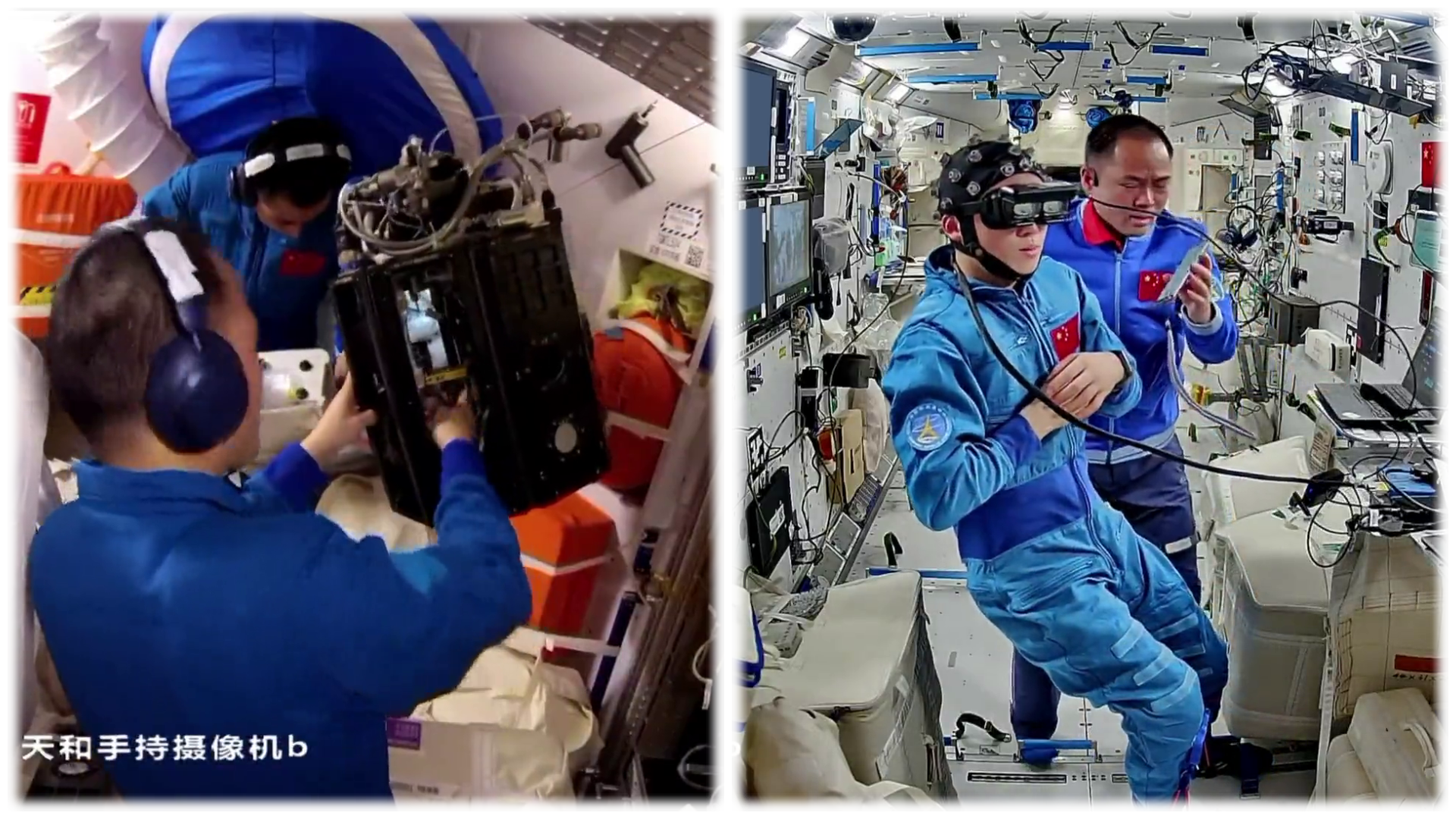
The crew completed medical rescue training in simulated hazardous conditions onboard Tiangong. While becoming familiar with the rescue operation methods and force characteristics in critical gravity environments, they further familiarized themselves with the location of equipment, reviewed usage methods, and consolidated their operating procedures and skills. Additionally, the crew completed emergency evacuation drills under simulated space station fire conditions.
In the field of space medicine experiments, the crew conducted related studies using brain-computer interface equipment. In the footage, taikonauts wearing glasses completed multiple experiments, including brain-face coordination tasks. This research aims to explore the characteristic patterns and trends of taikonauts' brain-controlled signals under weightless conditions. Simultaneously, studies were conducted on critical gravity perception, physical force perception, and spatial memory and regulation.
In the field of space materials science, in-situ research on the electrochemical and optical properties of quantum dot batteries4 is progressing smoothly. The related findings are expected to provide crucial theoretical support for the development and highly reliable application of quantum dot batteries in future space missions.
According to the experimental plan, the crew completed the replacement of the burner in the combustion science experimental cabinet, the disassembly and assembly of the experimental modules in the fluid physics experimental cabinet, as well as the cleaning of the sample body of the containerless experimental gun5, the replacement of the experimental samples, motor mechanism maintenance, and cleaning of window cover lenses in the containerless cabinet. In addition, ongoing activities include space station inspections, maintenance of life support system equipment, and inventory management tasks.
The technologically advanced space home will continue to record more stories of Chinese people exploring space. Stay tuned!
If there are any problems with this translation please reach out and correct me.
Tiangong supported several dozen experiments in 2025
On January 8th, the China Manned Space Agency released its 2025 edition of the ‘Progress Report on Scientific Research and Applications of China’s Space Station’ (中国空间站科学研究与应用进展报告), along with a short accompanying summary.
According to the agency, during 2025 eight-six experiments and projects were completed onboard Tiangong, with 1,179 kilograms of materials being sent up, 105 kilograms being returned to Earth, as well as one hundred and fifty terabits of scientific data being relayed down to researchers on Earth. Through that, it was said that over two hundred and thirty research papers were supported, along with seventy new patents for new innovations filed, thanks to the work of the current Shenzhou-21 crew, Shenzhou-20’s Chen Dong (陈冬), Chen Zhongrui (陈中瑞), and Wang Jie (王杰), as well as Shenzhou-19’s Cai Xuzhe (蔡旭哲), Song Lingdong (宋令东), and Wang Haoze (王浩泽).
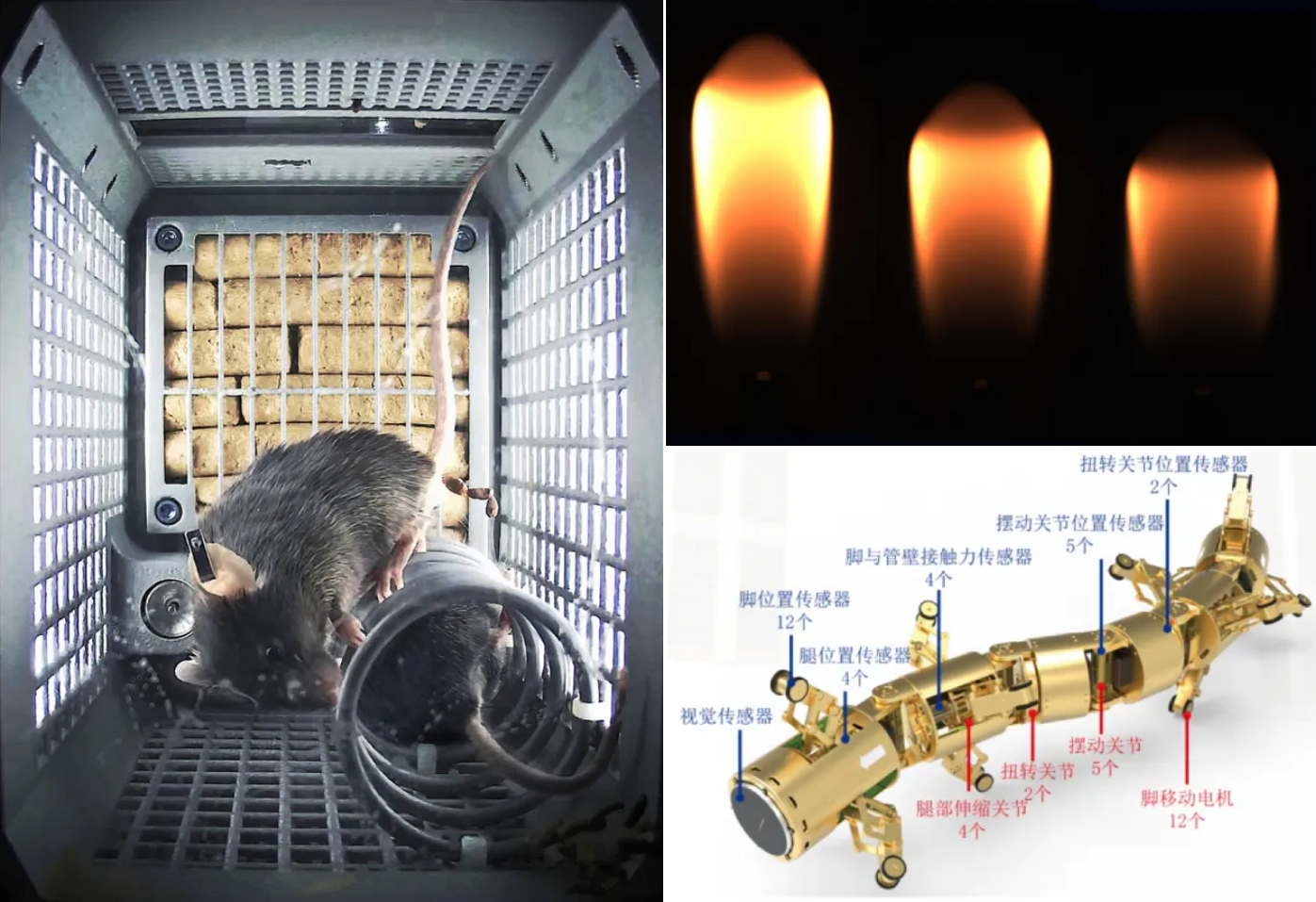
Experiments and innovations highlighted by the China Manned Space Agency were a two-week trip of four mice, tests of a microgravity pipeline inspection robot, the exposure of microorganisms from Earth’s extreme environments to space, the effects microgravity has on eyesight and related neural processes, microgravity’s effects on human fine motor skills, stresses and growth of the brain in microgravity, tests to produce iron-based superconducturs in-space, how methane flams combust and produce soot in microgravity, multiple process to grow plants in-space, and various breakthroughs for producing medicines in microgravity, alongside many more.
It was also noted that Tiangong has so far supported two-hundred and sixty-seven science experiments and technology application projects, as of December 2025, with many more set to be carried out while the station remains in orbit.
Tiangong TV Episode January 11th 2026 originally from the China Manned Space Agency, cloned to YouTube for archival.

Zhang Lu is the Commander and Pilot of the mission for his second spaceflight, having flown for the Shenzhou-15 mission between November 2022 and June 2023. He is from Hanshou County (汉寿县), Hunan (湖南) province, and was selected as part of China’s second taikonaut group in 2010, also being considered a ‘post-70s’ taikonaut having been born in November 1976.
Before becoming a taikonaut, Zhang served in the People’s Liberation Army Air Force and achieved the rank of Senior Colonel. He also joined the Communist Party of China in April 1999. After the Shenzhou-15 mission, Zhang was awarded the Spaceflight Merit Medal (Third Class) along with the honorary title of hero taikonaut.
Wu Fei is the Flight Engineer for this mission, which will be his first trip into space. He is from Baotou (包头市 / ᠪᠤᠭᠤᠲᠤᠬᠣᠲᠠ), in the Inner Mongolia Autonomous Region (内蒙古自治区 / ᠥᠪᠥᠷ ᠮᠣᠩᠭᠣᠯ ᠤᠨ ᠤᠨᠥᠪᠡᠷᠲᠡᠭᠨ ᠵᠠᠰᠠᠬᠤ ᠣᠷᠣᠨ), and was selected as part of the third taikonaut group in October 2020, while being considered a ‘post-90s’ taikonaut having been born in 1993.
Before his selection as a taikonaut, Wu was an engineer at the China Aerospace Science and Technology Corporation. He also joined the Communist Party of China in 2015.
Zhang Hongzhang is the Payload Expert for this mission, with it being his first trip to space. He is from Binzhou (滨州市), Shandong (山东) province, and was also selected as part of the third taikonaut group in October 2020, while being considered a ‘post-80s’ taikonaut having been born in 1986.
Prior to being selected as a taikonaut, Zhang was a researcher at the Dalian Institute of Chemical Physics, Chinese Academy of Sciences (中国科学院大连化学物理研究所), where he explored new materials and technology for batteries. He also joined the Communist Party of China in 2004.
For those who this is a new technology, here are two related papers about it.
Not a firearm. Details on the experiment rack are available here.