

Shenzhou-23 Mission Passes Two-Month Mark Aboard Orbiting Lab
Tiangong TV: July 26th 2026.

As of this week, Shenzhou-23’s Zhu Yangzhu (朱杨柱)1, Li Jiaying (黎家盈)2, and Zhang Zhiyuan (张志远)3 have been on board the Tiangong Space Station for over two months, having departed from Earth on May 24th. This week's activities, like most, have had the three taikonauts participating in and supporting various experiments, while maintaining the orbiting laboratory, as detailed in a new episode of ‘Tiangong TV’.
Attached below is a translated transcript of the newest episode:
The Shenzhou-23 crew has been in orbit for sixty days, and all scientific experiments aboard the space station are progressing smoothly. Let’s take a look at what the three taikonauts did last week.
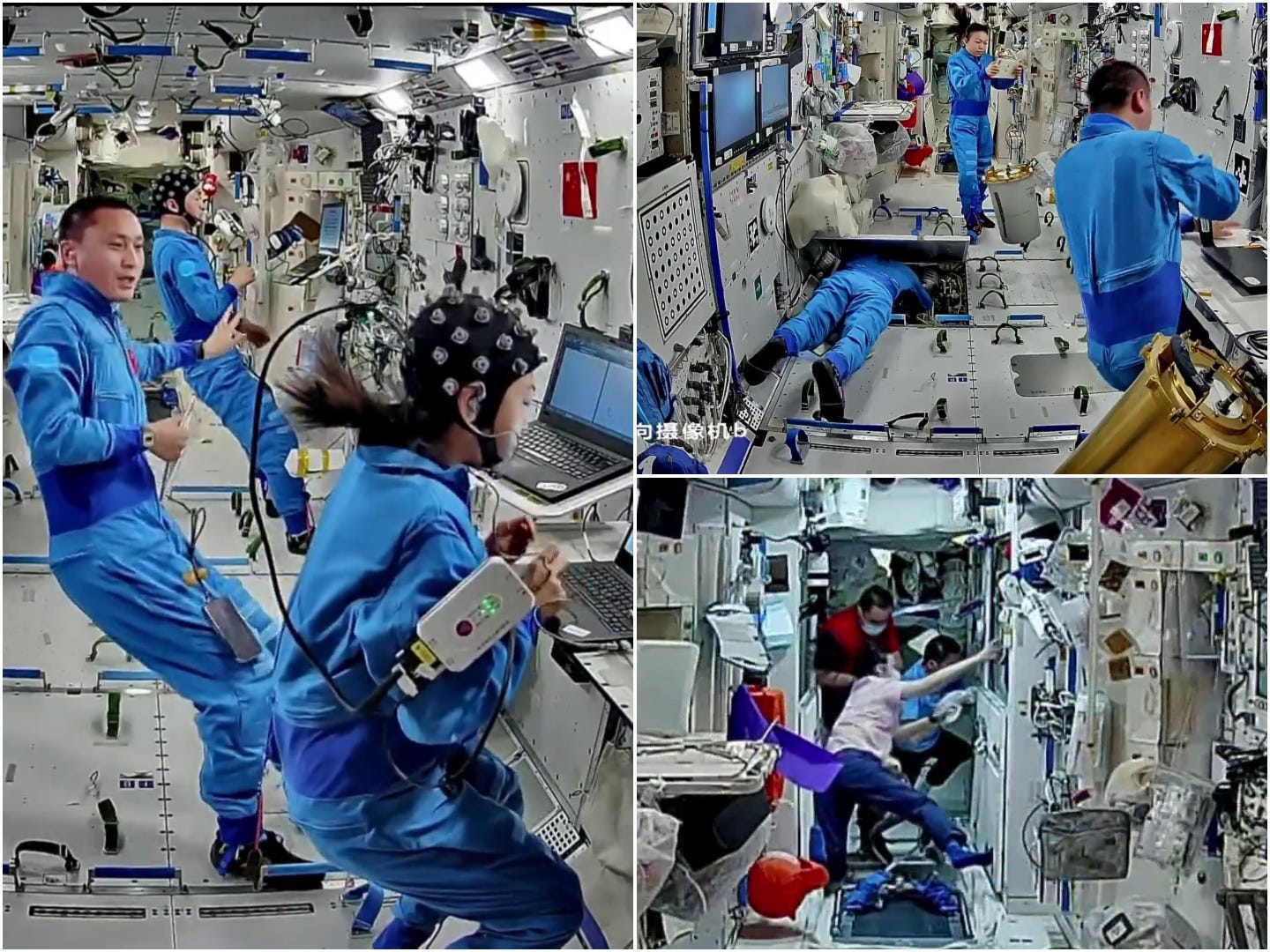
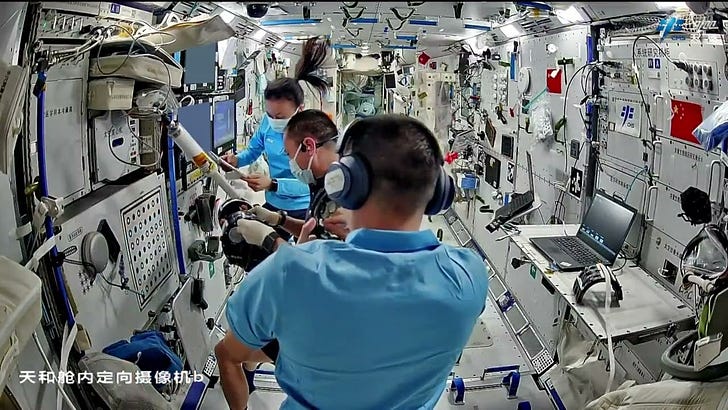
The Shenzhou-23 crew utilized a space-based Raman spectrometer to conduct experiments on the relationship between gut microbiota and nutritional metabolism. By analyzing metabolic components in urine samples, they investigated changes in gut microbiota during long-duration spaceflight and the resulting impact on nutritional metabolism. In the footage, the taikonauts are using relevant equipment and experimental software to conduct precision-control tests, with the collected data intended for studying the patterns of change in fine motor control and the mechanisms of adaptive learning among taikonauts during long-duration orbital flight.
Using electroencephalography measurement equipment, the crew conducted several in-orbit electroencephalography tests, including brain-computer interface evaluations driven by brain network mapping. The test results will help to characterize the physiological mechanisms underlying changes in taikonauts’ cognitive performance during long-duration spaceflight.
In the field of space microgravity physical science, and in accordance with the experimental schedule, the crew replaced the internal burner of the gas experiment insert within the combustion science experiment cabinet and swapped out the experimental samples in the in-orbit maintenance device control cabinet. They also completed tasks such as clearing samples from the combustion cabinet's experiment chamber, maintaining the axial mechanism motor, and cleaned and replaced the window cover lenses.
Last week, on-orbit training for rendezvous and docking was conducted as planned. Using the on-orbit cognitive training system, the taikonauts completed exercises such as image recognition under varying visual conditions.
As part of their maintenance duties on board the space station complex, the crew inspected and maintained the equipment of the regenerative life support system, replaced some components, installed, adjusted, and maintained the partition door in the core module’s sleeping area4, and tidied up the interior of the module.
In terms of health management, the crew completed routine medical examinations and daily cardiac function tests, continued to conduct in-orbit health monitoring using a traditional Chinese medicine diagnostic instrument, and maintained a regular exercise regimen while using equipment such as a bone loss countermeasure device5 to actively counteract the physiological effects of microgravity.
As the busy on-orbit schedule continues, what tasks remain on the Shenzhou-23 crew's to-do list? Tune in next week.
If there are any problems with this translation please reach out and correct me.
Tiangong TV Episode July 26th 2026 produced by the China Manned Space Agency, cloned to YouTube for viewing on the Western internet and archival.
Commander of the mission for his second spaceflight, having flown as part of the Shenzhou-16 mission, for 153 days from May 30th 2023 to October 31st 2023. Born in September 1986, he is from Peixian (沛县), in Jiangsu (江苏) province, and was selected as part of China’s third taikonaut group in 2020.
Before becoming a taikonaut, he worked as an Associate Professor of aerospace engineering within the People’s Liberation Army, where he achieved the rank of Colonel. Since December 2006, Zhu Yangzhu has been a member of the Communist Party of China. He has been awarded the title of ‘Heroic Astronaut’ too.
Mission Specialist for the mission, she is flying for the first time following selection as a fourth batch taikonaut in 2024. Born in November 1982, she is from the Hong Kong (香港) Special Administrative Region.
Prior to being selected, she was a Chief Inspector of the Hong Kong Police Force, reaching the rank of Superintendent, and holds a PhD in computational and information science-related subjects.
Spacecraft Pilot of the mission, he is in space for the first time after being selected as part of the third group in 2020. Born in June 1986, he is from Gansu (甘肃) province.
Before being selected as a taikoanut as part of the third group, he served in the People’s Liberation Army Air Force as a pilot, where he achieved the rank of Colonel. He has been a member of the Communist Party of China since 2011.
That door is for one of the sleeping bunks, providing some privacy between crewmates.
Two elasticized strings attached at the middle of a taikonaut’s shin that wrap under the middle of their feet. Those devices are part of their blue suits.