

Shenzhou-23 Mission Past One Month Mark, Taikonauts Remain Productive
Tiangong TV: June 28th 2026.

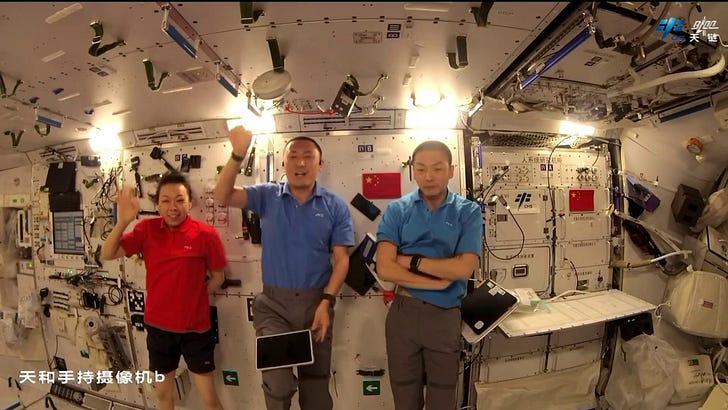
Having blasted off from Earth back on May 24th, Shenzhou-23’s Zhu Yangzhu (朱杨柱)1, Li Jiaying (黎家盈)2, and Zhang Zhiyuan (张志远)3 have spent over a month in space together onboard the Tiangong Space Station as of this week. It is also Zhu’s sixth month in orbit of his career. During this latest week onboard, the three taikonauts have continued to support experiments while installing new ones, and reactivating a robotic assistant, as shared in this week’s ‘Tiangong TV’.
Attached below is a translated transcript of the newest episode:
Time flies! It has already been a full month since the Shenzhou-23 crew’s mission began. While steadily advancing various space science experiments, the crew has also unlocked many new experiences during their time in space. Let’s take a look.
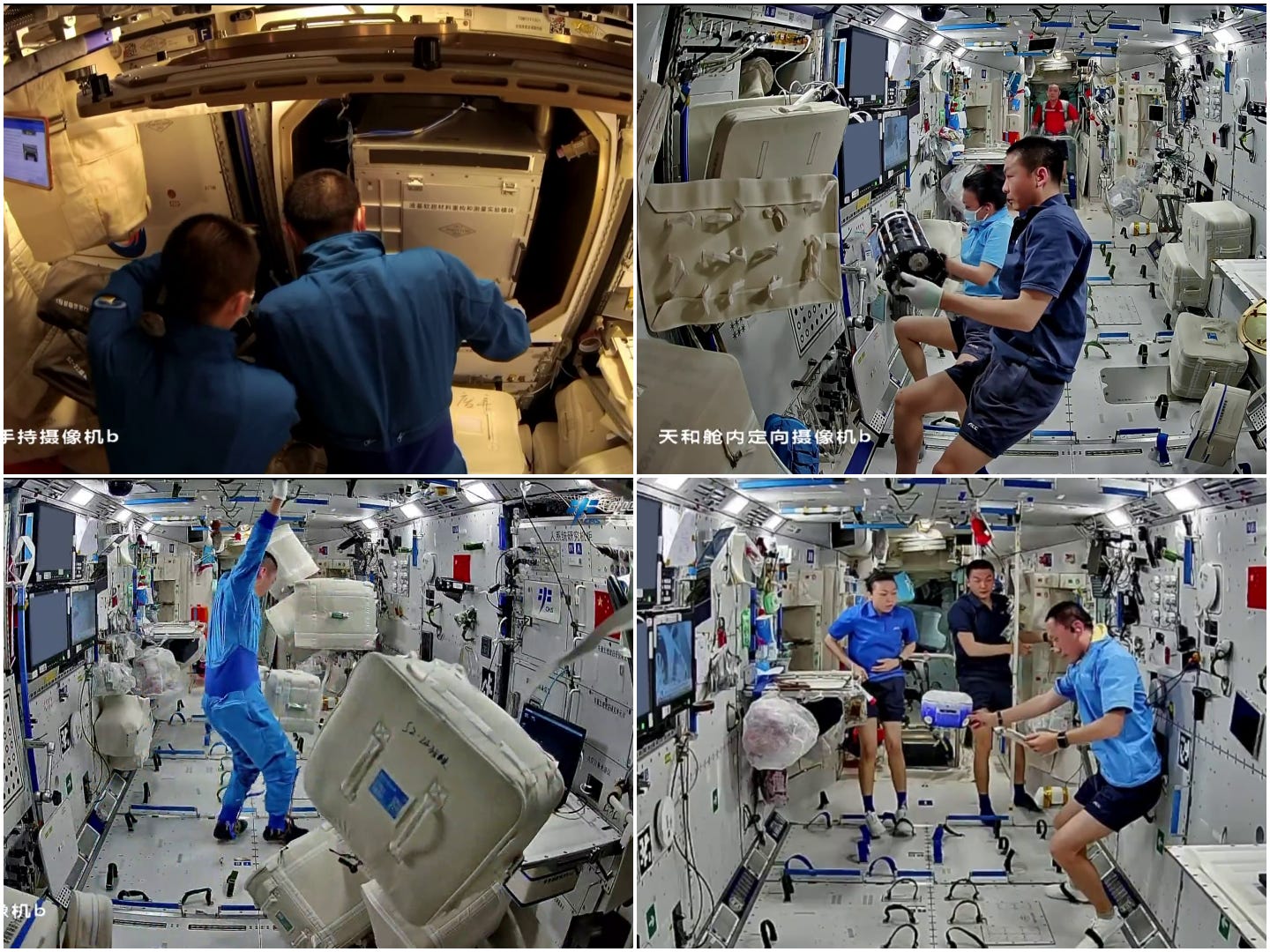
In the field of space medicine, the crew utilized ultrasound diagnostic equipment to collaboratively perform ultrasound examinations on areas such as the neck, limbs, and abdomen. The resulting data may be used to conduct research on various projects, including blood flow dynamics, blood flow physics, spatiotemporal evolution of blood flow, and the remodeling of sensitive organ systems.
Since October 2024, the robot Xiao Hang (小航)4 has interacted with taikonauts, recently conducting touch-based interaction tests and collecting data to optimize future motion planning methods for space station robots. After greater than a year on orbit, Xiao Hang’s social circle has expanded to include four Shenzhou crews.
Experiments related to in-orbit electroencephalogram testing are proceeding smoothly. The three taikonauts are using electroencephalogram data acquisition equipment to conduct various experimental tests, including those on visual-motor processing and behavioral responses to lighting conditions. Ground-based researchers will utilize the downlinked data for subsequent analysis. Additionally, static near-infrared brain imaging equipment is being employed to conduct experiments on the characteristics of brain networks in space. By collecting relevant data, researchers aim to study the impact of long-duration spaceflight on taikonauts' functional brain networks, as well as the mechanisms of spontaneous adjustment and adaptation by the brain in response to changes in the external environment.
In the field of microgravity physical science, the crew completed the installation of the liquid-based soft metamaterial reconstruction and measurement experimental module within the in-orbit maintenance and assembly cabinet. This experiment was transported to the space station via the Tianzhou-10 cargo spacecraft, and it is expected to yield breakthroughs in the study of soft matter and complex fluids.
The crew also installed the Bénard-Marangoni convection5 experimental unit in the fluid physics cabinet. This project is designed to provide scientific and theoretical support for understanding the formation of complex patterns in space materials and geophysical phenomena. In addition, they replaced experimental samples and performed tasks such as cleaning and replacing samples in the containerless cabinet’s experimental chamber, maintaining the reconfigurable electrodes, and cleaning the viewing window covers and lenses.
In terms of health management, the taikonauts used health monitoring systems to collect relevant data, providing a basis for researchers to conduct long-term in-orbit health monitoring of the crew. They also used relevant instruments to combat muscle atrophy and actively carried out various in-orbit rehabilitation exercises. Furthermore, the crew conducted tasks such as organizing supplies.
With over a month spent in orbit, the work and life of the Shenzhou-23 crew has been fulfilling and exciting, and the future holds great promise. See you next week!
If there are any problems with this translation please reach out and correct me.
Tiangong TV Episode June 28th 2026 produced by the China Manned Space Agency, cloned to YouTube for viewing on the Western internet and archival.
Commander of the mission for his second spaceflight, having flown as part of the Shenzhou-16 mission, for 153 days from May 30th 2023 to October 31st 2023. Born in September 1986, he is from Peixian (沛县), in Jiangsu (江苏) province, and was selected as part of China’s third taikonaut group in 2020.
Before becoming a taikonaut, he worked as an Associate Professor of aerospace engineering within the People’s Liberation Army, where he achieved the rank of Colonel. Since December 2006, Zhu Yangzhu has been a member of the Communist Party of China. He has been awarded the title of ‘Heroic Astronaut’ too.
Mission Specialist for the mission, she is flying for the first time following selection as a fourth batch taikonaut in 2024. Born in November 1982, she is from the Hong Kong (香港) Special Administrative Region.
Prior to being selected, she was a Chief Inspector of the Hong Kong Police Force, reaching the rank of Superintendent, and holds a PhD in computational and information science-related subjects.
Spacecraft Pilot of the mission, he is in space for the first time after being selected as part of the third group in 2020. Born in June 1986, he is from Gansu (甘肃) province.
Before being selected as a taikoanut as part of the third group, he served in the People’s Liberation Army Air Force as a pilot, where he achieved the rank of Colonel. He has been a member of the Communist Party of China since 2011.
First online during the Shenzhou-19 mission and previously mentioned in mid-February with the Shenzhou-21 crew.
Thanks Jack! Always appreciate the translation.
At the very beginning of the video, what are they cooking?