

Shijian Spacecraft Lost Due to Rare Long March Launch Failure [Long March 3B/E]
The Long March 3B/E's first outing of the year has fallen short of reaching orbit with a technology testing spacecraft.

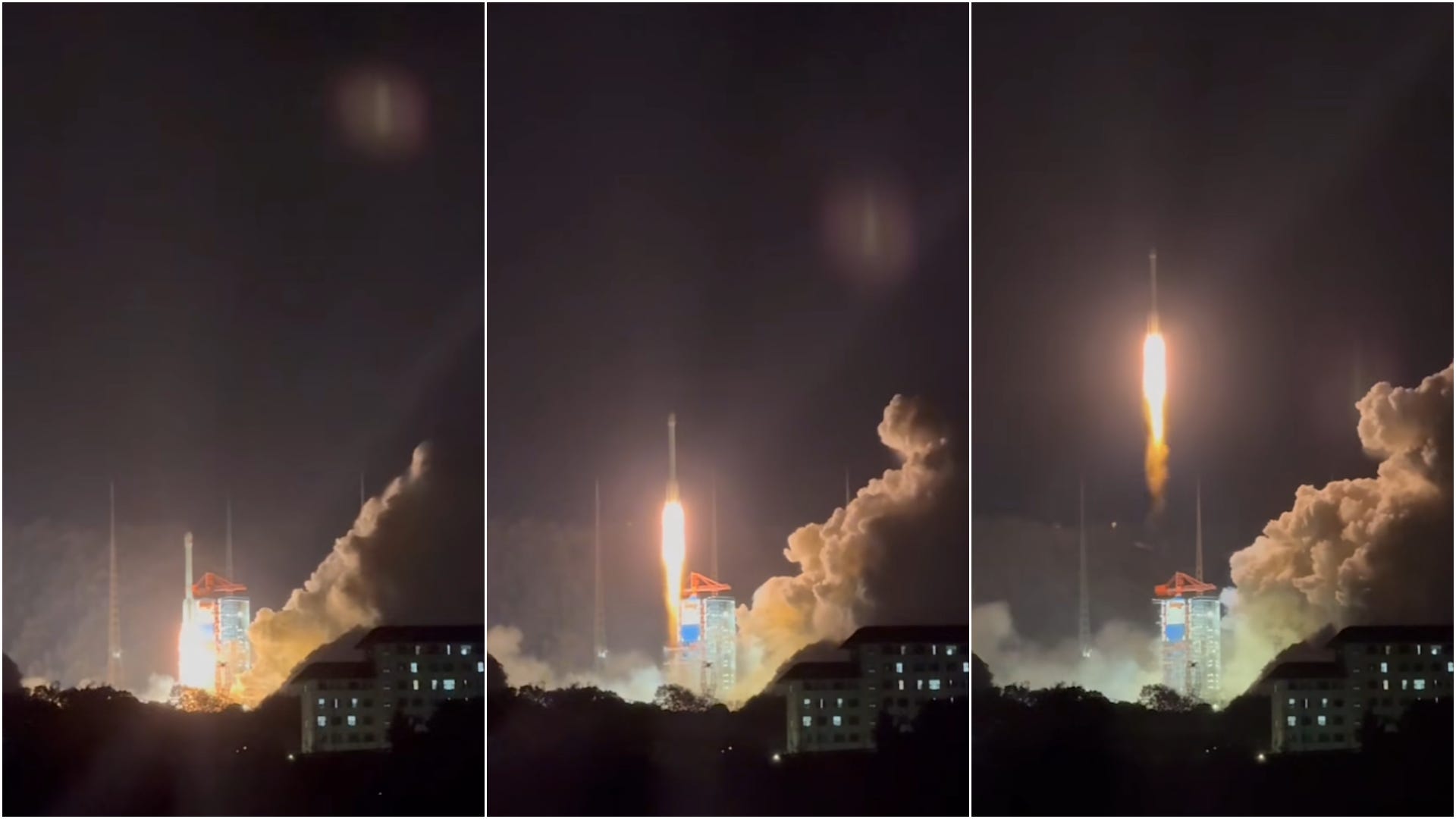
On January 17th at 00:55 am China Standard Time (January 16th at 16:55 pm Universal Coordinated Time), a Long March 3B/E lifted off from Launch Complex 3 at the Xichang Satellite Launch Center.
For today’s flight, the launch vehicle was carrying the Shijian-32 (实践三十二号卫星) technology testing spacecraft. Shijian (实践) designated spacecraft are flown to figure out best operational practices for new technologies, with the name literally translating to Practice in English.
Sadly, during the launch, likely towards geostationary space based on hazard notices, the Long March 3B/E failed during one of its planned burns and fell back towards Earth. Details provided several hours after liftoff briefly stated:
“The rocket flew abnormally and the launch mission failed. The specific reasons are being further analyzed and investigated.”
The China Aerospace Science and Technology Corporation (中国航天科技集团有限公司) shared the following a few hours after failure confirmation:
“The first and second stages of the rocket performed normally, but an anomaly occurred during the third-stage flight segment, resulting in the mission failure. The specific cause is currently under further analysis and investigation.”
Based on footage of the vehicle’s ascent, as well as a lack of reports of related debris outside of established and evacuated zones, today’s failure resulted in the stage and satellite probably falling somewhere into the Pacific Ocean.
Depending on the nature of the third-stage failure, several other Long March launch vehicles will be grounded alongside the Long March 3B/E. Other vehicles using the same stage are the Long March 3A, Long March 3C, Long March 7A, and Long March 8. If the failure is related to the YF-75 engine, those same launch vehicles will still be grounded, possibly alongside others using improved variants, like the Long March 5 and Long March 8A.
Compared to previous years, the Long March 3B/E is quite hardware-rich thanks to efforts to increase its flight rate through 2025, seeing it launch thirteen times. During those efforts, vehicle quality control was split between Beijing for monitoring defects during manufacturing, and Xichang for catching defects and swapping hardware when needed during launch processes.
With the amount of flight hardware between Beijing and Xichang, return to flight preparations could only take a few months. Last time, in 2020, a return to flight only took seventy-six days.
The previous time a Long March 3B/E failed was in April 2020 (also the last time a Long March vehicle failed), when carrying Indonesia’s Palapa-N1 communications satellite, due to an abnormal startup in one of the third-stage engines. Before that, the first failure was on the rocket’s debut outing in February 1996 while carrying the American Intelsat-708. Two partial failures have also occurred, in August 2009 due to an engine burn through and in June 2017 with a loss of roll control, both on the third-stage. With today, the vehicle has failed outright three times and partially failed twice.
Today’s mission was the 115th launch of a Long March 3B vehicle, and the 627th launch of the Long March launch vehicle series. This was also the 5th launch from China in 2026.
Ascent footage via PhilLeafSpace on Weibo.
Launch livestream via ThatSpaceDogeGuy on YouTube.
Check out the previous Long March 3B/E launch
Upgraded Weather Satellite Lofted Toward Geostationary Orbit [Long March 3B/E Y113]
![Upgraded Weather Satellite Lofted Toward Geostationary Orbit [Long March 3B/E Y113]](https://substackcdn.com/image/fetch/$s_!BLyX!,w_1300,h_650,c_fill,f_webp,q_auto:good,fl_progressive:steep,g_auto/https%3A%2F%2Fsubstack-post-media.s3.amazonaws.com%2Fpublic%2Fimages%2F812341fd-830a-4c4d-a35a-52d4d0e8a7db_3648x2147.jpeg)
Out of the Xichang Satellite Launch Center off of Launch Complex 2, a Long March 3B/E blasted off at 00:07 am China Standard Time on December 27th (16:07 Universal Coordinated Time on December 26th), heading toward a geost…
What is the Long March 3B/E?
This section is for those less familiar with China’s Long March series of launch vehicles.
The Long March 3B is an older-generation geostationary orbit workhorse of the China Academy of Launch Vehicle Technology. The first two stages and four boosters of the rocket burn Dinitrogen Tetroxide and Unsymmetrical Dimethylhydrazine, with liquid hydrogen and liquid oxygen in the third-stage.
Over the rocket’s almost twenty-eight-year launch history, two versions of the vehicle have flown, the 3B and 3B/E. Since 2012, only the 3B/E variant has flown due to its increased payload capacity. The payload capacity of the launch vehicle is currently as follows:
11,500 kilograms to low Earth orbit
7,100 kilograms to a sun-synchronous orbit
5,500 kilograms into a geostationary transfer orbit
2,000 kilograms into geostationary orbit
The first-stage is powered by four YF-21C engines that burn Dinitrogen Tetroxide and Unsymmetrical Dimethylhydrazine to generate 302 tons of thrust, while the boosters are powered by one YF-25 engine burning the same fuel to generate 72 tons of thrust each. Combined the four boosters and first stage generate a thrust of 590 tons. The second stage is powered by one YF-22E and four YF-23F vernier engines that also burn Dinitrogen Tetroxide and Unsymmetrical Dimethylhydrazine to generate 81 tons of thrust. The third-stage is powered by two YF-75 engines that burn liquid hydrogen and liquid oxygen to generate 17 tons of thrust.
On the launch pad, the Long March 3B/E is 56.3 meters tall and weighs 458,970 kilograms when fully fuelled. The first and second-stage have a diameter of 3.35 meters, while the third-stage has a diameter of 3 meters, along with the four boosters diameter of 2.25 meters, and the fairing has a diameter of 4.2 meters.
So far, every Long March 3B launch has occurred from the Xichang Satellite Launch Center, in the south of Sichuan province.
I mean this is really an extremely rare event because Long March 3B has been launched more than 100 times and it has a success rate of more than 95% . So , I am sure the problem would not be any big but still the root cause of the problem should be deeply analyzed and all the Long March3B rockets launches should be halted unless and until the detailed investigation report not prepared and not reviewed.
Regards