

State-Owned Firms Confident in Space-Based Computing Spacecraft
The China Academy of Space Technology believes significant amounts of compute can be put in orbit with present systems, pending resolution of a few issues.

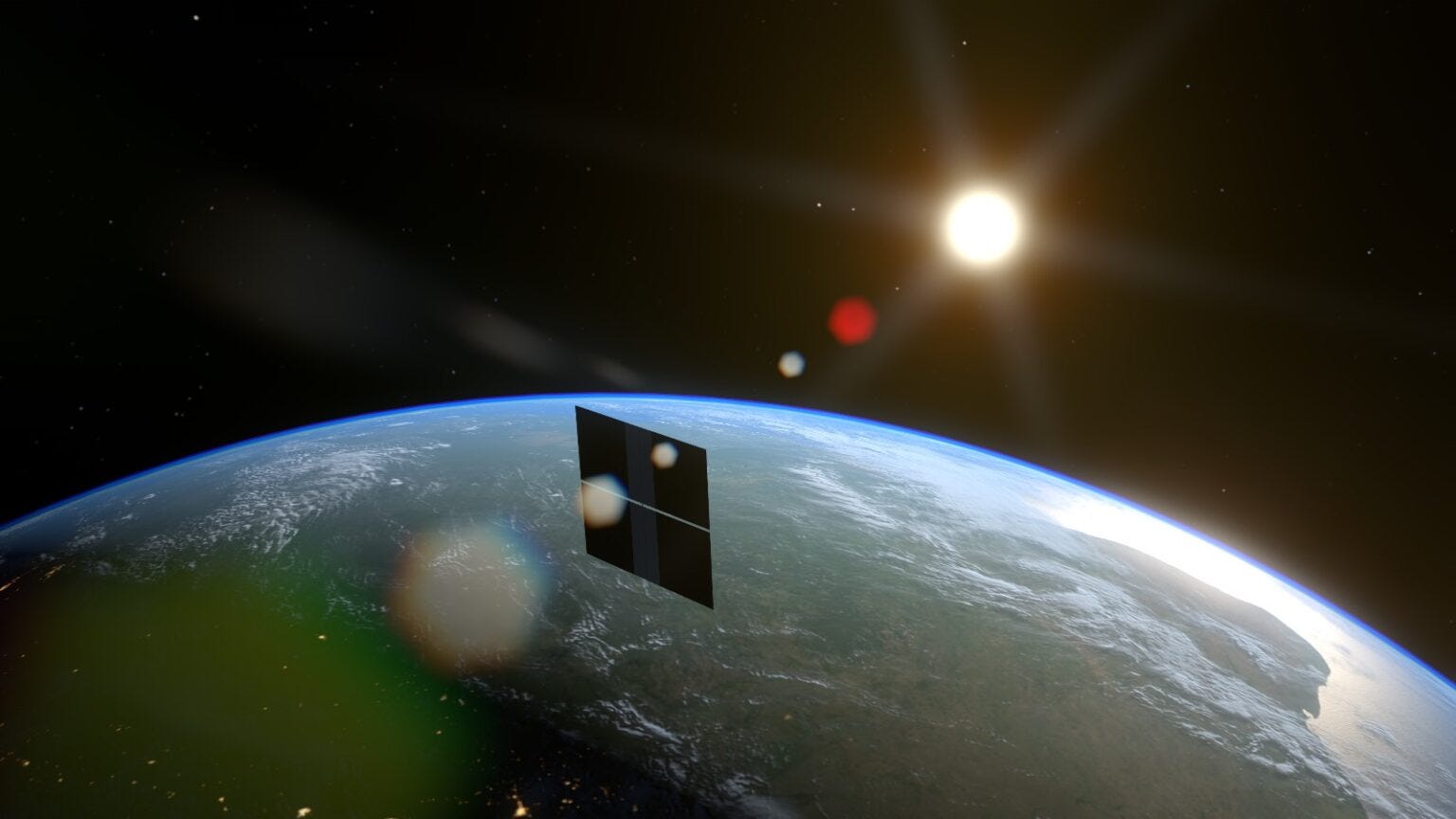
For the 15th Five-Year Plan period (2026-2030), space-based computing has been set as a focus area by the state-owned China Aerospace Science and Technology Corporation, which aims to have gigawatt-scale infrastructures, orbital data centers, established in the near future. Before that infrastructure can be placed into space, several technical milestones have to be passed and issues have to be overcome.
Those items were part of a recently published paper1 from the China Academy of Space Technology2 and the Beijing Institute of Control Engineering (北京控制工程研究所)3, and outlined to be:
Designing and manufacturing foldable solar panels and radiator structures that maximize both sunlight exposure for power and heat-dissipation area.
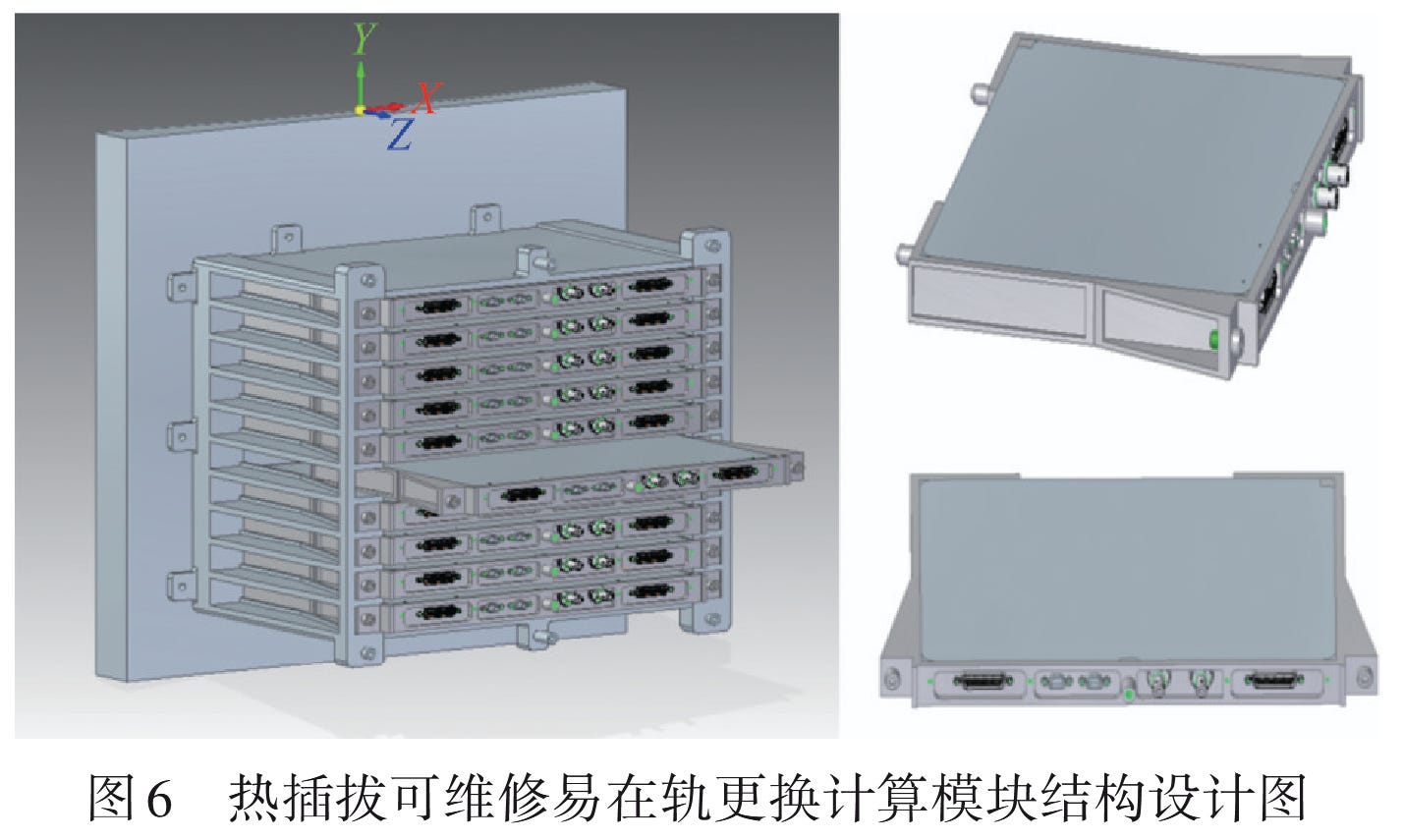
Equipment that is standardized, swappable, and low-cost when replaced by robotic systems without in-situ human intervention.
Establishing communications standards and systems that are both high-throughput and low-cost to be used at scale.
Proving systems that will run space-based compute satellites that have automatic fault diagnosis, self-maintenance abilities, and monitoring of the surrounding environment4.
Some of those items have work currently ongoing, as outlined in the paper. For power, China has notably been researching space-based solar-power stations to produce theoretically limitless clean energy since the 2000s, with technology breakthroughs coming in recent weeks. On the communications side, well-funded optical laser communications have been proven to communicate with spacecraft at one hundred gigabits per second in low Earth orbit, or with a geostationary satellite at a gigabit per second. Management systems and replaceable equipment5 are still concepts and will have to be proven by demonstration satellites.
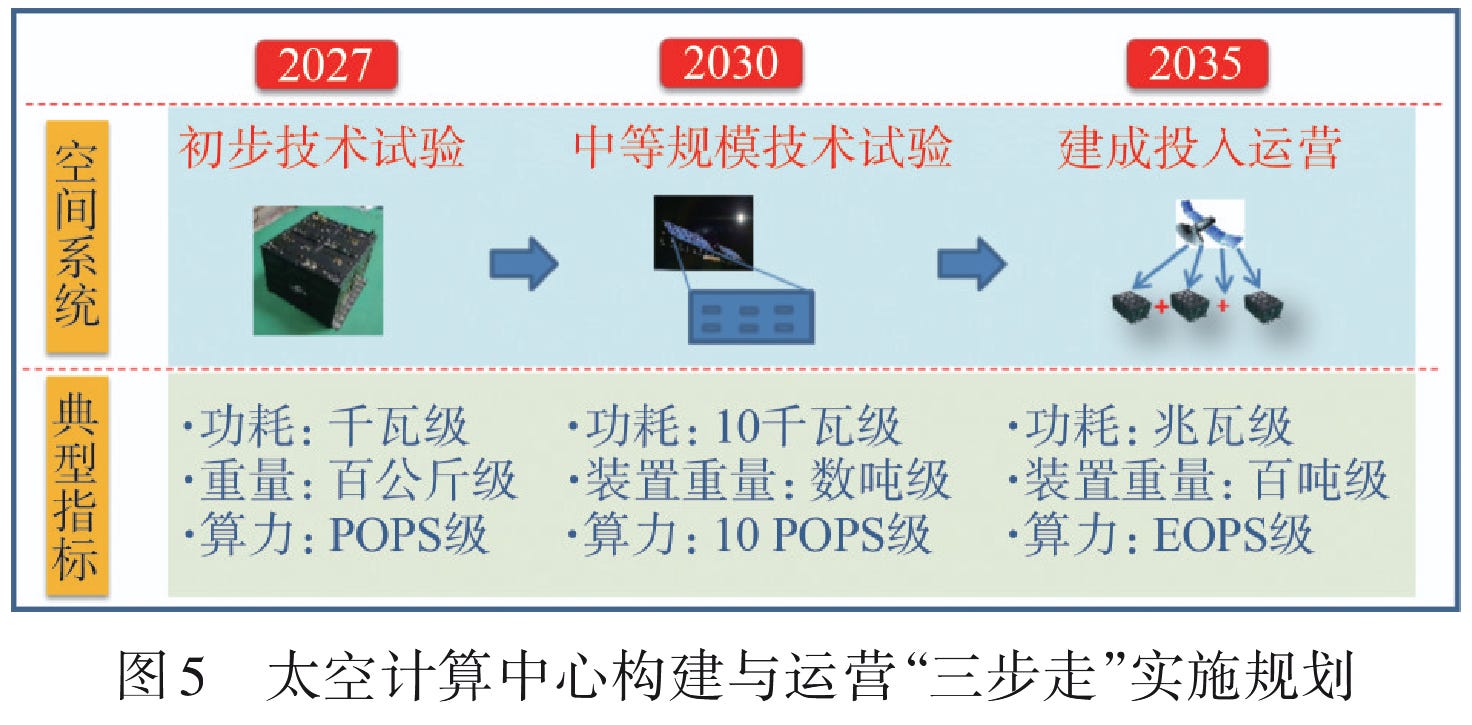
With that in mind, the China Academy of Space Technology confidently believes that significant amounts of space-based compute can be placed into orbit over the next decade through a step-by-step process. That would see an experimental 10-kilowatt class 1,000-kilogram satellite launched around 2027, to demonstrate necessary breakthroughs for hardware and software, then a series of 500-kilowatt class 20,000-kilogram satellites by 2030, to prove real services that would be used at scale, before building out a full-capability infrastructure in the 2030s.
Those satellites would be built around five core hardware segments, as detailed in the paper, with those being:
High-performance computing nodes made up of GPU6 clusters that handle the primary processing tasks.
Internal management switches that form a network for monitoring and controlling the cluster inside the satellite.
Communication switches that connect the satellite to Earth below and other spacecraft when needed.
Management computers that handle power generation, status monitoring of clusters, and overall satellite control.
Data storage units that provide significant storage capacity and caching of data across the satellites systems.
Alongside technology and systems, the paper also briefly considered the advantages and rationale of establishing space-based computing. If placed into a suitable orbit, orbital compute would be able to run all day at full capacity thanks to constant solar power while not having to pay for it from a terrestrial grid, therefore reducing running costs, which should be very low if systems are reliable. The system could also be complementary to the ‘Eastern Data and Western Computing’ plan, where data is produced in China’s activity-dense East and then processed in the energy-rich and less-populated West, to reduce emissions and costs.
Outside of state-owned enterprises, China is already making good progress on operational systems, arguably leading global efforts. ADA Space (国星宇航) has its first dozen satellites actively being tasked by users, while signing strategic agreements, ahead of a roughly tripling of compute power this year when more satellites are launched, opting for a mega-constellation-like approach to keep its system online and costs down7. Other entities like the Beijing Astro-Future Institute of Space Technology (北京星辰未来空间技术研究院) are well-financed to follow a similar approach to government efforts. Coordination and discussions between efforts are being facilitated as well by the Ministry of Industry and Information Technology (中华人民共和国工业和信息化部).
Titled ‘Technologies for Construction and Operational Management of Space Computing Centers (太空计算中心构建及运营技术研究)’.
Under the China Aerospace Science and Technology Corporation.
Under the China Academy of Space Technology.
To avoid debris or other spacecraft that may not maneuver.
Here is a concept from the paper of what a rack of space-based compute may look like:
A GPU, or graphics processing unit, is primarily designed for rendering computer-generated scenes by performing mathematical calculations rapidly, which also makes them useful for research and other math-based applications.
In terms of needed technological breakthroughs and financial, as smaller launches can be procured.