

Three-Body Computing Constellation Demos 8 Day Continuous Laser Link
Joint tasks are now possible to go on for days at a time at incredible distances between co-working satellites.

ADA Space (国星宇航) and Zhejiang Lab’s (之江实验室) Three-Body Computing Constellation is arguably the world leader in the field of space-based computing, and as of the end of July, another feat was demonstrated to support its future operation.
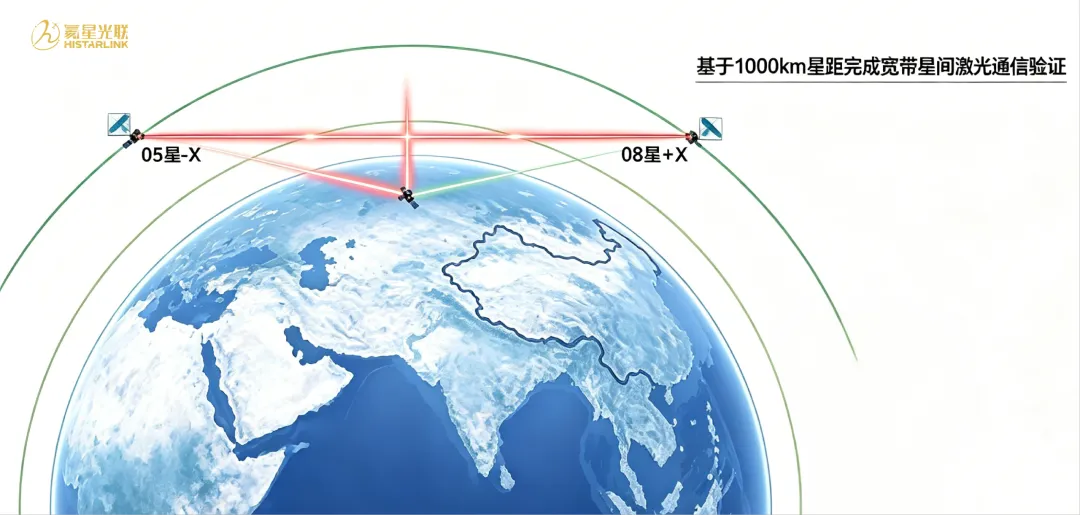
Announced on July 29th, it was shared that two satellites of the constellation had maintained a communications link via their optical laser terminals for 192 hours, 8 minutes, and 45 seconds, or just over eight whole days. Additionally, data transmission availability of the link was maintained at 99.99 percent uptime at distances of up to 1,000 kilometers apart.
All of that was done while the two participating satellites completed dozens of trips around Earth in their sun-synchronous orbit with active tasks running, causing tiny vibrations and fluctuating onboard thermal loads. Both also have secondary laser links to communicate with other members of the constellation and ground stations.
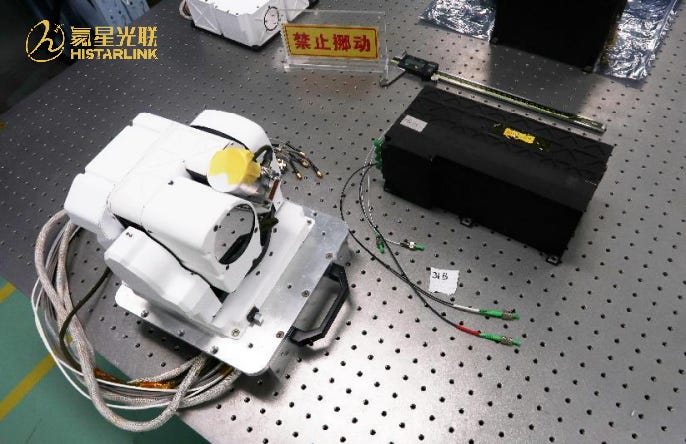
Enabling the feat were laser communication terminals from commercial enterprise HiStarlink (氦星光联), who also publicized it, and its close ‘customer-focused’ collaboration to pull it off. Those terminals, a key part of each of the constellation’s satellites, are able to beam data two-ways at speeds of up to 100 gigabits per second.
Prior to the recent feat, HiStarlink has proven laser-based networking across the currently twelve-satellite constellation with zero data loss, and maintained it at distances of between 650 and 1,100 kilometers.
Should ADA Space, Zhejiang Lab, and HiStarlink surpass the laser communication duration feat in the future, it will be a major boon for the Three-Body Computing Constellation. With stable and lossless links that are days long, multiple satellites in the constellation can jointly work on a single massive computing task that would be too ‘heavy’ for just one, and new additions can bolster the overall maximum joint compute.
With current plans, compute could be performed by up to 2,800 satellites launched by 2035. At present, ADA Space is expected to be readying the constellation’s second deployment whilst actively considering options for a third to triple current capacity. The first group was placed into orbit in May 2025, and since then the focus has been on fine-tuning the relevant technology and production to scale up properly with lessons learned.
Interest in uses for the Three-Body Computing Constellation have already come from across China despite it being barely a year old, with strategic agreements signed with technology giant Tencent (腾讯) and the Shanghai Meteorological Bureau (上海市气象局), along with support from Alibaba Cloud (阿里云) and technology collaboration with Shanghai Jiao Tong University (上海交通大学). SenseTime (商汤科技) is also exploring having 1,000 satellites based upon the constellations technology.
Meanwhile, the constellations’ closest competitor in China comes from Orbital Chenguang (轨道辰光), who recently had their Chenguang-1 (辰光一号卫星) computing satellite demonstrator launched to prove out necessary technologies for a few large compute spacecraft. The U.S.’ Starcloud is in a similar situation while being their national leader.
Elsewhere in China’s market of orbital laser communications, the technology has been used to talk with a satellite in geostationary space over multiple hours. The past two years have also seen a boom in availability and affordability in commercially made laser communications terminals, in what some would call ‘oversupply’.