

Vega-C Successfully Places Sino-European SMILE Spacecraft Into Orbit!
The joint mission is finally in space to start its space weather studies, with years of preparation work on Earth now behind it.

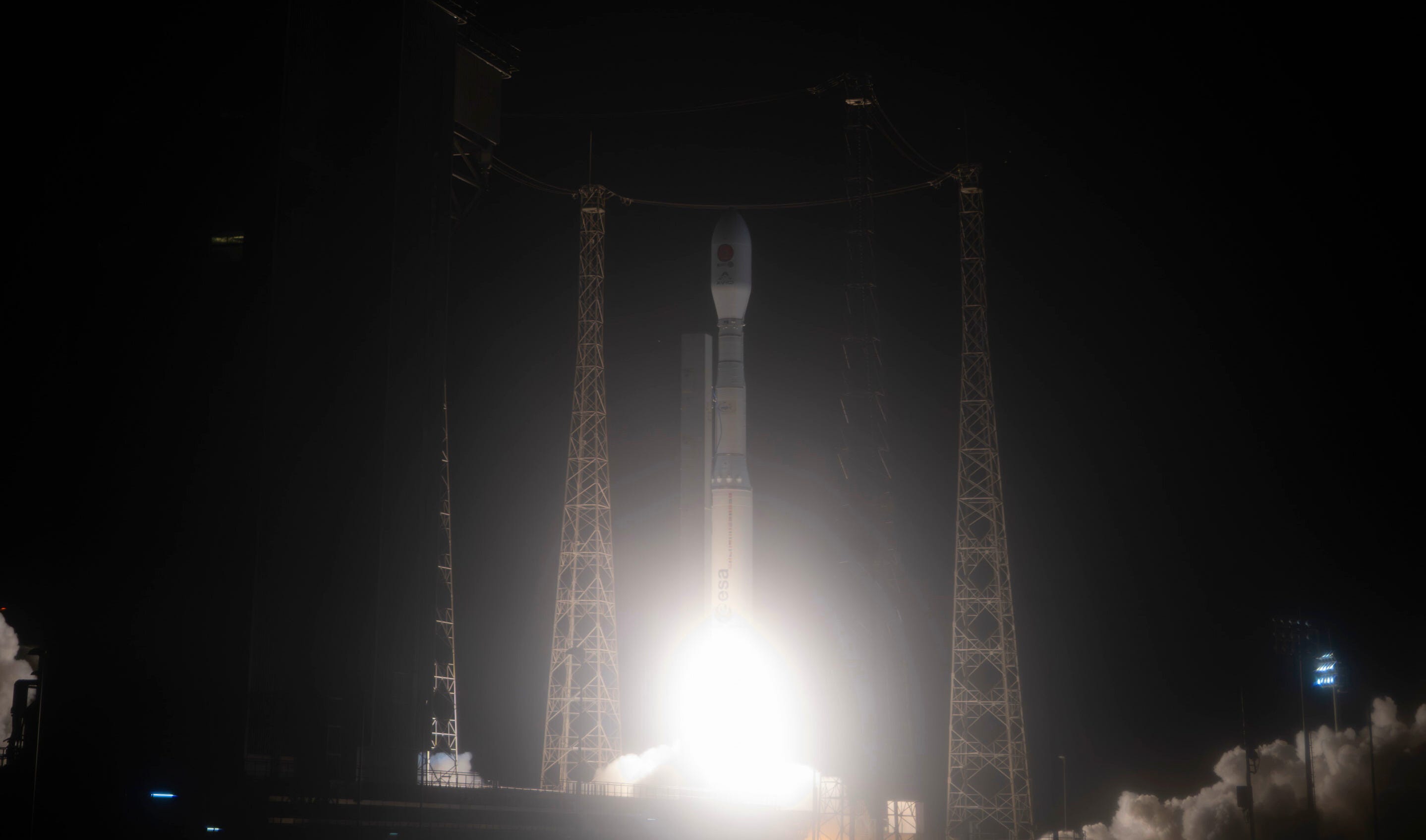
Earlier today, May 19th, the European Space Agency and the Chinese Academy of Sciences’ (中国科学院) SMILE spacecraft departed French Guiana atop of its Vega-C rocket to begin an important mission for at least the next three years.
Soaring from ‘Ensemble de Lancement Vega‘, at 11:52 am China Standard Time (03:52 am Universal Coordinated Time), Vega-C shot into the night sky through the power of its solid rocket boosters of stages one to three, separating the precise AVUM+ upper-stage just over seven minutes into flight. Two ignitions of AVUM+ then followed, twenty minutes and fifty-three minutes after liftoff, to bring SMILE into its initial orbit, then waiting a few minutes to release the spacecraft almost an hour after it left the ground.
Following separation, with Vega-C’s job complete, the 2,300-kilogram SMILE spacecraft is currently in a 700-kilometer 70- degree orbit of Earth, where it will come fully online over the next few days.
Over the next month after today, SMILE will slowly bring itself into its desired science-performing orbit, at altitudes of 121,000-by-5,000 kilometers.
With the successful launch, in an immediate post-launch statement1, Professor Chi Wang (王赤), Co-Principal Investigator for the mission and Director of China’s National Space Science Center2, stated:
“This is the result of what we have done for more than ten years. A huge thank you to everyone at the Chinese Academy of Sciences, the European Space Agency, Avio and China National Space Administration. We are proud of what we have achieved together, SMILE is a real mission now. … SMILE is more than a satellite, it is proof of what we can accomplish for science when we work together across the globe. The adventure starts now, we are looking forward to the first images and data!”
Jaione Martinez, SMILE payload manager at Airbus Defense and Space3, added onto the Professor’s statement, sharing:
“It is a very proud moment for all of us, seeing SMILE being successfully launched aboard Vega-C is the result of years of effort, dedication, and perseverance. We are happy and relieved to be progressing towards the next step of the mission, after a long journey on Earth.”
With today’s launch, SMILE has all of its joint preparation work behind it, and a a joint mission ahead of it. Approved by the two sides over ten years ago, in September 2024, development work in China was completed, followed by many weeks of environmental testing in the Netherlands through 2025, and eventual shipping to the launch site over February and March, with Vega-C integration coming in April. Related to that, the European Space Agency’s Director of Science Professor Carole Mundell said:
“The trusted collaboration between our engineering and science teams in Europe and China has endured through global challenges such as pandemic travel restrictions and geographically distributed teams. It’s exciting to see this all come together today and I’m looking forward to the new scientific discoveries SMILE will deliver.”
The SMILE mission, as detailed in a pre-launch media briefing, will have the spacecraft look down on Earth’s magnetosphere to study its interaction with charged solar wind particles originating from the Sun. Those particles cause auroras and other phenomena, but can also damage electronics on the planet and within the magnetosphere. After sufficient data is gathered, SMILE will assist with space weather forecasting and predictions too.
To perform those aims for solar weather and studying Earth’s magnetosphere, the European Space Agency and the Chinese Academy of Sciences have developed four instruments alongside their partners, with those being:
Soft X-ray Imager: to spectrally map the Earth’s magnetopause, magnetosheath, and magnetospheric cusps.
Developed, built, and calibrated at the University of Leicester, United Kingdom, and other institutions throughout Europe. The charge-coupled devices are procured from e2v by the European Space Agency and calibrated by The Open University, also in the UK.
UltraViolet Imager: for imaging Earth’s auroras that appear over both the north and south poles.
A joint venture between the University of Calgary in Canada, the Chinese National Space Science Centre, the Chinese Academy of Sciences, the Polar Research Institute of China, and Centre Spatial de Liège, Belgium.
Light Ion Analyser: to understand solar wind particle properties as they head towards Earth, two are onboard.
A joint venture between the Chinese National Space Science Centre, the Chinese Academy of Sciences, University College London’s Mullard Space Science Laboratory, UK, and the Laboratoire de Physique des Plasmas, France.
A Magnetometer: Also aimed at understanding solar wind particle properties en route to Earth.
A joint venture between the Chinese National Space Science Centre, the Chinese Academy of Sciences, and the Space Research Institute, Austrian Academy of Sciences.
Regarding the core parts of the SMILE, Europe is providing the payload module (the upper half) which hosts most of the instruments and two solar arrays, while China built the spacecraft platform4 (the lower half) to maneuver the spacecraft in orbit while hosting the two Light Ion Analysers.
Toward the end of live launch coverage.
Under the Chinese Academy of Sciences.
Also managing many parts of the European contribution to the mission.
Production of the China-made spacecraft platform components was tasked to the Innovation Academy for Microsatellites, Chinese Academy of Sciences (中国科学院微小卫星创新研究院).