

Wenchang Appears to Be Preparing for Major Mengzhou Spacecraft Test
Beyond the coastal launch site, the 'Linghangzhe' drone ship is being outfitted for the Long March 10B's debut.

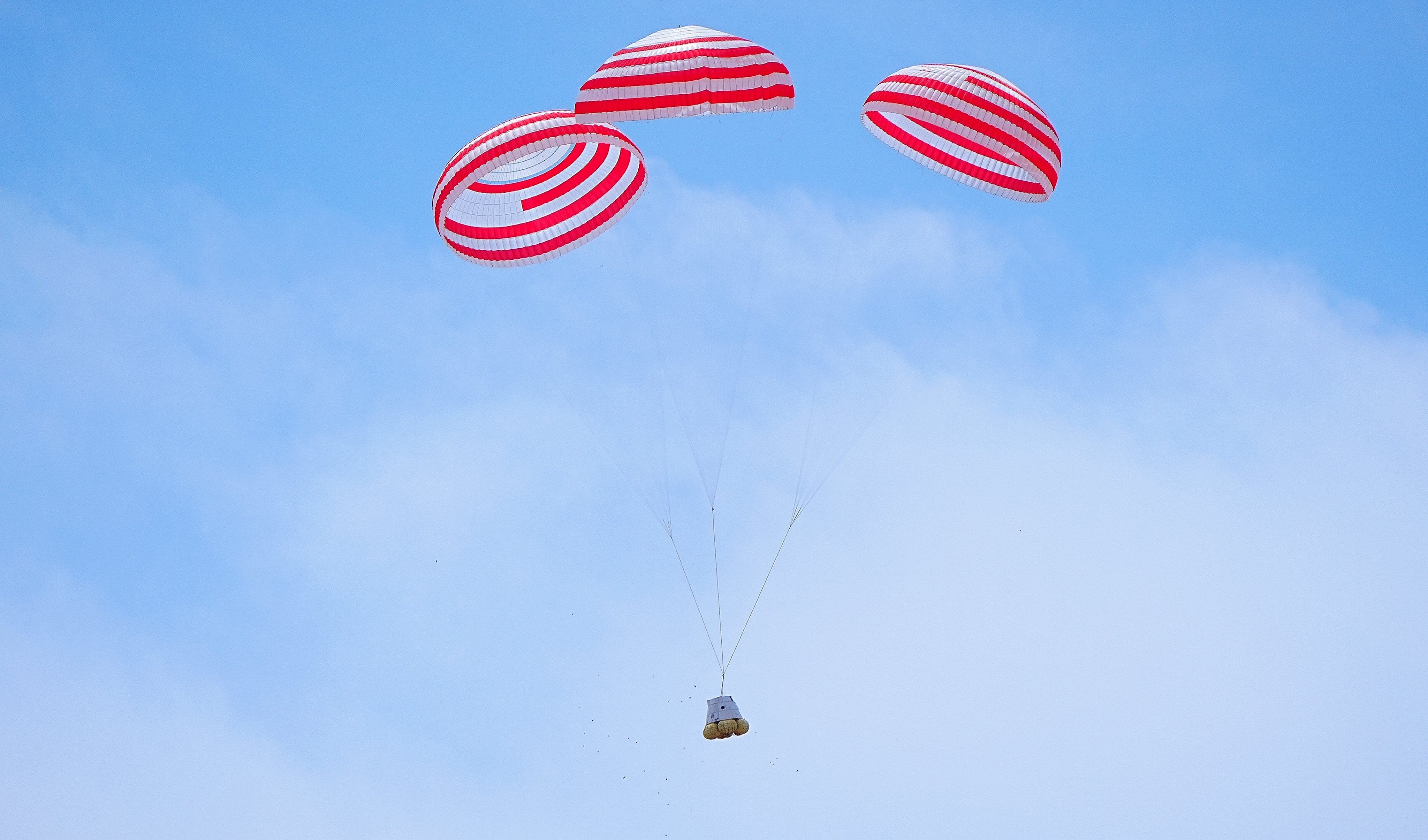
Ahead of the Mengzhou (梦舟) crewed spacecraft’s debut demonstration mission to the Tiangong Space Station in the second half of this year, efforts are underway for an in-flight abort test.
At the Wenchang Space Launch Site’s Launch Complex 301, a vehicle with the expected silhouette of the single-stick two-stage Long March 10A launch vehicle1 is being secured to a Long March 10 series’ mobile launch platform. Based on images gathered by those near the launch site, the vehicle appears to be a modification of the Long March 10 series static fire article, twice fired, with a boilerplate remainder of the first-stage on top, as well as half of its interstage. The boilerplate section of the stage has remained under a tarp for all of its appearances in January so far.
With a vehicle now roughly equivalent to the expected dimensions of a mission-ready Long March 10A first-stage, fit tests have been underway with the mobile launch platform. That has included attaching two commodity arms to the base of the stage as well as surrounding where the interstage is expected to be with access platforms, both attached to the mobile platforms partially constructed service tower.
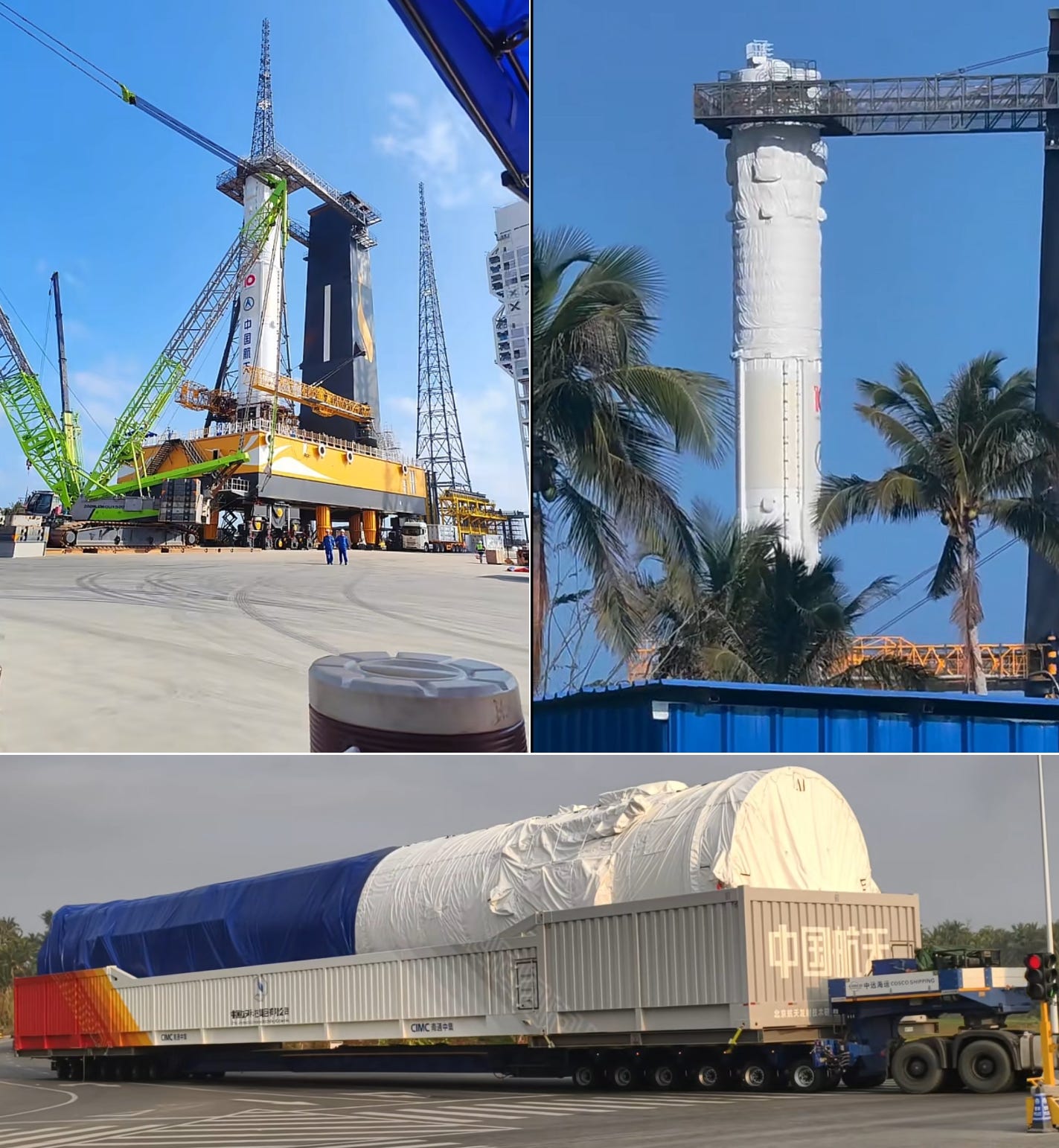
Some time in the coming weeks, it is being rumoured that a boilerplate second-stage, and the rest of the interstage, will be installed atop of the vehicle. That will then be added upon with a test Mengzhou capsule, an operational abort tower, and a mass-equivalent dummy service module. A similar setup, minus a service module, was used for Mengzhou’s launch pad escape test in June 2025.
As most of the Long March 10A is likely to be a boilerplate, to demonstrate how a full flight vehicle experiences initial ascent up to an abort point, the seven YF-100K engines may not be running at their full thrust of 892 tons. Any loaded propellant will be consumed quite quickly, in comparison to a flight vehicle, due to the modification of the static fire article.
Supporting the rumours of Mengzhou’s in-flight abort test being prepared, the Xiaoxiang Morning Herald (潇湘晨报) recently learned from the tourism arms of the Wenchang launch sites that almost all launch preparations have been halted to free up resources and personnel for a February 11th test flight. Only a Long March 8A is expected to fly uninterrupted on February 3rd.
Adding onto that, Capital Aerospace Machinery Co Ltd (首都航天机械有限公司), manufacturer of many of the China Academy of Launch Vehicle Technology’s Long March vehicles in its Tianjin (天津) factory, held a mobilization meeting in early January, encouraging its staff to commit themselves to an upcoming test flight that was stated to be of great importance to a new spacecraft and a launch vehicle’s maiden operational flights. In a related key ground-side test to that, Launch Complex 301’s water deluge system, to suppress the sound and energy of a rocket, was tested sometime in January.
Yang Liwei (杨利伟), the first Chinese person to be sent into space and Deputy Chief Designer at the China Manned Space Agency, said in the first week of the year that good progress is being made across hardware for China’s crewed lunar landing program.
Early signs for Long March 10B debut
Meanwhile, another member of the Long March 10 series is preparing to fly into orbit. Named as the Long March 10B in late December 2025, the partially reusable launch vehicle is expected to perform its debut flight around April from Commercial Launch Pad 2 at the Wenchang Commercial Space Launch Site.
In preparations for the reusable rocket’s flight, the drone ship ‘Linghangzhe (领航者)’ was spotted docked via satellite imagery and appearing to have its ‘tensioned wires’ recovery system being installed on its deck, as the Long March 10B uses that booster ‘landing’ style. During delivery in early December 2025, the drone ship did not have its first-stage booster recovery systems installed.


When the Long March 10B launches, it will be lofting up to 16,000 kilograms into orbit while being Wenchang’s first methane-utilizing launch, thanks to its second-stage. It will also probably be China’s fourth reusable rocket and the first not flying from Jiuquan2.
Dedicated to low Earth orbit tests of lunar mission hardware, the Tiangong Space Station, and commercial missions. The rocket is able to lift up to 18,000 kilograms into low Earth orbit. It is related to the Long March 10 Moon rocket, able to send up to 27,000 kilograms on a trans-lunar trajectory, without a third-stage or two additional first-stage boosters.
On December 3rd 2025, LandSpace’s Zhuque-3 flew for the first time. Twenty days later on December 23rd the Shanghai Academy of Spaceflight Technology debuted its Long March 12A launch vehicle. Sometime in the coming weeks, the Long March 12B is expected to become China’s third reusable rocket.
I am sure that when CALT does something , it does smoothly and flawlessly . Long March 10 and its related variants would all be a huge success .
Let's hope for better because Long March 10 and its reusable rockets will have a huge impact on the Space Industry of China.
Thank you for the article, but there is one point I did not fully understand. It appears that the CZ-10A, which is being prepared for the Mengzhou test, is also equipped with grid fins. Does this mean that the 10A variant is intended to be reusable?