

Where and When Will China Land Taikonauts on the Moon?
Candidate landing sites are starting to be published academically for a crewed landing set for before 2030 officially.

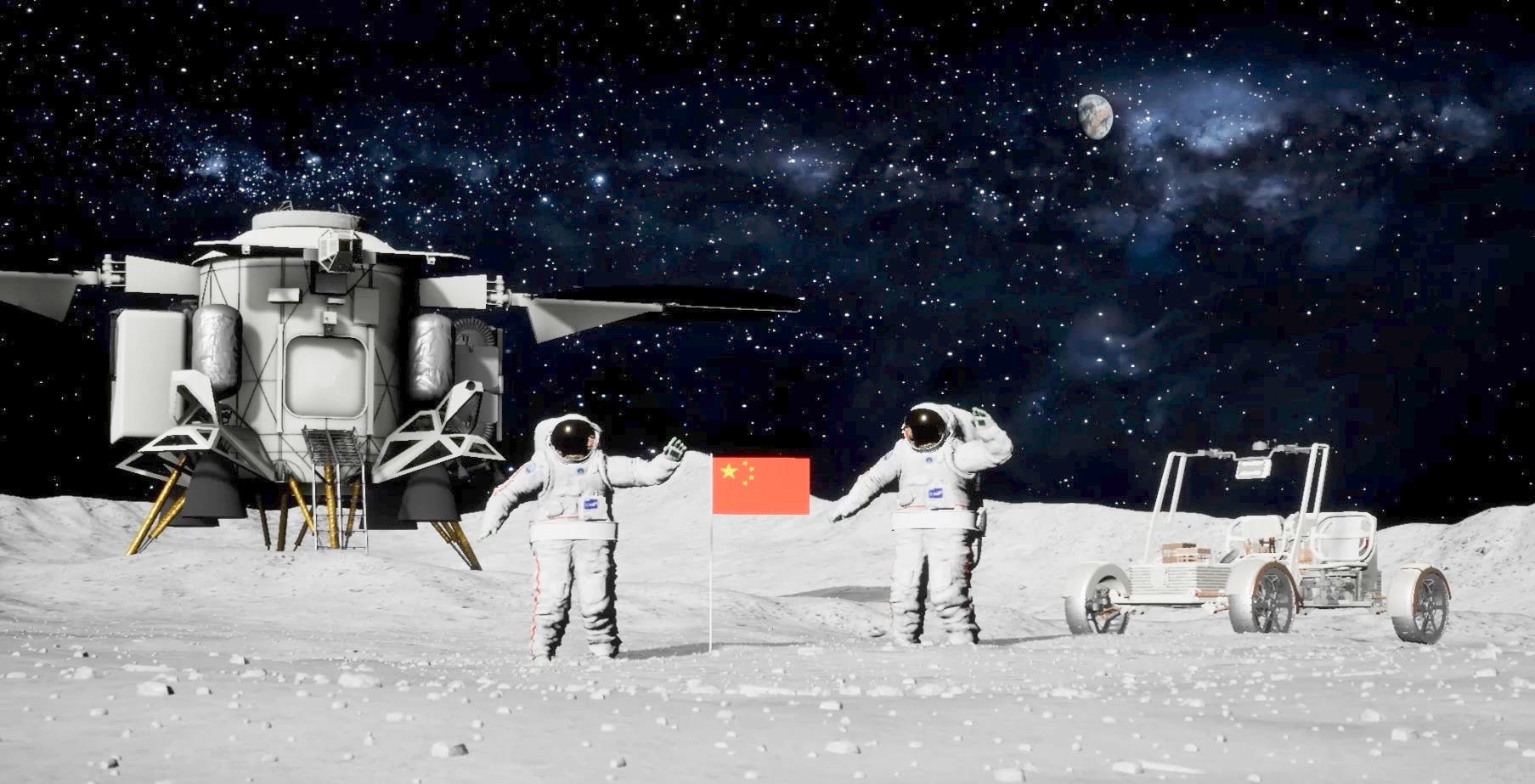
Before 2030, at least two taikonauts will step foot on the Moon for the first time, possibly being the first since the Apollo program over five decades ago. At the moment, when a lunar landing will take place isn’t known, and where they will explore isthe subject of ongoing analysis.
On March 9th, an article by Chinese and German planetary science researchers was published in the journal Nature Astronomy, performing analysis on the lunar region of Rimae Bode as a priority landing site for China’s first crewed lunar landing later this decade. That region sits on the Moon’s near-side at a low-latitude, with proposed exploration sites ten to twelve degrees north of the equator, which is easily accessible by China’s Mengzhou (梦舟) crew capsule and Lanyue (揽月) lunar lander. Alongside that, the region has high scientific value according to the article.
In the analysis, Rimae Bode ranked high1 due to its geological diversity. The region sits at the boundary between mare and highland terrain, hosting a wide variety of materials within a single accessible area: pyroclastic dark mantle deposits, low-titanium mare basalts, high-thorium basalts, highland anorthosites2, and ejecta from the Copernicus crater many kilometers away. Few other researched potential sites offer taikonauts the opportunity to collect samples of geologically diverse materials without needing to travel long distances between them.
The dark mantle deposits were stated to be a compelling target for sampling due to present pyroclastic glasses3, which were explosively erupted from deep within the lunar mantle and are thought to preserve a record of the Moon's interior. That deposit at Rimae Bode is theorized to be between 77 and 136 metres thick and could contain water in excess of 300 parts per million. Sinuous rilles4 near the candidate site are also of interest. Both of those areas of the region are likely to be valuable for understanding lunar volcanism and potentially utilizing water for producing air and propellant.
Looking at the site for spacecraft access, Rimae Bode offers an uninterrupted communication path back to Earth and generally flat traversable terrain with average slopes below eight degrees. That would allow for extensive use of the Tansuo (探索) lunar rover to explore several sampling sites, while mission control on Earth can monitor the status of taikonauts within their Wangyu (望宇) lunar spacesuits in near real-time.

Analysis of the Rimae Bode region was performed by data collected by Chang’e 15 for topography, NASA’s Lunar Reconnaissance Orbiter6 for imaging and thermal data, Arecibo Observatory’s ground-based radar7 for pyroclastic mapping, Japan’s SELENE for terrain imagery and elevation models, and India's Chandrayaan-18 for mineralogical data through its Moon Mineralogy Mapper spectrometer. The region had also previously been identified as a candidate landing site for the U.S.' cancelled Constellation program9, so a body of prior work already supported the researchers’ analysis.
Ahead of China’s first crewed lunar landing, further analysis of possible landing sites will be performed. A year ago, in March 2025, the China Manned Space Agency opened proposals for a lunar remote sensing satellite, to be operational in 2028, to support selecting landing sites. The China Academy of Space Technology won in the same month.
How soon will taikonauts venture to the Moon?
At present, the China Manned Space Agency repeats that ‘before 2030’ is the goal of when a taikonaut should first set foot on the Moon. In simple terms, they mean by December 2029 at the latest. Looking at the target from a political angle, two months before that, in October 2029, is the 80th Anniversary of the Proclamation of the People’s Republic of China by Chairman Mao Zedong (毛泽东) atop of the ‘Gate of Heavenly Peace (天安门)‘. For political reasons10, October 2029 could be a proper no-later-than target date.
As for when the earliest a crewed lunar landing may occur, that is dependent on a few things. The most obvious one will be the flights of the Long March 10 series launch vehicles, and as of early 2025, debut flights are expected to be around:
The single-stick two-stage Long March 10A will perform its first mission in its Mengzhou configuration later this year, for the capsule’s first orbital flight too.
The tri-core three-stage Long March 10 Moon rocket will fly in its cargo-carrying configuration in 2027 for the first time.
Then in 2028, the Long March 10 Moon rocket will fly in its Mengzhou configuration for the first time.
Lastly, also in 2028, the Long March 10A will perform its first cargo-carrying configuration mission11.
All of those dates are missing a month or quarter of the year to go with them, and are subject to moving around depending on system readiness. Ahead of those four vehicles, the Long March 10B will have its first flight in the coming weeks, where it will test a YF-100K-powered reusable first-stage, which is common with the four other vehicles, while using a different liquid methane-fueled second-stage. Once the Long March 10A and Long March 10 Moon rocket are flying, tests of the Mengzhou crew capsule and Lanyue lunar lander can go ahead in space for about two dozen months.
Outside of testing speculation, it has been communicated12 to nations that have previously cooperated with China on Chang’e missions that a hardware readiness date of all relevant systems for a crewed landing is being pursued within 2028, without mentioning a specific quarter. Hardware readiness may mean that all relevant systems have been tested or that a landing mission is ready to be performed with spacecraft staged at the launch site.


From a pool of 106 initial sites and a narrower selection of 14 locations.
Ancient calcium-rich rocks that make up much of the lunar highlands formed when lighter minerals floated to the surface of the Moon’s early magma ocean.
Tiny beads of volcanic glass formed when magma from deep inside the Moon was violently ejected to the surface in ancient eruptions.
Channel-like valleys on the lunar surface, thought to have been carved by flowing lava.
Orbiting the Moon from November 5th 2007 to March 1st 2009.
Which has been orbiting the Moon since June 23rd 2009.
Used from November 1st 1963 to its collapse on Decmber 1st 2020.
Which orbited the Moon from November 9th 2008 to August 29th 2009.
Pursued from January 2004 to April 2011 with an aim for sending astronauts to the Moon and later Mars, hardware like the Orion spacecraft and new five-segment modified Space Shuttle boosters were later used for the Space Launch System under the U.S. Artemis program.
To draw a parallel to the U.S., several presidents have sought to have a major crewed exploration mission within their presidential term (or terms). Current President Donald Trump originally believed he would serve two back-to-back terms, and as such sought to have a Moon landing by the end of 2024, which is now set for before the end of 2028 in his present administration.
This is likely to accelerate the replacement of the Long March 7 as the Tianzhou cargo spacecraft’s launch solution.
As of six months ago via state-to-state channels, per sources.
As an American, I hope the USA wins the Space Race 2, but there's no doubt that China does have one major advantage: with an authoritarian state, there are no shifting political winds that need to be dealt with. The USA has largely been lost in space the last 20 years as the White House/Congressional majorities have shifted.