


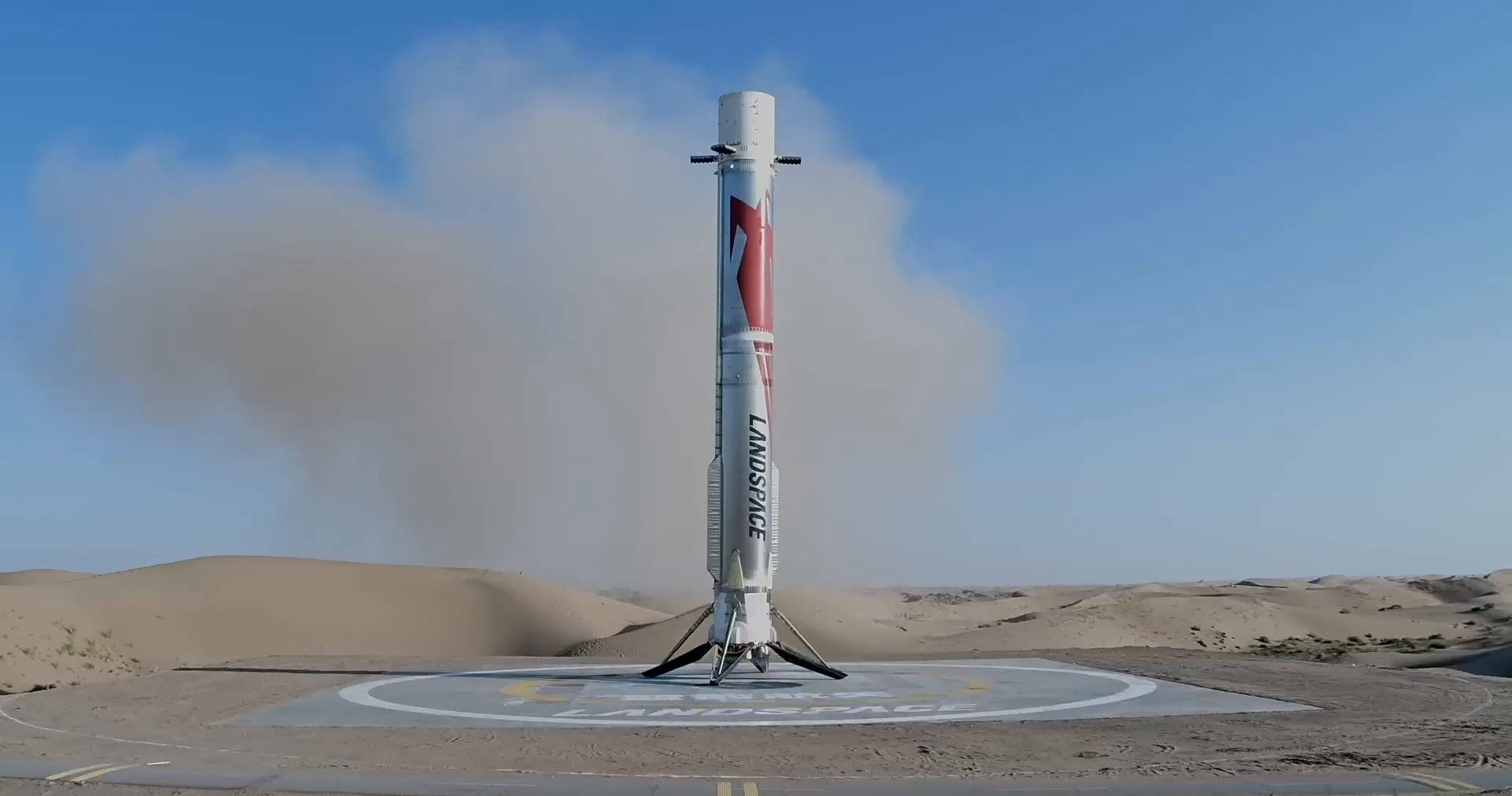
On their second-ever attempt, LandSpace’s big day came on August 19th when they successfully landed the first-stage booster of the partially reusable Zhuque-3 launch vehicle, while delivering a customer satellite into orbit too, becoming the second launch provider in China to achieve the feat.
Unfortunately for the stainless steel booster, it only stood on its four aluminum-titanium landing legs for several hours before falling over. LandSpace has not detailed how that occurred or any damage incurred, leading to speculation aplenty.
From available post-landing media, it appears that the four legs and the pistons attaching them to the first-stage started to weaken, as the stage visibly pivoted and slouched, before a fire expanded out during liquid methane and liquid oxygen propellant offloading. A series of small fires, caused by engine shutdown1, were ongoing at the base of the first-stage ahead of that, using thermal protection materials as kindling to sustain themselves.
It’s unclear when the booster fell over, but satellite imagery from Europe’s Copernicus shows that it was stood for at least four hours. Supposed leaked images show that one of the landing legs was removed too, as it is not under the booster.
Considering that, LandSpace’s recovery teams may have assessed the risks to their staff and recovery equipment, deciding it was too high and felling the booster in a controlled manner2. Images captured by onlookers show that it fell towards a tarp as well.


As for damage sustained, the inter-stage and upper propellant tank will have taken the brunt of it, as physics dictates that they fell the furthest and fastest of any sections. Up to two grid fins may have been pushed into those parts due to the angle at which the booster fell and the fact that they are no longer visible. The lower propellant tank has gained a hole near the bottom and some charring from the propellant vent fire, while two nozzles of the nine TQ-12A engines have been deformed.
In the months leading up to the second flight, LandSpace officials shared that they wanted to reuse the booster should it land. With the damage, they may not be able to reuse the whole booster unless it undergoes a lengthy repair, refurbishment, and re-testing campaign, but they can still pull parts off of it3. Hardware that will be insightful to refly include undamaged engines and grid fins, to prove they can handle repeated use through the high-temperature environment of launch and landing.
It was known that, should the first recovered booster have been brought back in one piece, LandSpace would have disassembled it and thoroughly inspected each of its components for signs of serious fatigue, before putting it back together to fly again with replaced parts where needed. That would have been a practice in establishing post-mission inspection processes too.
The mission most affected by the falling of the booster is Zhuque-3’s fourth flight, expected sometime in the first half of 2027. It could now await the recovery of the third flight's booster or fly a fresh one, pushing out the first reuse of first-stage.
Within LandSpace’s considerations is when to put all effort into the launch vehicle’s ‘Block 2’ version. That will see Zhuque-3 grow to 76.6 meters tall, incorporating the more powerful TQ-12B and TQ-15B engines, and increasing its fully-fuelled mass to 660,000 kilograms. ‘Block 2’ is designed to carry up to 18,300 kilograms to low Earth orbit with a booster landing downrange.

No matter how clean a shutdown is designed to be, residual propellant in liquid and gaseous form will still burn in the nozzle for a little while afterwards.
It was said to have occurred slowly by media teams on site.
Including the propellant tanks separately, as they do not have a common dome between them due to being transported apart.