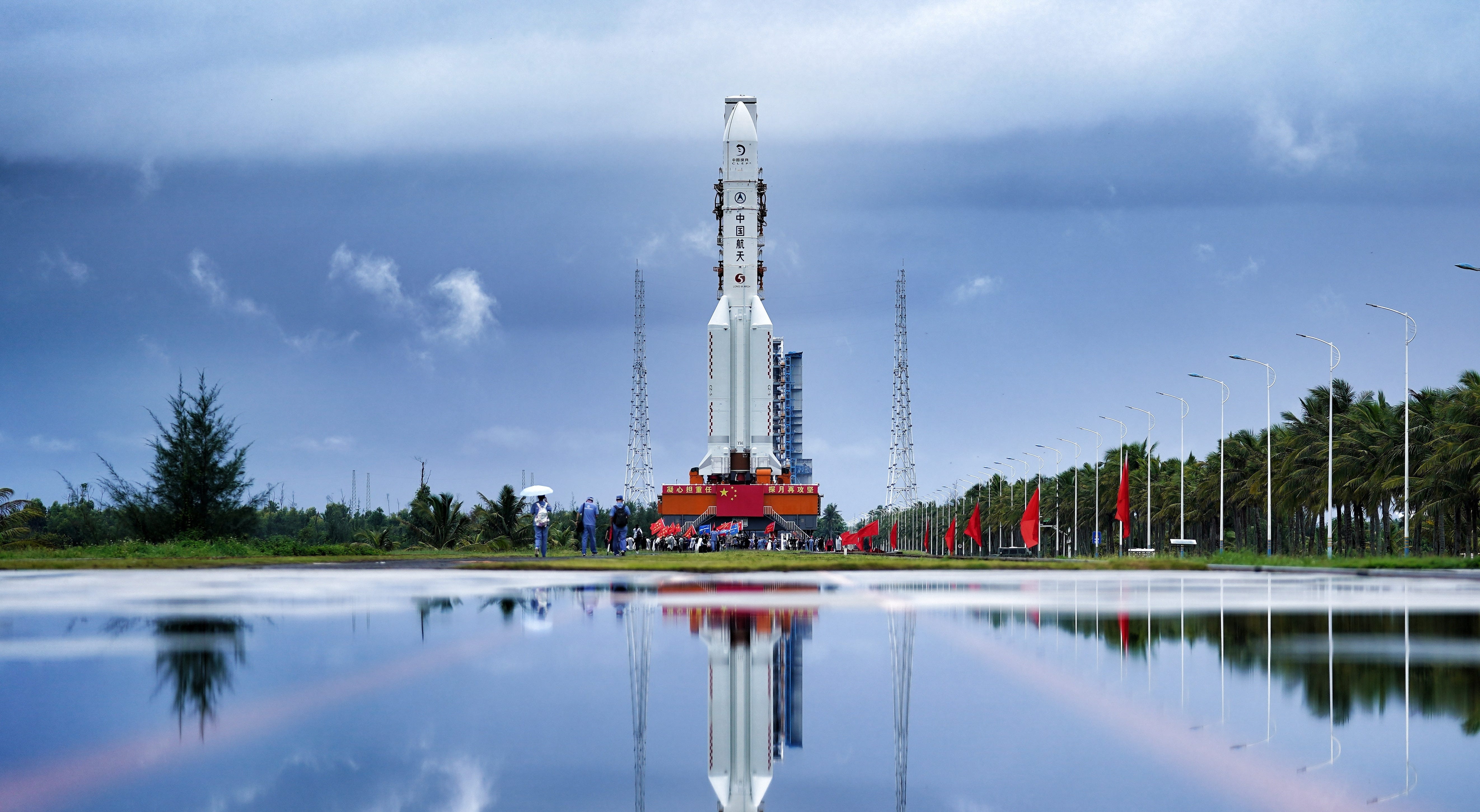
Chang’e 7 Rolls Out Ahead of Moon Launch From Wenchang
A three-month trek to the lunar south pole, bringing along international partners, is about to begin.

As early as August 24th, at 08:00 am China Standard Time (00:00 am Universal Coordinated Time)1, China’s Chang’e 7 robotic mission to the Moon’s south pole in search of water ice will lift off from the Wenchang Space Launch Site.
Ahead of that, the Long March 5 launch vehicle carrying it, encapsulated inside its 5.2-meter diameter fairing, rolled out from its vehicle assembly building to Launch Complex 101 on the morning of August 19th. That had the vehicle’s mobile launch platform drive 2.75 kilometers over a couple of hours, being bolted down to the pad once it arrived. Various commodity supply lines were also plugged in while the Long March 5 was surrounded by access platforms of the launch support tower.
The China Manned Space Agency, managing the mission and the Chinese Lunar Exploration Program (中国探月工程) moving forward, and involved state-owned enterprises confirmed not long after rollout that both Chang’e 7 and the Long March 5 were healthy at Launch Complex 101.
In the time between now and launch, the lunar spacecraft and launch vehicle will undergo final tests to verify that they are ready to fly, as disclosed by the China Academy of Launch Vehicle Technology2 and the Shanghai Academy of Spaceflight Technology3:
“Moving forward, pre-launch functional checks, integrated tests, and propellant loading will be carried out as scheduled, with the launch planned to take place in the coming days when conditions are favorable.”
If there are any problems with this translation please reach out and correct me.
The China Academy of Space Technology, who are responsible for a majority of Chang’e 7’s systems and components, shared a similar message, adding that its dedicated teams are making every effort to ensure the mission’s success in reaching the Moon.
Flying to Chang’e 7’s favored landing site, a permanently illuminated peak next to Shackleton crater at 123.4 degrees East and 88.8 degrees South, will take about three months as the spacecraft performs dozens of observation passes to determine the presence of any hazards, along with any geographic changes. Entering a low polar lunar orbit will also take about eight days4.
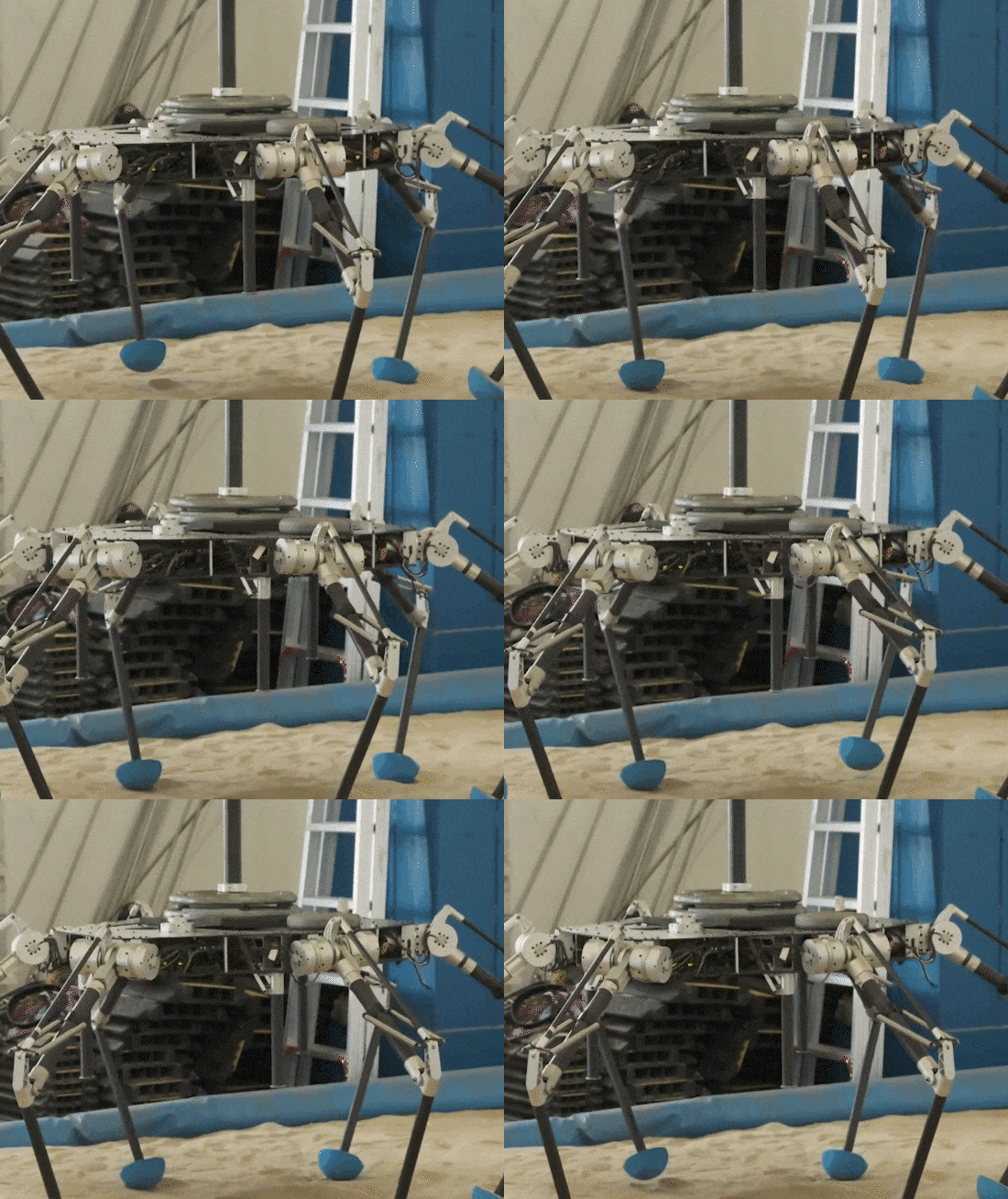
Once on the surface, Chang’e 7’s lander is planned to perform science around its landing site for eight years with its rover and hopper, which will look into permanently shadowed craters and walk around5. Meanwhile, the orbiter will support them with regular imaging of the environment, highlighting points of scientific interest.
Chang’e 7 reaching the lunar south pole will be important not just for Chinese scientists, but for an international cohort too. With instruments onboard, there is the Hawai’i-headquartered International Lunar Observatory Association, Italy’s Laboratori Nazionali di Frascati, the National Astronomical Research Institute of Thailand, the Russian Academy of Sciences, Switzerland’s Physical Meteorological Observatory, the Bahrain Space Agency, and the Egyptian Space Agency.
When liftoff occurs, it will be the end of an over-four-month launch campaign, which began with the arrival of Chang’e 7 after an overnight flight in early April. The Long March 5 launch vehicle made it to Wenchang in mid-July. Both completed comprehensive independent testing at their respective production facilities and the launch site ahead of integration.

That is when the launch window opens; it runs for four hours and is repeated until August 31st.
Which manufactures the Long March 5’s first and second stages.
They produce the Long March 5’s four boosters.
With the orbiter performing a series of three burns to make efficient use of its onboard propellant, to extend its operational life supporting surface exploration.
In a manner similar to this prototype: