

ChinaSat Spacecraft Lost in Failed Wenchang Launch [Long March 7A Y16]
China has suffered its second failure of a geostationary space-dedicated launch vehicle this year, today with the modern part of the Long March family.

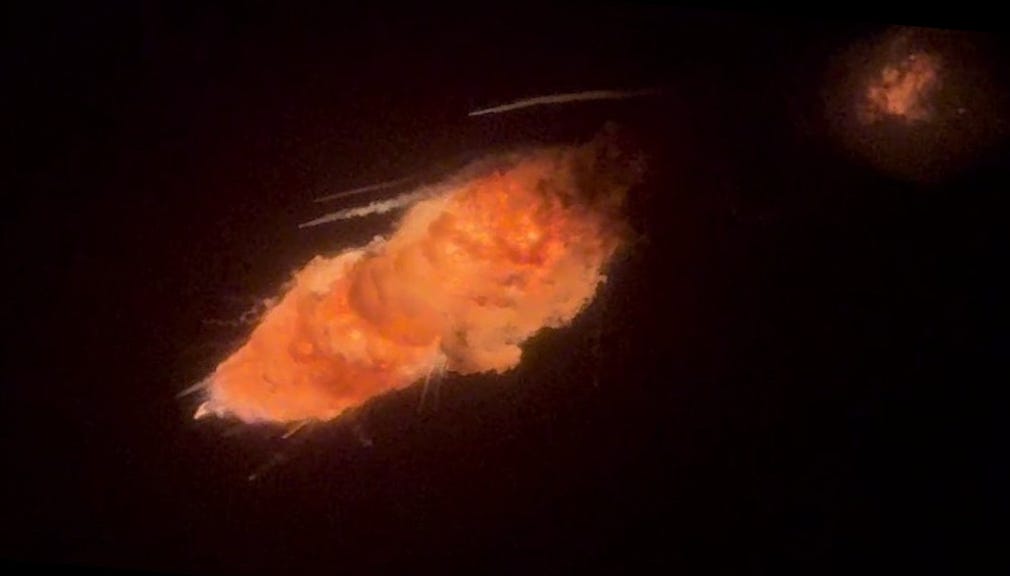
At around 20:02 pm China Standard Time (12:02 pm Universal Coordinated Time), a Long March 7A lifted off from Launch Complex 201 at the Wenchang Space Launch Site, carrying a single spacecraft away from the planet for its latest geostationary mission.
Ascent away from Wenchang went well, with the launch vehicle pitching downrange to the southeast to align with the target orbital inclination. However, at about 83 seconds into flight, an anomaly occurred during the joint burn of the first-stage and four boosters. The anomaly escalated rapidly into an explosion, leading to a loss of the Long March 7A and its payload over the South China Sea.
It is unclear what caused the anomaly, but it could be like March 2020’s Long March 7A failure, which before today was its only one. That was reportedly caused by a loss of pressure in one of the four boosters, resulting in an underperformance in expected speed and altitude, leading to the mission’s termination shortly into second-stage flight. With that failure mode being known, the launch vehicle’s control systems should be programmed to activate flight termination system explosives upon receiving known anomalous data.

As for what spacecraft was lost, China National Radio (中央人民广播电台) wrote quickly after liftoff that ChinaSat-4B (中星4B卫星) was to be delivered towards geostationary space. That spacecraft was going to provide various radio, television, and communication services to global users, while being the newest addition to the ChinaSat fleet since June 2025.
With the failure today, the Long March 7A will obviously be grounded for the foreseeable future until an anomaly investigation can be completed. A handful of in-production vehicles will also not leave the China Academy of Launch Vehicle Technology’s factories so they can be inspected.
Wider effects across the modern Long March family of rockets are also unclear. As the failure happened in a joint burn of the first-stage and boosters, the YF-100 engine is under suspicion as a potential candidate. A majority of the modern Long March vehicles use that engine, including the Long March 6 series1, Long March 8 series2, and Long March 5 series3. The last of those is set to launch the internationally involved Chang’e 7 robotic mission to the Moon’s south pole in two weeks. Backup opportunities for the lunar mission run well into October.
Earlier this year, the legacy half of the Long March family had a major failure too, when the geostationary workhorse in the Long March 3B/E was lost due to a third-stage issue in January. That third-stage is also shared with the Long March 7A.
Today’s mission was the 18th launch of a Long March 7A vehicle, the 29th launch of the Long March 7 series, and the 662nd launch of the Long March launch vehicle series. This was also the 56th launch attempt from China in 2026.
Liftoff footage via ThatSpaceDogeGuy on YouTube.
Launch livestreams via International Rocket Launches and ThatSpaceDogeGuy on YouTube.
Check out the previous Long March 7A launch
First Next Generation Tiangong Relay Deployed Toward Geostationary Orbit [Long March 7A Y29]
![First Next Generation Tiangong Relay Deployed Toward Geostationary Orbit [Long March 7A Y29]](https://substackcdn.com/image/fetch/$s_!S1gu!,w_1300,h_650,c_fill,f_webp,q_auto:good,fl_progressive:steep,g_auto/https%3A%2F%2Fsubstack-post-media.s3.amazonaws.com%2Fpublic%2Fimages%2F6cc0785a-de97-4052-9e3a-b5329be1e330_5633x3005.jpeg)
A Long March 7A lifted off from Launch Complex 201 at the Wenchang Space Launch Site at 19:50 pm China Standard Time (11:50 am Universal Coordinated Time) on July 29th, bringing a single satellite towards geostationary space.
What is the Long March 7A?
This section is for those less familiar with China’s Long March series of launch vehicles.
The Long March 7A is the new-generation workhorse for beyond low Earth orbit missions, and was developed by the China Academy of Launch Vehicle Technology. This vehicle utilizes a three-and-a-half-stage design and is fuelled by rocket-grade kerosene and liquid oxygen in its boosters, first, and second stages long with liquid hydrogen and liquid oxygen in the third-stage.
The payload capacity of the launch vehicle is currently as follows:
8,000+ kilograms to a medium Earth transfer orbit
7,000 kilograms to geostationary transfer orbit
5,500 kilograms to a 700-kilometer sun-synchronous orbit
5,000 kilograms to a trans-lunar trajectory
The Long March 7A’s first stage is equipped with two YF-100 engines that produce 245 tons of thrust using rocket-grade kerosene and liquid oxygen, complemented by four boosters, each with a YF-100 engine generating 122 tons of thrust, resulting in a combined thrust of approximately 733 tons. The second stage is powered by four YF-115 engines, which together generate 72 tons of thrust using the same fuel combination. The third stage of the Long March 7A features two YF-75 engines, providing 17 tons of thrust by burning liquid hydrogen and liquid oxygen.
On the launchpad, the Long March 7A stands at 60.13 meters tall and weighs 573,000 kilograms when fully fuelled. The first and second-stage have a diameter of 3.35 meters, the four boosters are 2.25 meters in diameter, and the third-stage has a diameter of 3 meters, while the fairing has a diameter of 4.2 meters.
So far the Long March 7A has only flown from the Wenchang Space Launch Site, on the east coast of Hainan province.
The Long March 6, Long March 6A, and Long March 6C.
The Long March 8 and Long March 8A.
The Long March 5 and Long March 5B.