

China Continues Space Progress Through 2025
2025 has been China's busiest year for its space exploration and business efforts.

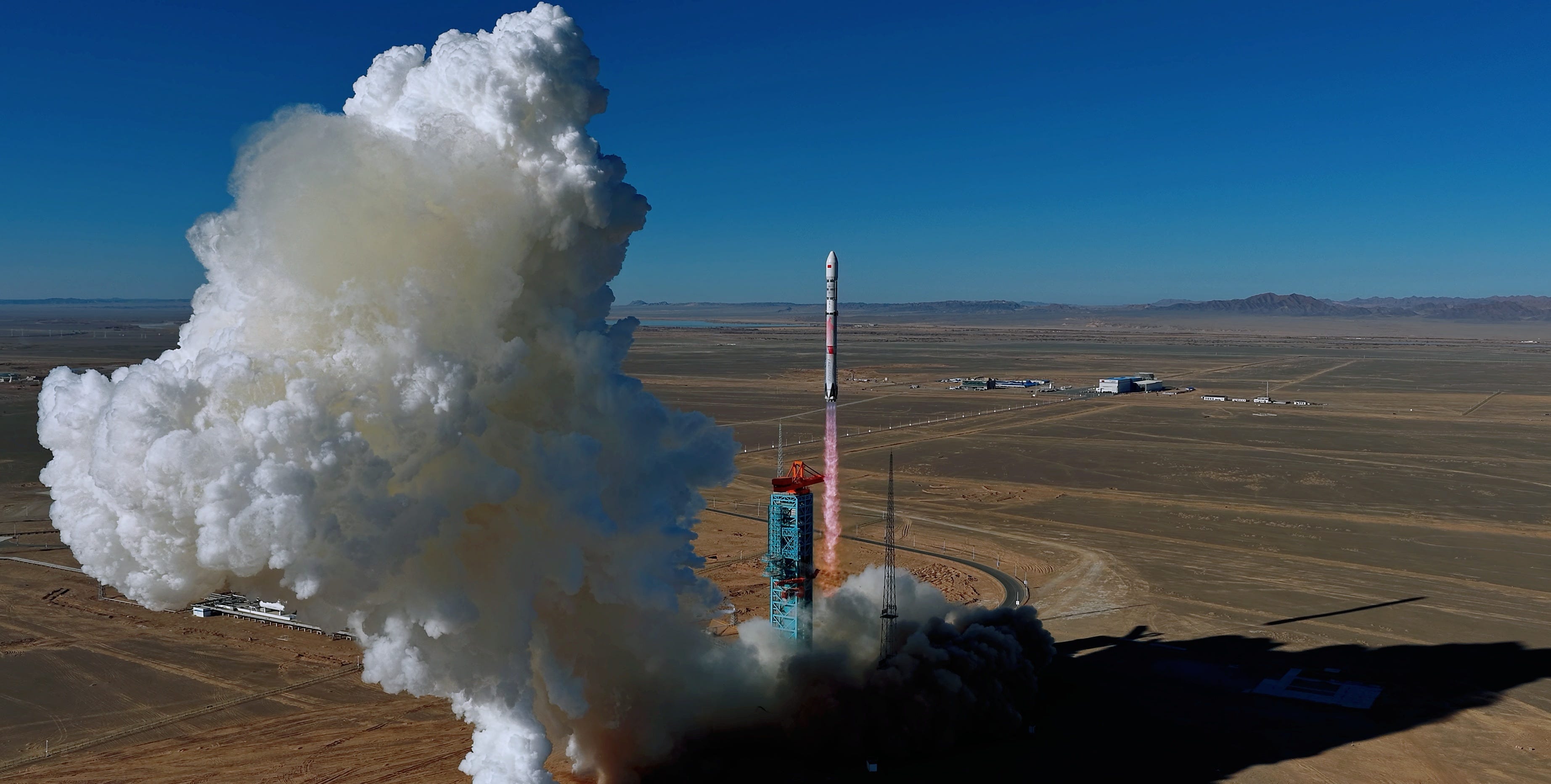
2025 has been the busiest year for China’s space sector, with ninety-three launches taking place, two reusable rockets making their debuts, new technology demonstrations in space, exploration efforts departing Earth, and a continued human presence in low Earth orbit. With the year now over, the start of 2026 is a good opportunity to briefly look back, and ahead to the new year.
Looking back on 2025
Tiangong remains crewed despite first emergency
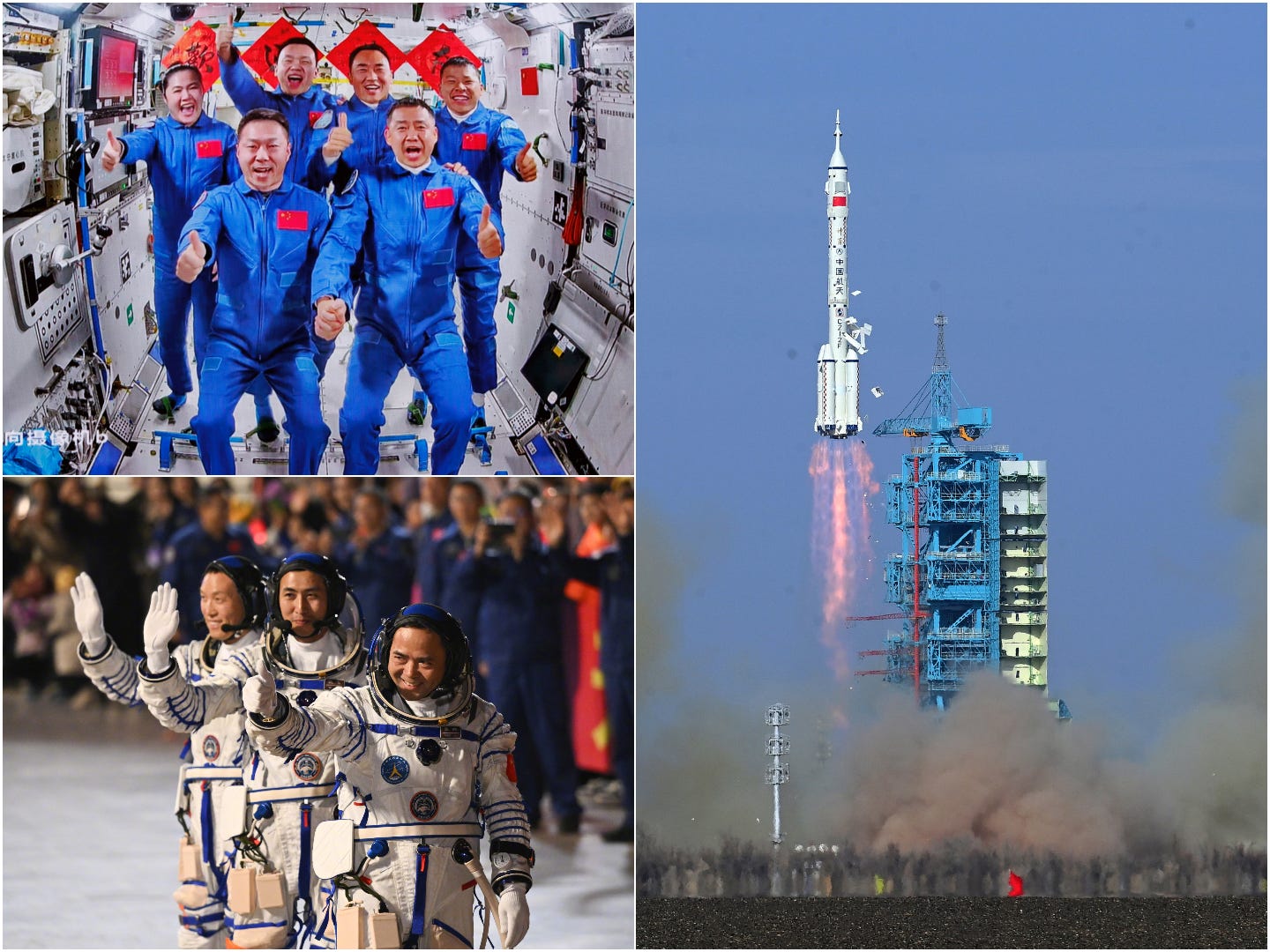
To start this year’s activity onboard the Tiangong Space Station, the incumbent Shenzhou-19 crew of Commander Cai Xuzhe (蔡旭哲), Operator Song Lingdong (宋令东), and Science Operator Wang Haoze (王浩泽), performed their second spacewalk over January 20th and 21st to install space debris protection devices. Two months later on March 21st, another spacewalk was performed to install further protection devices, using life-extended second-generation Feitian (飞天航天服) spacesuits.
As the Shenzhou-19 mission headed towards its conclusion after six months in space, the Shenzhou-20 mission began on April 24th, carrying Commander Chen Dong (陈冬), Operator Chen Zhongrui (陈中瑞), and Science Operator Wang Jie (王杰) to the station, boarding it under a day later. With the new crew onboard, the Shenzhou-19 trio returned to Earth, touching down on April 30th.
During their time onboard the space station, the Shenzhou-20 crew conducted experiments related to life sciences in microgravity and tested a new AI assistant system. Four spacewalks were also performed on May 22nd, June 26th, August 15th, and September 25th, all to install debris protection devices.
By October, Chen, Chen, and Wang’s six-month mission was coming towards its end while the Shenzhou-21 mission was being prepared on Earth. That culminated in a successful launch on October 31st with Commander Zhang Lu (张陆), Flight Engineer Wu Fei (武飞), and Payload Expert Zhang Hongzhang (张洪章). A little over three hours after launch, the Shenzhou-21 spacecraft had docked with Tiangong and allowed a boarding shortly afterwards. During a handover period between the Shenzhou-20 and Shenzhou-21 crews, the six taikonauts had a barbecue feast using a new hot air oven.
When the Shenzhou-20 crew was expected to return in November, the China Manned Space Agency abruptly announced a delay to it. The reason for the delay would be revealed to be a debris strike to one of the Shenzhou-20 spacecraft’s windows. Due to the strike, the Shenzhou-20 trio took the Shenzhou-21 spacecraft back to Earth, returning on November 14th. Due to the early return-to-Earth use of Shenzhou-21 and the damage to the Shenzhou-20 spacecraft (still docked to Tiangong today), the Shenzhou-22 spacecraft launched as an ‘emergency response’ mission on November 25th to restore normal crew and cargo return capabilities.
After the events of November, Zhang, Wu, and Zhang have worked onboard Tiangong like its previous crews, maintaining experiments, participating in drills, and supporting new technology development. A spacewalk was also conducted on December 9th, where yet more protective devices were installed alongside maintaining a temperature controller.
Tianwen-2 starts trek to Kamoʻoalewa
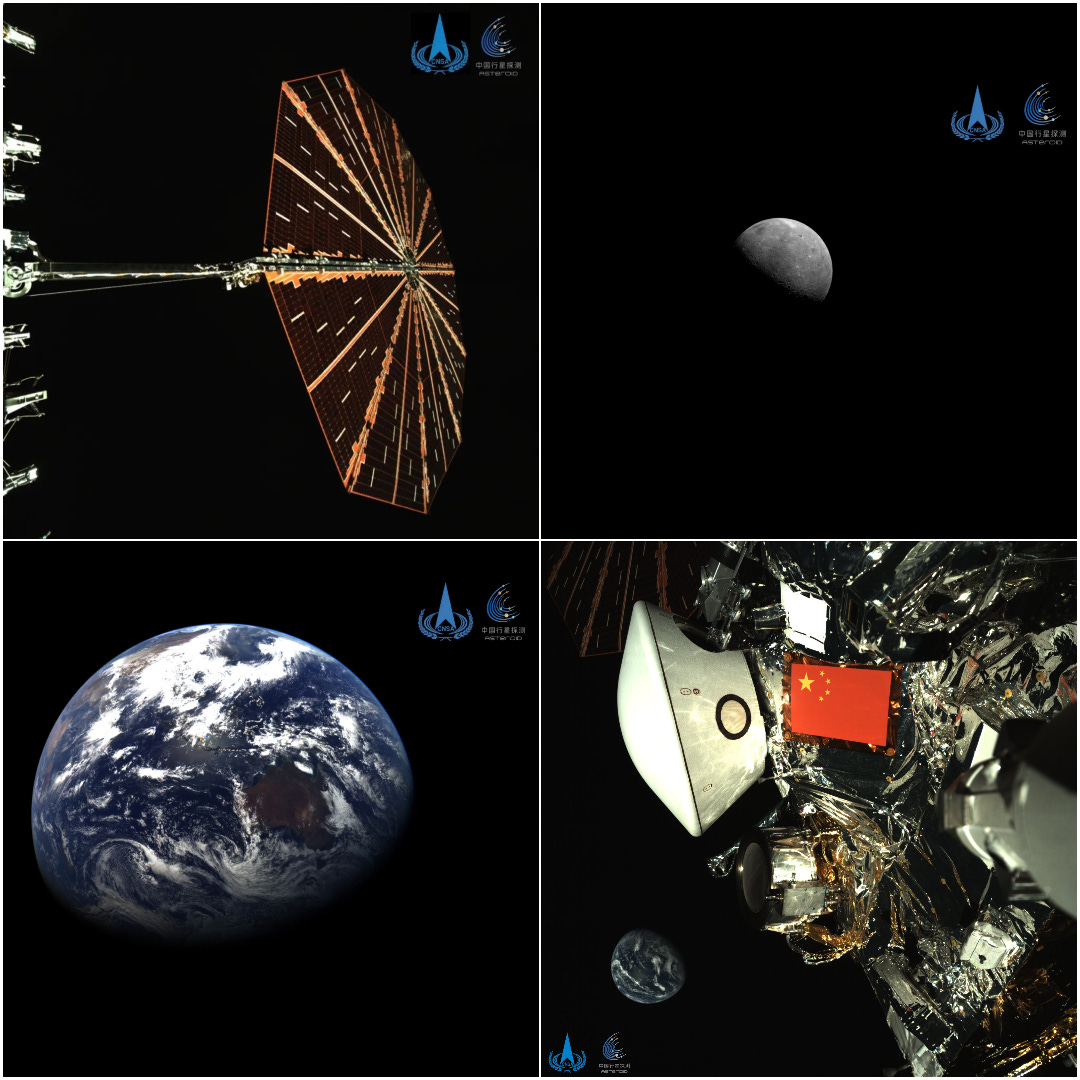
Back in May, the Tianwen-2 asteroid sample return mission was launched out of the Xichang Satellite Launch Center for a year-long mission to asteroid 2016HO3/469219 Kamoʻoalewa and back. Just over a week into the mission, the first images from the spacecraft began to be publicly released.
By July, the spacecraft was already twelve million kilometers away from Earth, and in October had reached the halfway point toward Kamo’oalewa, being forty-three million kilometers away from Earth and forty-five million kilometers from its target. At the moment, Tianwen-2 is on track for a summer 2026 arrival at the asteroid, followed by a sample collection and departure in 2027.
After collecting between 200 and 1,000 grams, they will be dropped off in a small reentry capsule back to Earth during a 2029 flyby, while Tianwen-2 will begin its extended mission to asteroid 311P/PanSTARRS out in the asteroid belt between Mars and Jupiter through the 2030s.
Steady progress towards human Moon missions
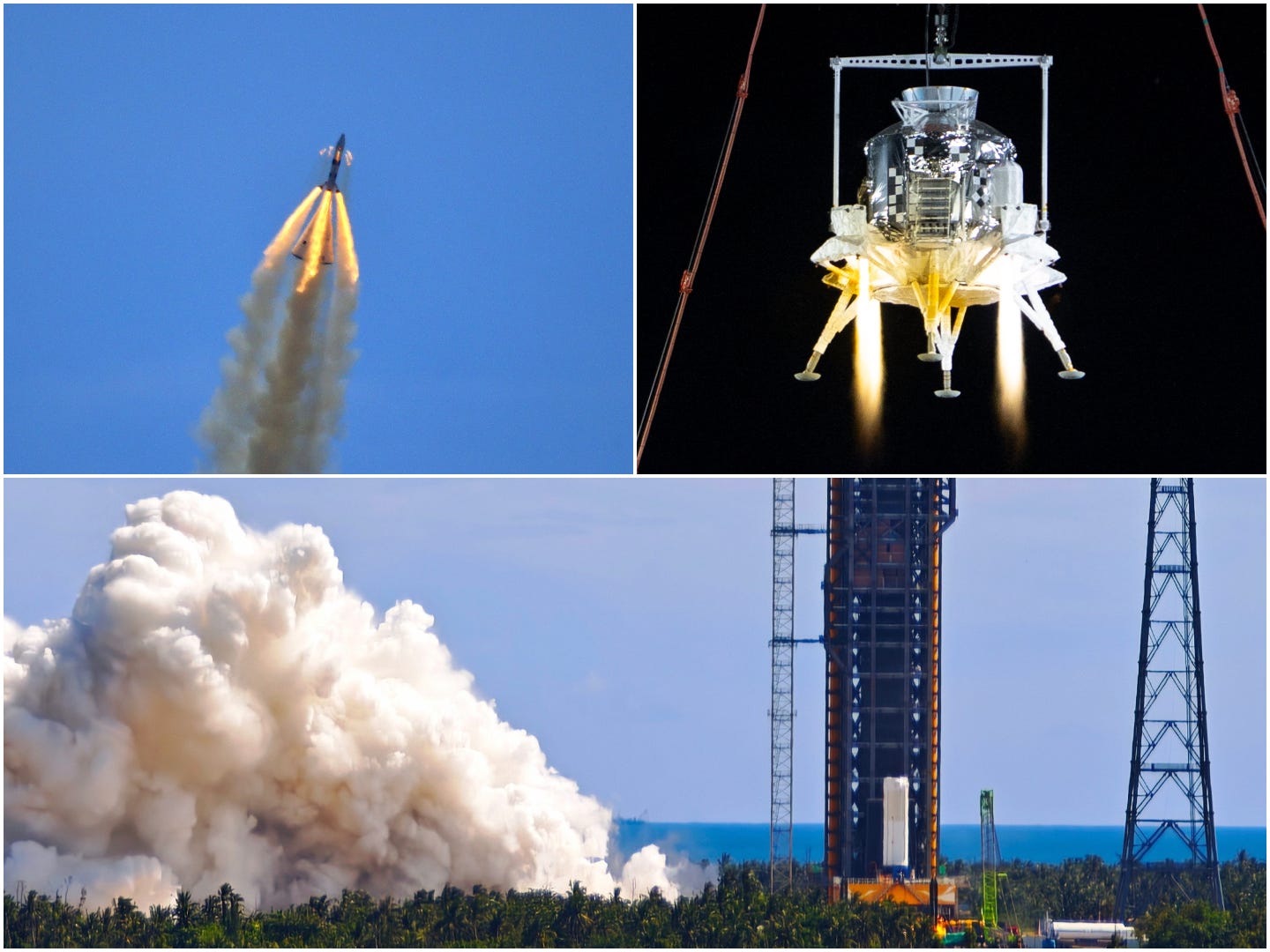
With a goal of landing taikonauts on the Moon before 2030, China has made steady progress towards that during the year, with a handful of major tests.
In June, the Mengzhou capsule shot up into the skies over the Jiuquan Satellite Launch Center for its zero-altitude launch escape test, to begin publicly known progress on the crewed lunar program in 2025. That test is relatively simple but highly important as a live launch escape system pulled a flight-representative Mengzhou off of a simulated launch pad failure, before the capsule’s parachutes were deployed for a soft touchdown.
Following Mengzhou, the Lanyue lunar lander concluded a set of various lunar landing and take-off tests in August. Using a purpose-built extraterrestrial gravity simulator, test flight burns for normal flight, emergency flight, and takeoff from different lunar surface environments were performed with a basically fully equipped propulsion, electrical, and support systems.
At the Wenchang Space Launch Site atop of the newly built, but not quite complete, Launch Complex 301, the Long March 10 series static fire article was placed on the pads’ mobile launch platform (of which there will be two) for its first test in August. That test saw seven YF-100K engines firing up for thirty seconds to prove simultaneous ignition, control, and operation of the engines. About a month later in September, a second test took place to demonstrate that the seven engines can be jointly controlled through low and high throttle settings while gimbaling.
The static fire tests at Launch Complex 301 are critical pre-flight milestones for the single-stick two-stage Long March 10A1 and triple-core three-stage Long March 102 launch vehicles before they fly in 2026 and 2027. During 2025, the engines powering both vehicles have been gaining flight experience elsewhere through the YF-100K on the Long March 12 and the YF-75DA on the Long March 8A.
Reusable rockets take off!
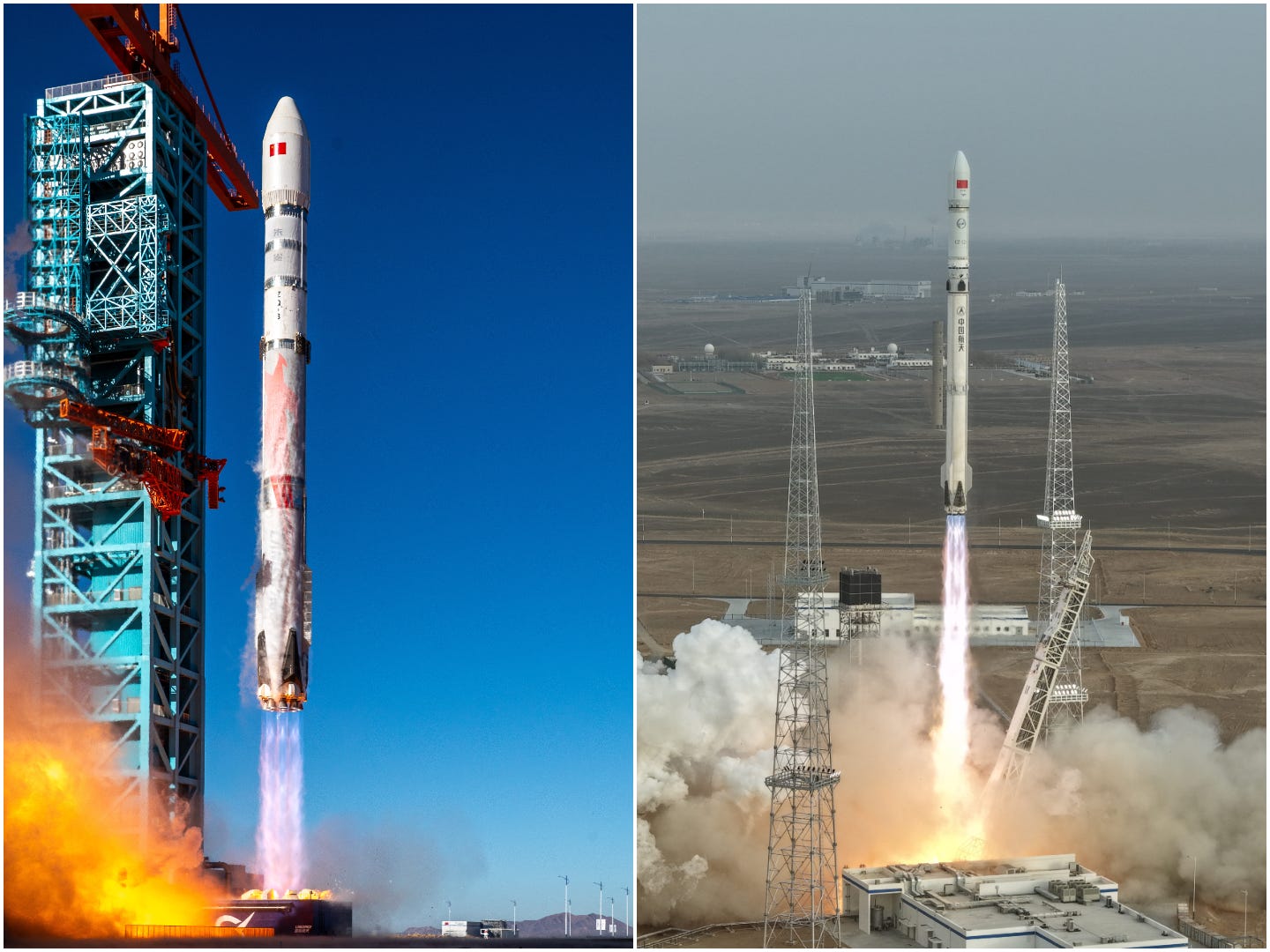
At the start of the year, around a half dozen reusable rockets from China’s state-owned and commercial space enterprises were expected to fly during the year. In 2025, just two took place.
On December 3rd, LandSpace performed China’s first flight of a partially reusable launch vehicle with its Zhuque-3 flying out of the Jiuquan Satellite Launch Center. The liquid methane and liquid oxygen burning rocket successfully and cleanly flew into low Earth orbit, while making it most of the way back to Earth.
Just before entering the atmosphere, an approximately 46-second burn was performed to protect the stage from intense reentry heat, allowing for a continuation of the descent. Almost a minute after that, the landing burn began, but an anomaly occurred shortly afterward, resulting in the booster undergoing a partial, rapid, unscheduled disassembly before hitting the edge of its landing pad at speed.
A little over three weeks later on December 23rd, the Shanghai Academy of Spaceflight Technology was ready to fly its Long March 12A launch vehicle, also burning liquid methane and liquid oxygen and flying from Jiuquan. Like Zhuque-3, the rocket performed a perfect flight into low Earth orbit, followed by being lost on its journey towards landing.
Following its ascent burn and separation from the second-stage, the Long March 12A’s booster passed its atmospheric reentry burn in one piece, albeit a little on fire. During its landing burn, three engines were meant to ignite, but only two engines ignited and the other failed, resulting in a high-speed impact with the ground around five kilometers away from its landing pad.
Both flights are still a huge success for China, as both surpassed Blue Origin’s New Glenn’s first flight by a significant margin, and is far along in SpaceX’s testing process for Falcon 9 by comparison.
TJSW spacecraft fleet doubles
Since January and through to the end of the year, a new TJSW (通信技术试验卫星) spacecraft, known as Communication Technology Experimental Satellite in English, has been heading to or above geostationary space most months, allowing for a doubling in size of the fleet. This year saw a total of nine satellites for the series launch via the Long March 3B/E, Long March 7A, and Long March 5 with its larger fairing variant. Launch dates and the present orbits for the satellites are:
January 23rd, TJSW-14 on a Long March 3B/E. Now in geostationary orbit over Central Africa.
March 10th, TJSW-15 on a Long March 3B/E. Now in geostationary orbit over the east of the Indian Ocean.
March 29th, TJSW-16 on a Long March 7A. Now in geostationary orbit just to the east of New Guinea.
April 10th, TJSW-17 on a Long March 3B/E. Now in geostationary orbit slightly further to the East of New Guinea.
May 12th, TJSW-19 on a Long March 3B/E. Now in geostationary orbit over New Guinea.
October 23rd, TJSW-20 on a Long March 5. Now in geosynchronous orbit over the west of the Indian Ocean.
November 21st, TJSW-21 on a Long March 3B/E. Now in high Earth orbit while lingering over the northern hemisphere.
December 9th, TJSW-22 on a Long March 3B/E. Now in geostationary orbit over the central-western Indian Ocean.
December 20th, TJSW-23 on a Long March 5. Currently in transit to its operational orbit.
Through the launches this year, the TJSW fleet now sits in a chain across the sky from Central Africa to the Pacific Ocean just east of New Guinea. 2025’s additions join TJSW-4, TJSW-5, TJSW-6, TJSW-9, TJSW-10, TJSW-11, and TJSW-12 in the chain. Meanwhile, TJSW-7 remains rather lonely above the Pacific to the West of South America. With TJSW-21, TJSW-13 is less lonely in high Earth orbit over the northern hemisphere.
For all of the TJSW launches this year, the reported purpose has been that they are for communications, radio, television, and data transmission, while having a secondary task of technology verification of multi-band high-speed throughput communications.
China likely demonstrated autonomous in-space refueling
Starting with the launch of the Shijian-25 (实践二十五号) in-space refueling technology demonstration spacecraft for China’s first launch of the year, satellite operators have been taking slow steps to prove the world’s first autonomous in-space refueling out in geostationary space. For that, Shijian-25 targeted Shijian-21 (实践二十一号), previously tasked with debris mitigation.
Throughout the first half of the year, the two spacecraft were slowly heading towards each other, likely to conserve propellant, before coming within a few kilometers for what is now thought to have been a docking rehearsal in mid-June. That was followed by an actual docking in June-July after the spacecraft became indiscernible from one another.
Over July and August, a refueling of Shijian-21 from Shijian-25 is believed to have taken place due to several weeks of inactivity. Those were followed by a small burn for an orbital drift, then a larger energy-intensive orbital inclination-lowering burn3. Finally in December, the two spacecraft were spotted separate from one another, after months of no observable activity, another possible indication of refueling tests.
Now following what is believed to have been a successful refueling demonstration, Shijian-25 and Shijian-21 are operating in close proximity to each other again. Possibly for post-test inspections or further technology demonstrations.
Constellations ramp up deployments
In 2025, China’s planned connectivity mega-constellations saw almost two hundred satellites placed into orbit for five separate efforts, those were:
January 23rd - Polar Group 06 (18 satellites)
March 11th - Polar Group 05 (18 satellites)
October 17th - Polar Group 18 (18 satellites)
February 11th - GuoWang Group 02 (9 satellites)
April 29th - GuoWang Group 03 (10 satellites)
June 6th - GuoWang Group 04 (5 satellites)
July 27th - GuoWang Group 05 (5 satellites)
July 30th - GuoWang Group 06 (9 satellites)
August 4th - GuoWang Group 07 (9 satellites)
August 13th - GuoWang Group 08 (10 satellites)
August 17th - GuoWang Group 09 (5 satellites)
August 25th - GuoWang Group 10 (9 satellites)
September 27th - GuoWang Group 11 (5 satellites)
October 16th - GuoWang Group 12 (9 satellites)
November 10th - GuoWang Group 13 (9 satellites)
December 6th - GuoWang Group 14 (9 satellites)
December 8th - GuoWang Group 15 (5 satellites)
December 12th - GuoWang Group 16 (9 satellites)
December 26th - GuoWang Group 17 (9 satellites)
Geely Future Mobility Constellation
August 8th - Future Mobility Group 04 (11 satellites)
September 8th - Future Mobility Group 05 (11 satellites)
September 24th - Future Mobility Group 06 (12 satellites)
May 19th - Tianqi-16, 17, 19, & 20 (4 satellites)
Three-Body Computing Constellation
May 15th - Computing Group 01 (12 satellites)
As is shown above, the state-backed GuoWang was 2025’s big winner with sixteen launches for one hundred and twenty-six satellites, followed by the Shanghai-backed Qianfan constellation, which managed just three launches of fifty-four spacecraft due to issues plaguing previously deployed groups. Automaker Geely managed to have thirty-six satellites launched for three groups of its Future Mobility Constellation, while ADA Space’s AI compute constellation saw just one group of twelve satellites, and Guodian Gaoke (国电高科) deployed just four Tianqi spacecraft.
What’s to come in 2026?
Chang’e 7 to explore the lunar south pole
In August 2026, the Chang’e 7 mission, the latest installment in China’s lunar exploration program, is set to be launched atop of a Long March 5 and head towards the Moon, where it will land on a permanently illuminated peak next to Shackleton crater, at 123.4 degrees East and 88.8 degrees South.
Once on the lunar surface, the mission will search for traces of ice in and below the surface, while also investigating the resources around its landing site. Chang’e 7 is set to conduct its search for at least eight years, while supporting six global instruments from Egypt, Bahrain, Switzerland, Russia, Thailand, Italy, and the United States4.
More reusable rockets incoming
With only two reusable launch vehicles having flown in 2025, the debut flights of many expected have been moved into 2026. The various vehicles hopefully flying this year are5:
Long March 10A: from the China Academy of Launch Vehicle Technology to be able to lift up to 18,000 kilograms into low Earth orbit.
Long March 10B: from the China Academy of Launch Vehicle Technology to place up to 16,000 kilograms into low Earth orbit when reused.
Long March 12B: from the Shanghai Academy of Launch Vehicle Technology for sending up to 15,000 kilograms into sun-synchronous orbit or 12,000 kilograms into low Earth orbit.
Tianlong-3: from Space Pioneer and planned to be capable of delivering 17,000 kilograms to low Earth orbit or 14,000 kilograms to a sun-synchronous orbit.
Kinetica-2: from CAS Space and capable of carrying 12,000 kilograms to low Earth orbit or 8,000 kilograms to a sun-synchronous orbit.
Pallas-1: from Galactic Energy to carry 8,000 kilograms to low Earth orbit. For missions to a 700-kilometer sun-synchronous orbit, it will handle up to 5,000 kilograms.
Nebula-1: from Deep Blue Aerospace and set to carry up to 2,000 kilograms to low Earth orbit, with planned upgrades increasing this capacity to 6,000 kilograms.
Gravity-2: from OrienSpace and it should carry 17,400 kilograms to low Earth orbit, 11,900 kilograms to a 500-kilometer sun-synchronous orbit, or 3,900 kilograms to a geostationary transfer orbit.
Yuanxingzhe-1: from Space Epoch and expected to lift 6,500 kilograms to a 1,100-kilometer sun-synchronous orbit.
AS-1: from Astronstone to send up to 15,700 kilograms into orbit when expended or 10,000 kilograms when reused.
Hyperbola-3: from iSpace and carrying up to 13,600 kilograms to low Earth orbit in expendable mode and 8,600 kilograms when reused.
Leap-1: from Cosmoleap and set to carry 6,250 kilograms with booster recovery or 10,400 kilograms with the booster expended to a low Earth orbit altitude of 1000 kilometers.
Mengzhou spacecraft to fly debut mission
In 2026, the Mengzhou spacecraft is expected to perform its debut mission into Earth orbit, launched via a Long March 10A. This mission has been outlined by the China Manned Space Agency, flying uncrewed with an unknown date, as heading to the Tiangong Space Station through two mission logo notices.
Menghzou’s first flight is largely expected to validate spacecraft performance during flight alongside delivering and returning cargo to the space station.
Tiangong to host Pakistani visitor, 12-month taikonaut stay
Announced in February via an agreement between the China Manned Space Agency and Pakistan’s Space and Upper Atmosphere Research Commission, a Pakistani astronaut is expected to visit Tiangong in 2026, becoming the station’s first international visitor when they do.
As for when that will take place, it has been indicated that it will be via the Shenzhou-24 mission in October 2026. For that, the visitor will head up with the Shenzhou-24 crew, remain onboard for about a week, before returning on board the Shenzhou-23 spacecraft. For that, a taikonaut from the Shenzhou-23 crew will be onboard the station for one year, to accommodate the visitor, returning via the Shenzhou-24 spacecraft, becoming the first taikonaut to spend a whole year in space.
Will the Xuntian telescope launch?
Having been delayed to December 2026 way back in May 2024, the Xuntian (巡天) space telescope could launch into low Earth orbit, where it will co-orbit and occasionally dock with Tiangong, this year atop of a Long March 5B. News on the 15,500-kilogram telescope has been scarce since the delay, with slow but stable progress on its systems, with issues from its 2-meter mirror being ironed out.
Once launched, the primary mission for Xuntian will be high-resolution large-area multiband imaging, slitless spectroscopy surveys, and for precise cosmology. Xuntian has a total of five instruments onboard for its mission: a survey camera, a terahertz receiver, a multichannel imager, an integral field spectrograph, and a cool planet imaging coronagraph. The telescope is also set to be three hundred times more powerful than NASA’s Hubble space telescope.
China’s launches in 2025
Throughout the year, China continued to head into space to perform science onboard Tiangong, support life on Earth with weather satellites and connectivity constellations, while demonstrating new technologies across orbits. For those and many more missions, an incredible national-record-breaking ninety-three orbital launches took place, far surpassing 2024’s sixty-eight.
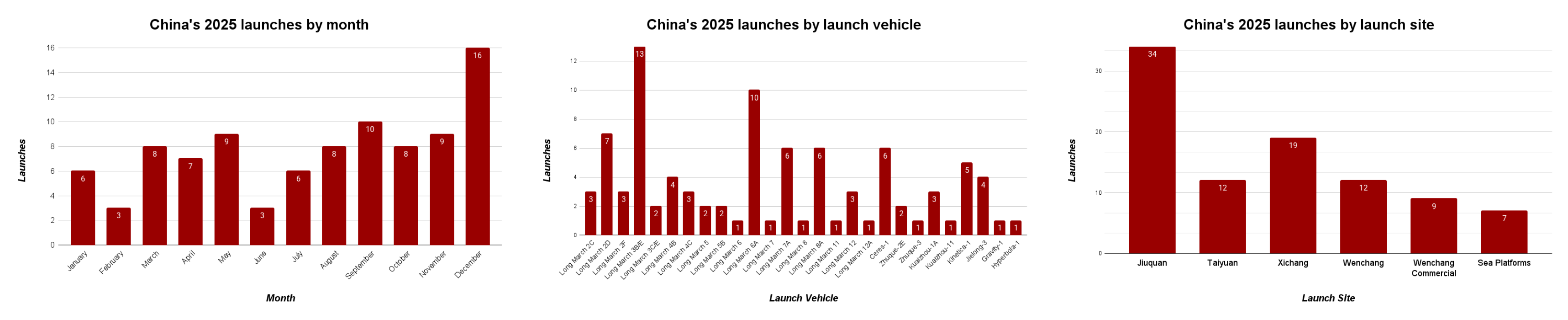
Across the country’s five launch sites and a few sea-launch platforms, the Jiuquan Satellite Launch Center was far out in front, supporting thirty-four missions, followed by the Xichang Satellite Launch Center with nineteen, while the Wenchang Space Launch Site and the Taiyuan Satellite Launch Center tied with twelve, as the Wenchang Commercial Space Launch Site saw nine launches over its first full calendar year in operation, while sea-launch platforms supported just seven missions.
As for what was flying, a total of twenty-seven different rockets flew this year, with the Long March series accounting for 74.19 percent and commercial options making up the remaining 25.81 percent. Regarding older-generation hypergolic-fuelled Long March vehicles6, those made up just 37.63 percent of the national launch total, while being 50.72 percent of Long March missions.
For the top five flown vehicles, the Long March 3B/E got an early lead over every other Chinese launch vehicle via its thirteen flights this year, as the Long March 6A claimed a solid second place with ten launches, ahead of the third-place Long March 2D with seven missions, while with six missions each the Long March 7A, Long March 8A, and Galactic Energy’s Ceres-1 reached a joint fourth, and CAS Space’s Kinetica-1 end up in fifth via its five missions.
Like 2024, December ended up being the busiest month (although not tied with May in 2025), followed by May and November, then August and October. February and June jointly saw the least launch activity.
If you would like to know what each of China’s launches this year was, they are listed in order below with a link to reports on each of them:
Long March 3B/E with the Shijian-25 (实践二十五号) in-space refueling technology demonstration spacecraft.
Jielong-3 with ten CentiSpace-1 (厘空间01组10颗) navigation satellites.
Long March 2D with Pakistan’s PRSC-EO1, Tianlu-1 (天路一号), and Lantan-1 (蓝碳一号), all for Earth observation.
Ceres-1 with four Yunyao-1 (云遥一号) meteorology satellites and Jitianxing-A-05 (吉天星A-05) remote sensing spacecraft.
Long March 3B/E with communications spacecraft TJSW-14 (通信技术试验卫星十四号).
Long March 3B/E communications satellite ChinaSat-10R (中星10R).
Long March 2C with Siwei Gaojing-1 03 (四维高景一号03) and Siwei Gaojing-1 04 (四维高景一号04) remote sensing satellites.
Kauizhou-1A with unknown payloads (2025 failure No.1).
Long March 3B/E with communications spacecraft TJSW-15 (通信技术试验卫星十五号).
Long March 2D with Siwei Gaojing-3 02 (四维高景三号02) and Tianyan-23 (天雁23) for Earth observation.
Ceres-1 with six Yunyao-1 (云遥一号) meteorological satellites, and Zhongke 06 (中科卫星06) and Zhongke 07 (中科卫星07) remote sensing spacecraft.
Ceres-1 with six Yunyao-1 (云遥一号) meteorological spacecraft.
Long March 3B/E with relay satellite Tianlian-2-04 (天链二号04星).
Long March 7A with communications spacecraft TJSW-16 (通信技术试验卫星十六号).
Long March 2D with four spacecraft for satellite internet technology testing and verification.
Long March 6 with space environment monitoring spacecraft Tianping-3A-02 (天平三号A星02星).
Long March 3B/E with communications satellite TJSW-17 (通信技术试验卫星十七号).
Long March 6A with six Shiyan-27 satellties (试验二十七号卫星01星/02星/03星/04星/05星/06星).
Long March 2F/G with Shenzhou-20 carrying Chen Dong (陈冬), Chen Zhongrui (陈中瑞), and Wang Jie (王杰).
Long March 3B/E with relay spacecraft Tianlian-2-05 (天链二号05星).
Long March 6A with three satellites for Yaogan-40 Group-02 (遥感四十号02组).
Long March 3C/E with communications satellite TJSW-19 (通信技术试验卫星十九号).
Long March 2D with twelve satellites for the Three-Body Computing Constellation.
Zhuque-2E with Tianyi-29 (天仪29星), Tianyi-34 (天仪34星), Tianyi-35 (天仪35星), Tianyi-42 (天仪42星), Tianyi-45 (天仪45星), and Tianyi-46 (天仪46星).
Ceres-1S with four Tianqi (天启) Internet-of-Things satellites.
Long March 7A with communications spacecraft ChinaSat-3B (中星3B).
Kinetica-1 with Taijing-3-04 (泰景三号04), Taijing-4-02A (泰景四号02A), Xingrui-11 (星睿十一号), Xingjiyuan-1 (星迹源一号), Lifang108-001 (立方108-001), and Xiguang-1-02 (西光壹号02).
Long March 3B/E with the Tianwen-2 asteroid sample return mission.
Long March 4B with the Shijian-26 (实践二十六号) remote sensing satellite.
Long March 2D with Italo-Chinese Zhangheng-1-02 (张衡一号02星) geophysical field detection satellite.
Long March 3B/E with communications satellite ChinaSat-9C (中星9C).
Long March 4C with space monitoring satellite Shiyan-28B-01 (试验二十八号B星01星).
Hyperbola-1 with remote sensing-tasked Enshi Selenium Capital Mountain Spring Satellite (恩施硒都山泉号卫星).
Zhuque-2E with unknown payloads (2025 failure No.2).
Long March 4C with space monitoring satellite Shiyan-28B-02 (试验二十八号B星02星).
Kinetica-1 with ThumbSat-1, ThumbSat-2, Zhongke-05 (中科卫星05), Duogongneng Shiyan-2-01 (多功能试验二号01), Duogongneng Shiyan-2-02 (多功能试验二号02), Duogongneng Shiyan-2-03 (多功能试验二号03), and Tianyan-26 (天雁26).
Long March 3C/E with space monitoring satellite Shiyan-29 (试验二十九号).
Ceres-1 with Earth imaging spacecraft Kaiyun-1 (开运一号) and Yuxing-3-08 (驭星三号08), as well as meteorology satellite Yunyao-1-27 (云遥一号27).
Long March 6A with three satellites for Yaogan-40 Group-03 (遥感四十号03组).
Long March 7A with the Yaogan-45 (遥感四十五号卫星) remote sensing spacecraft.
Long March 2C with four satellites for internet technology testing and verification.
Long March 4C with the Fengyun-3H (风云三号H) weather satellite.
Long March 2D with the Earth observing Shiyan-30 01 and 02 (试验三十号卫星01, 02).
Gravity-1 with the Earth monitoring satellites Shutianyu 01 and 02 (数天宇星01/02试验星) alongside Jixing Wideband 02B07 (吉星宽幅02B07星).
Long March 2D with the optical imaging spacecraft Shiyan-31 (试验三十一号卫星).
Kinetica-1 with Pakistan’s PRSC-HS1 alongside AIRSAT-03 (中科卫星03星) and AIRSAT-04 (中科卫星04星).
Long March 5 with communications spacecraft TJSW-20 (通信技术试验卫星二十号).
Long March 3B/E with optical stereo mapping satellite Gaofen-14-02 (高分十四号02星).
Long March 2F/G with the Shenzhou-21 mission carrying Zhang Lu (张陆), Wu Fei (武飞), and Zhang Hongzhang (张洪章).
Long March 7A with remote sensing satellite Yaogan-46 (遥感四十六号卫星).
Long March 11H with Shiyan-32-01, 02, and 03 (试验三十二号卫星01星,02星,03星) for optical imaging testing.
Kinetica-1 with Chutian-2-01 and Chutian-2-02 (楚天二号技术试验01星,02星) technology testing satellites.
Ceres-1 with Jixing Gaofen 04C (吉星高分04C星), Jixing Platform 02A04 (吉星平台02A04星), and North China University of Technology Satellite-1 (中北大学一号卫星). (2025 failure No.3).
Long March 2C with space environment monitoring satellites Shijian-30A, 30B, and 30C (实践三十号A, B, C).
Long March 3B/E with communications satellite TJSW-21 (通信技术试验卫星二十一号).
Long March 2F/G carrying the ‘emergency response’ Shenzhou-22 spacecraft.
Long March 7A with the officially mission-less Shijian-28 (实践二十八号).
Kuaizhou-1A with VDES-A and VDES-B (VDES卫星A星B星) for maritime navigation and communications support.
Long March 4B with the Yaogan-47 (遥感四十七号卫星) remote sensing satellite.
Long March 3B/E with communications spacecraft TJSW-22 (通信技术试验卫星二十二号).
Kinetica-1 with Egypt’s Space Plasma Nano-satellite Experiment (SPNEX), United Arab Emirates’ UAE-813 Satellite, a satellite for Nepal’s ‘Slippers to Satellite’ program, Dongpo-15 (东坡15号卫星), Yixing-2 09 (驭星二号09星), Yixian-A (逸仙-A星), Jilin Gaofen 07B01 (吉星高分07B01星), Jilin Gaofen 07C01 (吉星高分07C01星), and Jilin Gaofen 07D01 (吉星高分07D01星).
Kuaizhou-11 with the commercial cargo spacecraft Dear-5 (迪迩五号) and remote sensing satellite Hope-5 Phase-II (希望五号二期卫星).
Long March 4B with the Ziyuan-3-04 (资源三号04星) remote sensing satellite.
Long March 5 with communications satellite TJSW-23 (通信技术试验卫星二十三号).
Long March 3B/E with the Fengyun-4C (风云四号C星) weather satellite.
Long March 7A with the Shijian-29A and Shijian-29B (实践二十九号卫星A星/B星) space environment monitoring satellites.
China in Space’s 2025
For the site’s first proper full calendar year, China in Space has had an incredible year, going from nineteen subscribers to just over five hundred and fifty, alongside around six hundred and twenty Substack-network followers. Through the dedicated readership of the now hundreds of you all, the articles published this year were read just shy of two hundred thousand times in total!
In 2026, no major changes are currently planned for content being released compared to 2025. Around the middle of the year, there may be fewer articles than has been standardized, as I look to wrap up my university studies. Posts relating to major missions or historical space anniversaries should be ready regardless.
To conclude, I’d like to thank every paying and free subscriber who joined and followed China in Space in 2025; it has been the best encouragement to remain writing and practicing reading Chinese. I hope to see you all back here next year, along with many others!
Dedicated to low Earth orbit tests of lunar mission hardware, the Tiangong Space Station, and government missions. The rocket is able to lift up to 18,000 kilograms into low Earth orbit.
Dedicated to the crewed lunar landing program and able to send up to 27,000 kilograms on a trans-lunar trajectory.
Orbital inclination is how many degrees north or south a satellite drifts from the equator during its orbit.
Via the International Lunar Observatory Association in partnership with the University of Hong Kong’s Laboratory for Space Research.
With the major development or hardware updates linked.
Those vehicles are: Long March 2C, Long March 2D, Long March 2F, Long March 3B/E, Long March 3C/E, Long March 4B, and Long March 4C.