


Commercial manufacturer of spacecraft thermal management systems Thermal AI (热数科技) announced on August 12th that it has sourced new financial resources of several hundred million Yuan (at least 44.9 million United States Dollars, as of August 14th) in support of efforts in making larger systems.
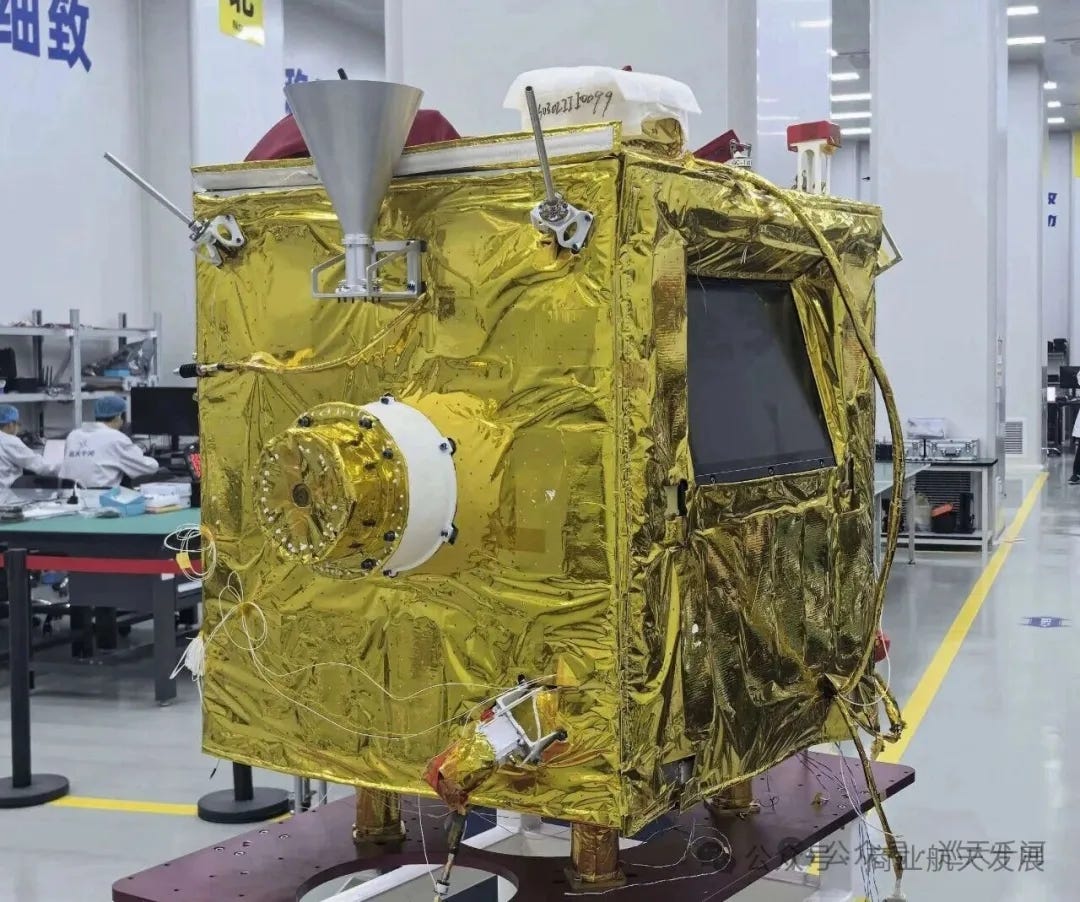
Without providing a timeline, the company shared that the capital will be used to develop its flexible-rollout thermal radiators as well as a verification in space, citing market demand for the technology. A first look at the flexible radiator was provided in April, where it was claimed to be able to dissipate over 10,000 watts of heat through an ‘innovative’ combination of materials that requires less radiator space, weighing only two kilograms per square meter.
Demand for such a system has come from efforts to place massive amounts of computing infrastructure in space, primarily for artificial intelligence (AI) purposes, on sizeable singular spacecraft. Several enterprises in China’s space sector are actively exploring doing so, with state-owned firms believing it to be possible in the near future.
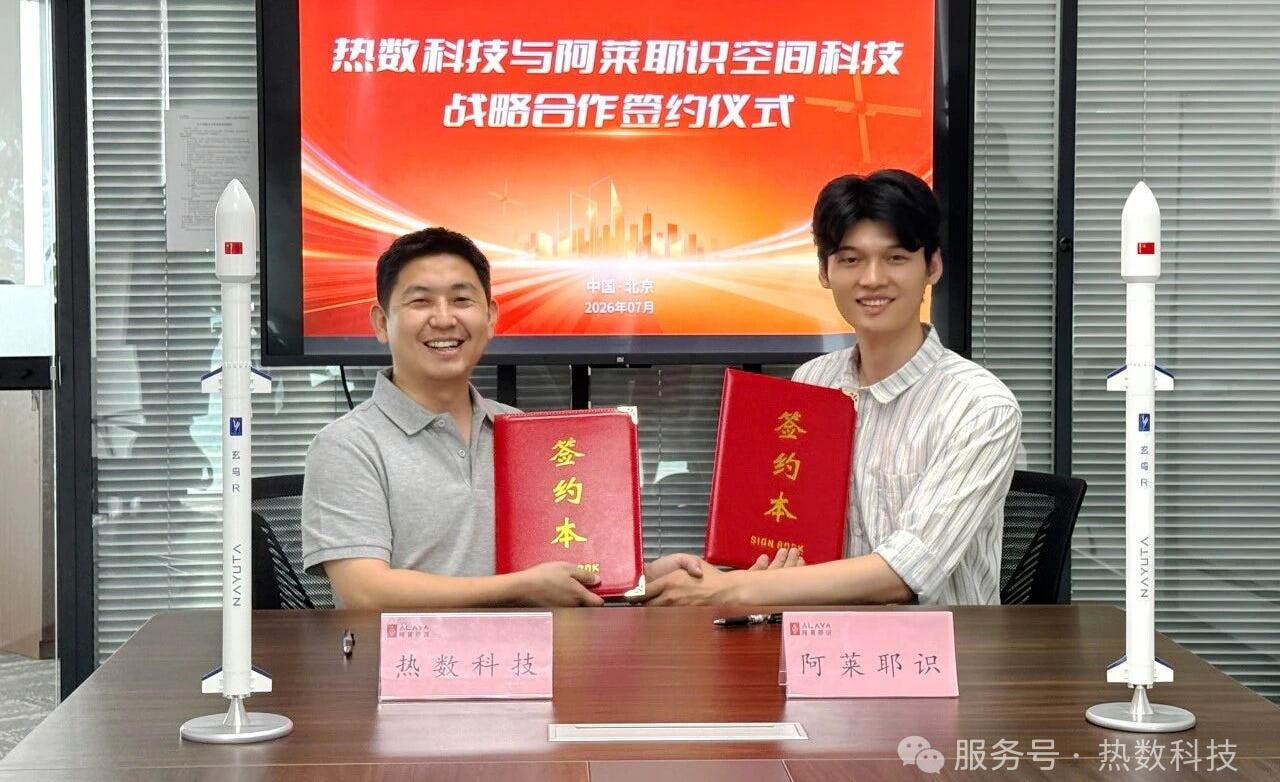
Launch startup Nayuta Space (千亿航天) is one of those enterprises exploring it, with its ‘Ālaya’ concept to modify their reusable launch vehicle’s second-stage as a platform for orbital computing by equipped them with the necessary hardware. That concept could be an anchor customer for the flexible radiators, as the Chief Executive Officers of Thermal AI, Lian Hongkui (连红奎), and Nayuta Space, Li Rui (李锐), signed a strategic cooperation agreement in July.
Using their currently developed systems, Thermal AI has supported ADA Space (国星宇航) and Zhejiang Lab’s (之江实验室) arguably world-leading and technologically impressive Three-Body Computing Constellation. Over three hundred thermal management components were used on just the first group of that orbital compute network and were produced within two and a half months.
Conventional satellites have, to date, made up the vast majority of the users of Thermal AI’s systems, with buyers from state-owned and commercial firms to universities. The company’s hardware first entered orbit in September 2024 and has since supported well over a dozen spacecraft, including the ultra-flat Zidingxiang-3 (紫丁香三号卫星)1 and a set of navigation satellites2. Some components are also aboard Qianfan’s (千帆) second group.
More AI for Earth imaging satellites
Meanwhile, at Earth imaging enterprise China Siwei Survey and Mapping Technology (中国四维测绘技术有限公司), owned by the China Aerospace Science and Technology Corporation, a new subsidiary has been set up in Hangzhou (杭州市) with a registered capital of 2 billion Yuan (296.5 million United States Dollars).
Currently doing business as Hangzhou Siwei Space Intelligent Technology Co Ltd (杭州四维太空智能科技有限公司), the subsidiary is reportedly tasked with exploring AI solutions for satellite systems and the data they collect, along with the innovative services enabled by them. Those solutions have already been explored and deployed on many satellites from commercial imaging firms over the past few years.
With that in mind, China Siwei is likely seeking to integrate AI capabilities onto its over a dozen upcoming satellites to better compete in the market. The company already operates a fleet of sixteen spacecraft3 capable of synthetic aperture radar, multispectral, panchromatic, and optical imaging.
By establishing a separate subsidiary to explore AI solutions, China Siwei reduces the financial risks directly linked to them, since it has only provided some of the startup capital.
According to publicly available information, China Siwei has only a 25 percent stake in Hangzhou Siwei; the state-owned Aerospace Investment Holdings Limited (航天投资控股有限公司)4 has a 24 percent stake; the largest stake of 26 percent is held by the municipally-owned Hangzhou West Lake Yunchuang Group Co Ltd (杭州西湖云创集团有限公司); and the fourth major stake holder is the state-linked Hangshi Technology Development Hangzhou Co Ltd (杭实创新(杭州)投资发展集团有限公司) with a 15 percent stake; while the remaing 10 percent his backed by two provincal funds under the Zhejiang (浙江) government.
Shanghai firm to trail first of 1,000 spacecraft
To chase down the current capabilities of ADA Space and those being tested by Orbital Chenguang (轨道辰光), Shanghai Xuntian Qianhe Space Technology Co Ltd (上海巡天千河空间技术有限公司) shipped out its first orbital computing demonstration satellite on August 10th.
Designated XS-01 (XS-01卫星), the satellite is reported as being equipped with a ‘large’ onboard AI model to monitor all systems and command its remote sensing tasks, while processing the collected data onboard before it gets sent to users on Earth. Parameters of the model or its verification plans were not mentioned.
What Xuntian Qianhe has been keen to mention to the media is its involvement in a constellation of 1,000 computing satellites in Earth orbit, operating in a similar way to the Three-Body Computing Constellation, led by Shanghai Xingshu Tiansuan Space Technology Co Ltd (上海星枢天算航天科技有限公司) and Fudan University (复旦大学), with support from the municipal government of Shanghai (上海市). 800 of those satellites are planned to be for ‘central’ computing while 200 are reserved for ‘edge’ compute. That constellation is currently simply known as the ‘Star Hub Plan (星枢计划)’ and was announced at the 2026 World AI Conference in mid-July.
Previously, Xuntian Qianhe has manufactured or supported a total of twelve satellites, including the AI-utilizing Tianyan-27 (天雁27) for ‘ultra-high resolution’ remote sensing and the more standard Yinglong Fengguang-1 (应龙风光一号卫星) weather spacecraft. The company claims it can make satellites weighing up to 1,000 kilograms too.
Launched July 22nd 2026 via Gravity-1.
Being the second group of CentiSpace (微厘空间02组卫星) navigation spacecraft from Beijing Future Navigation Technology Co Ltd (北京未来导航科技有限公司) atop of a Jielong-3 in March.
All launched by either the Long March 2C or Long March 2D launch vehicles, see a few:
Under the China Aerospace Science and Technology Corporation.