

Galactic Energy's Pallas-1 Appears at Jiuquan Ahead of Debut Flight
Another partially reusable launch vehicle has arrived at its launch site for the first time.

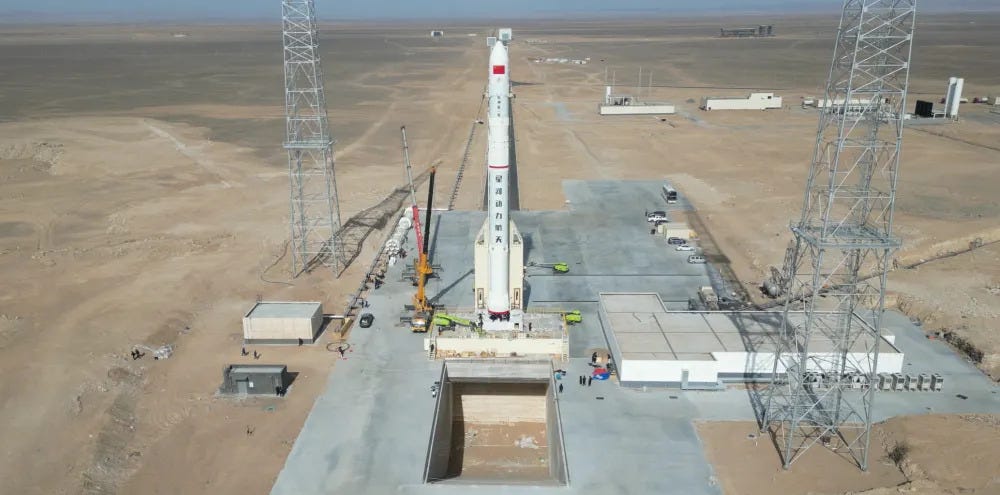
In a significant update regarding the development of the partially reusable Pallas-1, Galactic Energy shared on May 26th that the launch vehicle is at the Jiuquan Satellite Launch Center, and that the launch pad to support it is complete.
New facilities at Jiuquan include, of course, the launch pad, Pallas-1’s transporter-erector, two massive lightning diversion towers, rocket-grade kerosene, liquid oxygen, and gaseous pressurization pipelines to load the launch vehicle. Away from the pad, there is a horizontal vehicle integration building for Pallas-1 and payloads, as well as a local control office for resolving issues on site and hosting visitors before a launch. Those facilities are part of a ‘Phase One’ plan for operations at Jiuquan, with the company writing:
“With the official completion of Launch Pad Phase One, Galactic Energy has taken a solid step forward in infrastructure development, providing robust support for the high‑frequency, large‑scale launch of liquid‑propellant rockets and laying a firm foundation for the development and operation of the Pallas‑1 and subsequent rocket systems.”
If there are any problems with this translation please reach out and correct me.
Next door to Pallas-1’s facilities, there is also a blank concrete pad, visible to satellite imagery but not mentioned by Galactic Energy, likely to support operations of the company’s solid propellant Ceres-1 and Ceres-2 launch vehicles, which currently flies from Launch Site 95 alongside its competitors, decreasing flexibility.
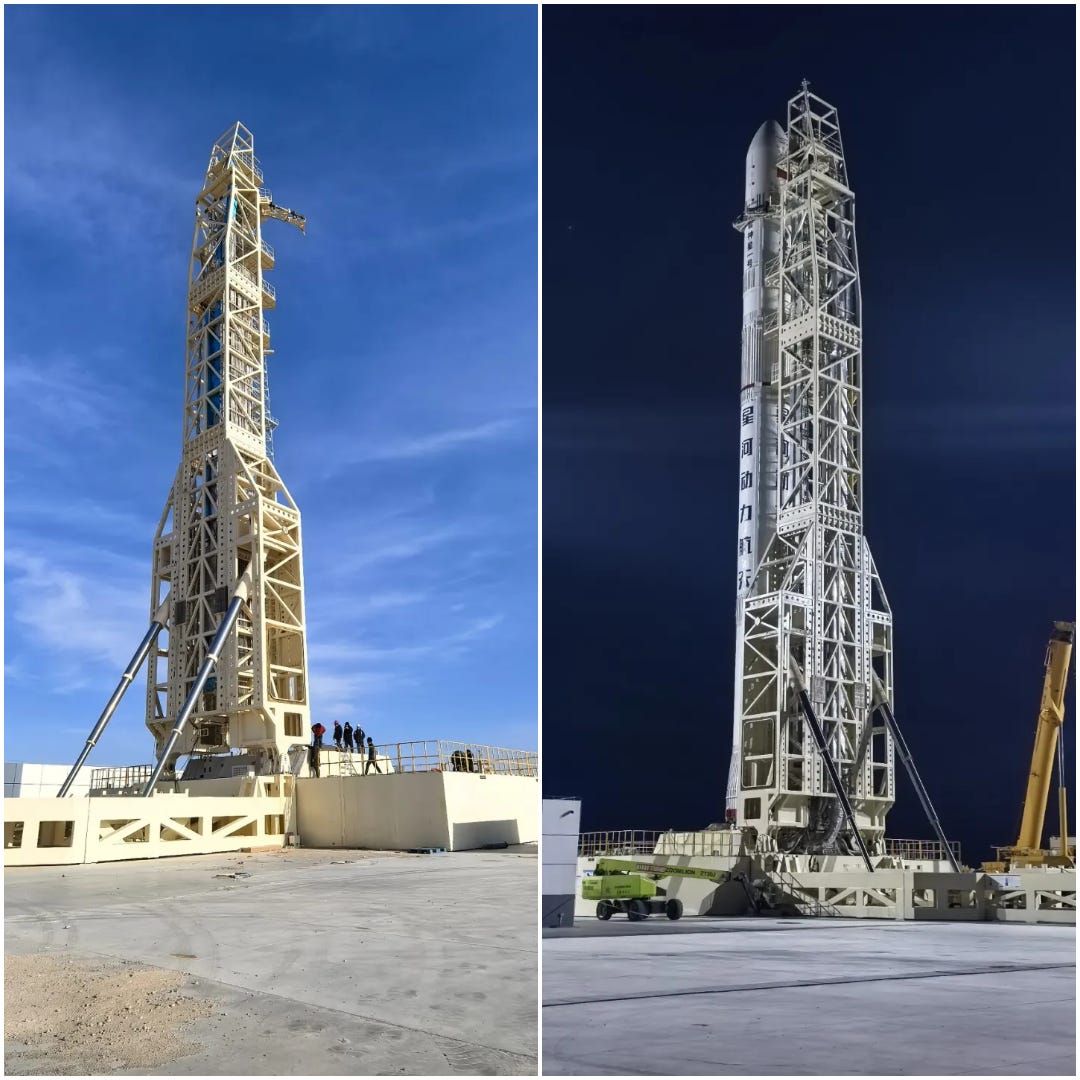
It’s unclear when Pallas-1 arrived in Jiuquan, as at the very end of 2025, the first complete launch vehicle was preparing to be shipped out while work on the launch pad continued. Whenever it occurred, shipping of the vehicle probably took a few days by truck, as did the transportation of Space Pioneer’s Tianlong-3 and LandSpace’s Zhuque-3.
In previous efforts to bring Pallas-1 towards its debut flight, a second-stage static fire took place in September 2025 to verify its expected engine performance in flight. Then in November 2025, the first-stage arrived in Haiyang (海阳市), Shandong (山东) province, for its pre-debut flight static fire, lighting its seven CQ-50 engines for a comprehensive test that included coordinated throttling of thrust levels up to 350 tons and gimbaling.
Between those static fires, Galactic Energy said they have made good progress on reusable rocket hardware, such as grid fins and landing legs. However, that hardware is not expected to be included on initial Pallas-1 flights.
Despite now being at Jiuquan, Galactic Energy has remained tight-lipped about when Pallas-1 will fly for the first time. Since the end of last year, the company has only vaguely said it will occur in the ‘near future’. Before that, it was expected that a launch would occur before the Spring Festival (春节) in mid-February, which obviously did not happen.
When Pallas-1 is ready to fly, it will stand about 42 meters tall, with its two 3.35-meter-diameter stages loaded with rocket-grade kerosene and liquid oxygen to have it weigh about 283,000 kilograms. It remains to be seen if customers will utilize the up to 8,000 kilograms of payload capacity on the launch vehicle’s first outing.
Upon flying, Pallas-1 will join a handful of reusable launch solutions1 that are operational in China. Launch vehicles that have done so to date are LandSpace’s Zhuque-3, the Shanghai Academy of Spaceflight Technology’s Long March 12A, CAS Space’s Kinetica-2, and Space Pioneer’s Tianlong-3. The China Academy of Launch Vehicle Technology’s Long March 10A and Long March 10B2, as well as the China Aerospace Science and Technology Commercial Launch Vehicle Group’s Long March 12B, are also near flying for the first time too.
Some flying expendably for the first few flights to prove reliability in delivering customer payloads into desired orbits and gaining manufacturing experience.
Delayed through this month due to issues with its launch pad.