

Kinetica-2 to Launch Commercial Geostationary Relay Satellites
CAS Space could become China’s first non-state-owned firm to deliver a customer’s payload into geostationary space.

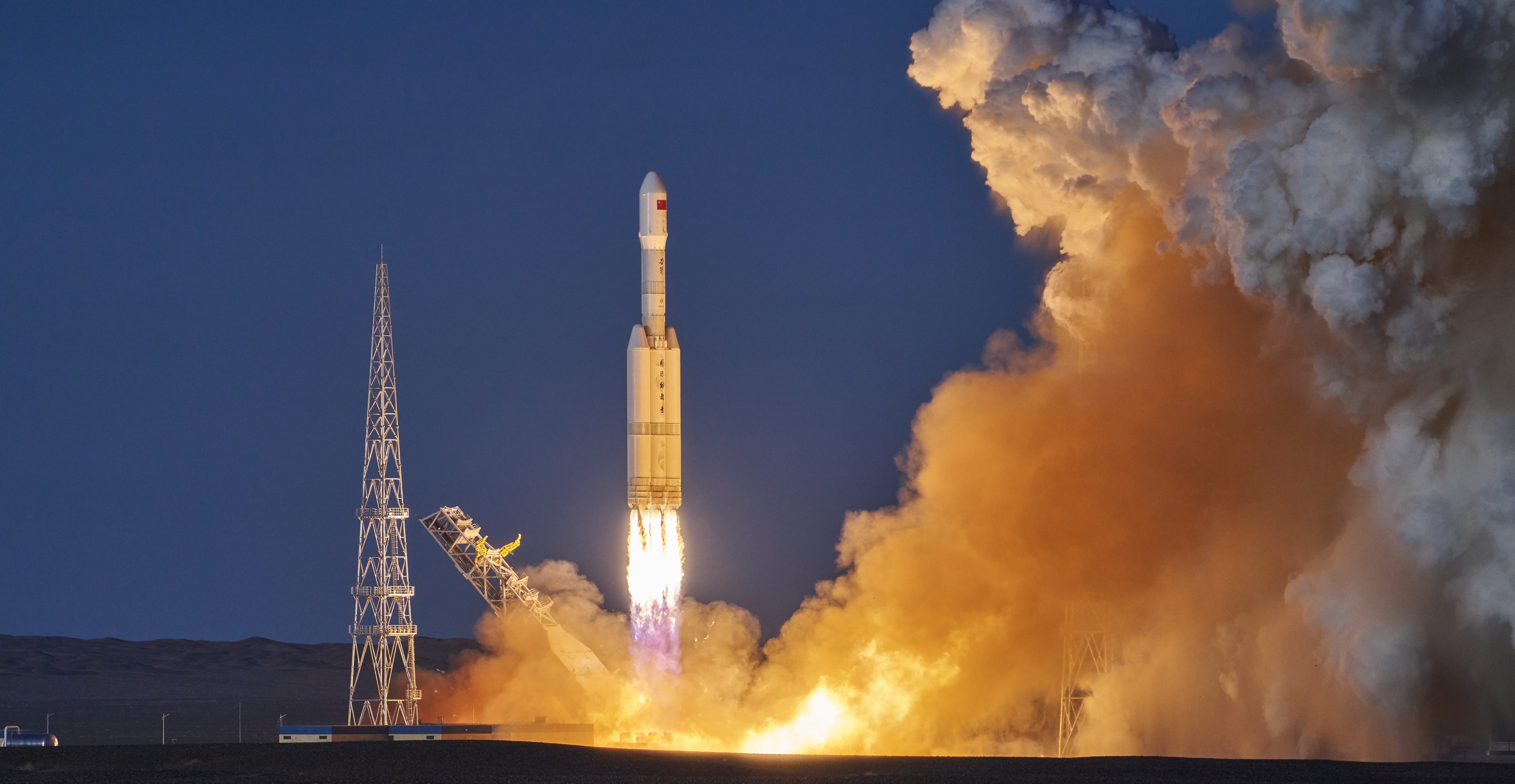
On July 31st, CAS Space announced that it has signed a letter of intent with Interstellar Datalink Beijing Technology Co Ltd (星际数链(北京)科技有限公司) to deliver its series of commercial relay satellites to geostationary space at an appropriate time in the future, pending the signing of a launch contract.
To launch those satellites, the company intends to use its Kinetica-2 launch vehicle and the ‘Kinastra (力巡)’ upper-stage. The so-far once-flown launch vehicle will bring the customer’s satellite and the upper-stage out of the atmosphere before it is then boosted onto a geostationary transfer orbit or brought near its intended geostationary orbital slot, depending on the satellite’s mass.
Part of the hardware to fulfill that launch exists, with Kinetica-2 already preparing for a second mission, but ‘Kinastra’ is still under development. So far, CAS Space has shown the storable propellant-burning Kinecore-4 (力擎四号) engine that will power it in testing, while alluding to the remainder of the 2.9-meter-wide, 3.4-meter-tall stage.
If satellite launches for Interstellar Datalink manifest, Kinetica-2 would become China’s first non-Long March launch vehicle to fly to geostationary space, alongside possibly being the first mission to that orbital regime from the Jiuquan Satellite Launch Center1.
As for information about the geostationary relay satellites, that was disclosed in a written interview with Zhan Keqiang (詹克强), Founder and Chief Executive Officer of Interstellar Datalink, published in May. According to it, the company’s system will consist of four satellites, launched in pairs, to provide tracking, telemetry, and communications links to small spacecraft in low Earth orbit, reaching where ground stations can’t. Users will initially include smaller satellites and orbital launch vehicles before later expanding to autonomous aircraft and Internet-of-Things devices.
To technically do so, the four relays will use the 5G non-terrestrial network protocol2, with plans to upgrade to 6G once it is standardized, to provide around 1,200 affordable connections in orbit. With the use of geostationary space the time to send data to and from connected user spacecraft should be between three and five seconds.
The interview also disclosed that the company has filed with the relevant national regulators to acquire the needed geostationary orbit slots, expecting to receive a judgement on whether they can proceed by year’s end.
Backing some confidence in Interstellar Datalink is that Zhan Keqiang has prior experience at the China Academy of Space Technology with direct systems involvement in the first two generations of the human-spaceflight supporting Tianlian (天链) network of geostationary relays, which is now on its third-generation.
According to publicly available information, Interstellar Datalink was established in May 2024 with a small amount of registered capital as of the end of 2025. Filings for systems related to their geostationary plans began to appear online in February.
Other commercial satellite makers in China have avoided geostationary space due to the high costs of reaching the orbital regime as well as the stringent international regulations that have to be complied with3. That has left satellite communication and tracking enterprises to develop Earth-based solutions, like Emposat (航天驭星) and its selection of stationary and mobile systems. A recent exception to that is Shifang Satlink (十方星链) with the Kunlun-1 relay constellation (昆仑一号卫星星座).
This depends if CAS Space plans to utilize the Wenchang Commercial Space Launch Site, should they establish a launch preparation facility and compatible transporter-erector.
This is something that appears to be feasible; see this paper.
Including ensuring spacecraft end-of-life procedures can have it vacate its occupied slot and move into a ‘graveyard’ orbit several hundred kilometers higher.