


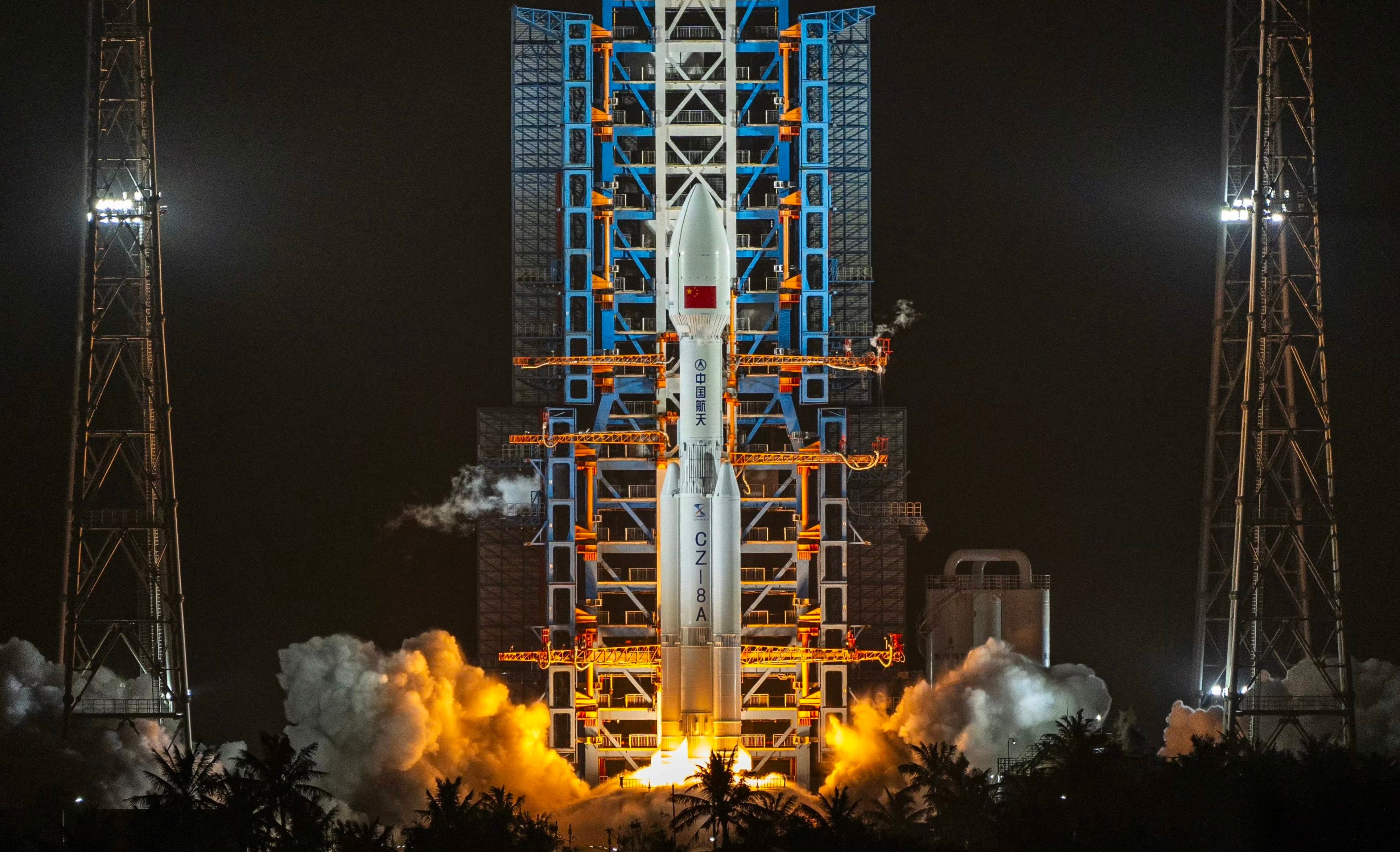
From Commercial Launch Pad 1 at the Wenchang Commercial Space Launch Site, a Long March 8A lifted off at 21:43 pm China Standard Time (13:43 pm Universal Coordinated Time) on July 5th to bring the largest group of Qianfan satellites into a polar orbit.
Making up the largest group to date, which is the fourteenth overall, were twenty satellites manufactured by the Innovation Academy for Microsatellites, Chinese Academy of Sciences (中国科学院微小卫星创新研究院). That brings the total number of Qianfan satellites deployed up to 238, with all past the second hundred coming within the past two days.
Costing under 10 million Yuan (1.47 million United States Dollars, as of July 4th) a piece, each Qianfan satellite weighs 300 kilograms with a ‘flat pack’ design, with a single solar array, to fit as many satellites as possible inside the rocket fairing in two parallel stacks. For maneuvering in orbit, each satellite has an electric hall-effect thruster burning krypton to generate 20 millinewtons of thrust, with a specific impulse of 1,385 seconds.
The Qianfan (千帆) mega-constellation, sometimes referred to as SpaceSail, is operated by Shanghai Spacesail Technologies Co Ltd (上海垣信卫星科技有限公司), aiming to provide space-based internet connectivity services in China and abroad in places including Brazil, Malaysia, Kazakhstan, Türkiye, and via airlines, around the fourth quarter of this year. As of December 2025, the deployment aims to have 324 satellites launched in 20261, while contracted manufacturers have been encouraged to hasten production.
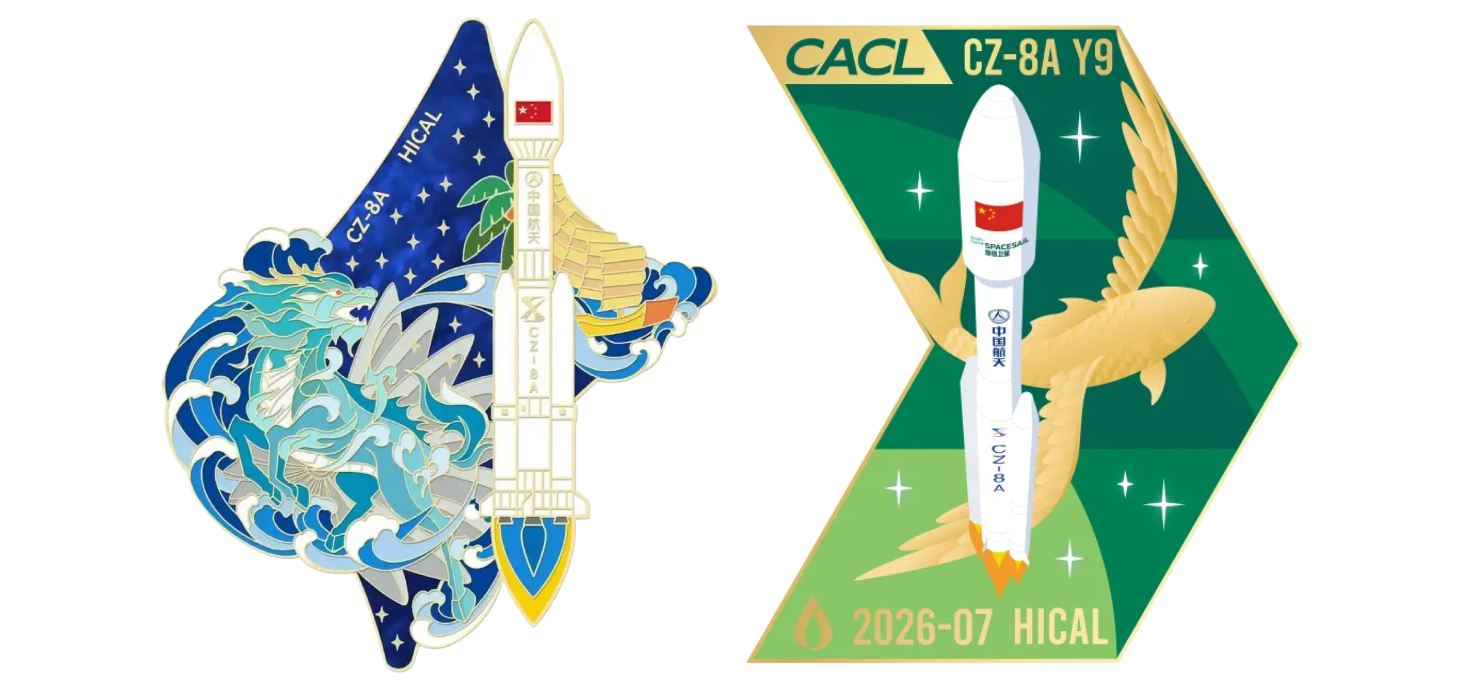
Today’s launch was delayed by a few days due to Typhoon Mayask building up in the South China Sea and making landfall to the south of the launch site in Hainan (海南) province. In order to protect the Long March 8A and its many satellites, debris-catching netting surrounded the launch vehicle at Commercial Launch Pad 1 not long after meteorological warnings were received, with rain-diverting tarpaulins added above once more information was available.
Protecting the Long March 8A was additionally critical, with China Rocket (中国火箭) detailing that a handful of upgrades were implemented. Those include improved insulation on the second-stage, keeping propellants in their desired temperature window longer, as well as the introduction of the YF-75DB engine, boasting cleaner and more possible startups. They all allow for a stated payload capacity increase of almost 1,000 kilograms.
Optimizations to pre-launch testing were spoken of by the China Aerospace Science and Technology Corporation too, supposedly keeping stages and other hardware in a launch-like position2 for far longer. That has been enabled by the completion of a second Long March 8 series preparation bay around a month ago.
In March, China Central Television (中国中央电视台) reported that the Long March 8 series of launch vehicles, including the Long March 8 and 8A, is set to fly fifteen times in total this year, for nine more flights over the next six months. With current infrastructure at the launch site, the Long March 8 series is stated to be able to fly up to thirty times per year.
The China Aerospace Science and Technology Commercial Launch Vehicle Group (中国航天科技集团商业火箭有限公司) acted as the liaison between the China Academy of Launch Vehicle Technology and Shanghai Spacesail Technologies for this launch mission.
This mission was the 9th launch of a Long March 8A vehicle, the 16th launch of the Long March 8 series, and the 656th launch of the Long March launch vehicle series. This was also the 47th launch from China in 2026.
Liftoff footage via 我们的太空 and 中国火箭 on WeChat.
Launch livestream via ThatSpaceDogeGuy on YouTube.
Check out the previous Long March 8A launch
GuoWang Mission Ends China's Month-Long Launch Hiatus [Long March 8A Y8]
![GuoWang Mission Ends China's Month-Long Launch Hiatus [Long March 8A Y8]](https://substackcdn.com/image/fetch/$s_!-CEF!,w_1300,h_650,c_fill,f_webp,q_auto:good,fl_progressive:steep,g_auto/https%3A%2F%2Fsubstack-post-media.s3.amazonaws.com%2Fpublic%2Fimages%2F0525a346-88f2-41c0-abb2-06c5479fd310_2528x1390.jpeg)
Out of the Wenchang Commercial Space Launch Site, off of Commercial Launch Pad 1 a Long March 8A lifted off at 03:48 am China Standard Time on March 13th (19:48 pm Universal Coordinated Time on March 12th), carrying a …
What is the Long March 8A?
This section is for those less familiar with China’s Long March series of launch vehicles.
The Long March 8A is an improved and more cost-efficient upgrade of the Long March 8 and the future workhorse of its developer, the China Academy of Launch Vehicle Technology. The vehicle utilizes a two-and-a-half-stage design and is fuelled by rocket-grade kerosene and liquid oxygen in its first-stage and boosters along with liquid hydrogen and liquid oxygen in the second-stage.
The payload capacity of the launch vehicle is currently as follows:
10,000+ kilograms to low Earth orbit
7,000 kilograms to a 700-kilometer sun-synchronous orbit
6,800 kilograms to a 900-kilometer sun-synchronous orbit
3,500 kilograms to geostationary transfer orbit
The Long March 8A’s boosters and first-stage are powered by YF-100 engines, with two engines on the first stage and one on each of the two boosters, generating a combined thrust of 490 tons at liftoff. The second-stage is equipped with two YF-75DB engines, which produce 20 tons of thrust.
On the launchpad, the core alone Long March 8A stands at 50.5 meters tall and weighs 371,000 kilograms when fully fuelled. The first and second-stage have a diameter of 3.35 meters, the two boosters have a diameter of 2.25 meters, while the fairing has a diameter of 4.2 or 5.2 meters.
Currently, the Long March 8A is flown from the Wenchang Space Launch Site and the Wenchang Commercial Space Launch Site, both on the east coast of Hainan province.


So far, 130 out of 324.
Upright, as on transport stands when moving through the launch site.