

Long March 10A Test Booster Flew As Expected Despite Grid Fin Issue, Rocket Designer Says
Following its successful February 11th flight, the test booster has been retrieved from the South China Sea and is heading back ashore.

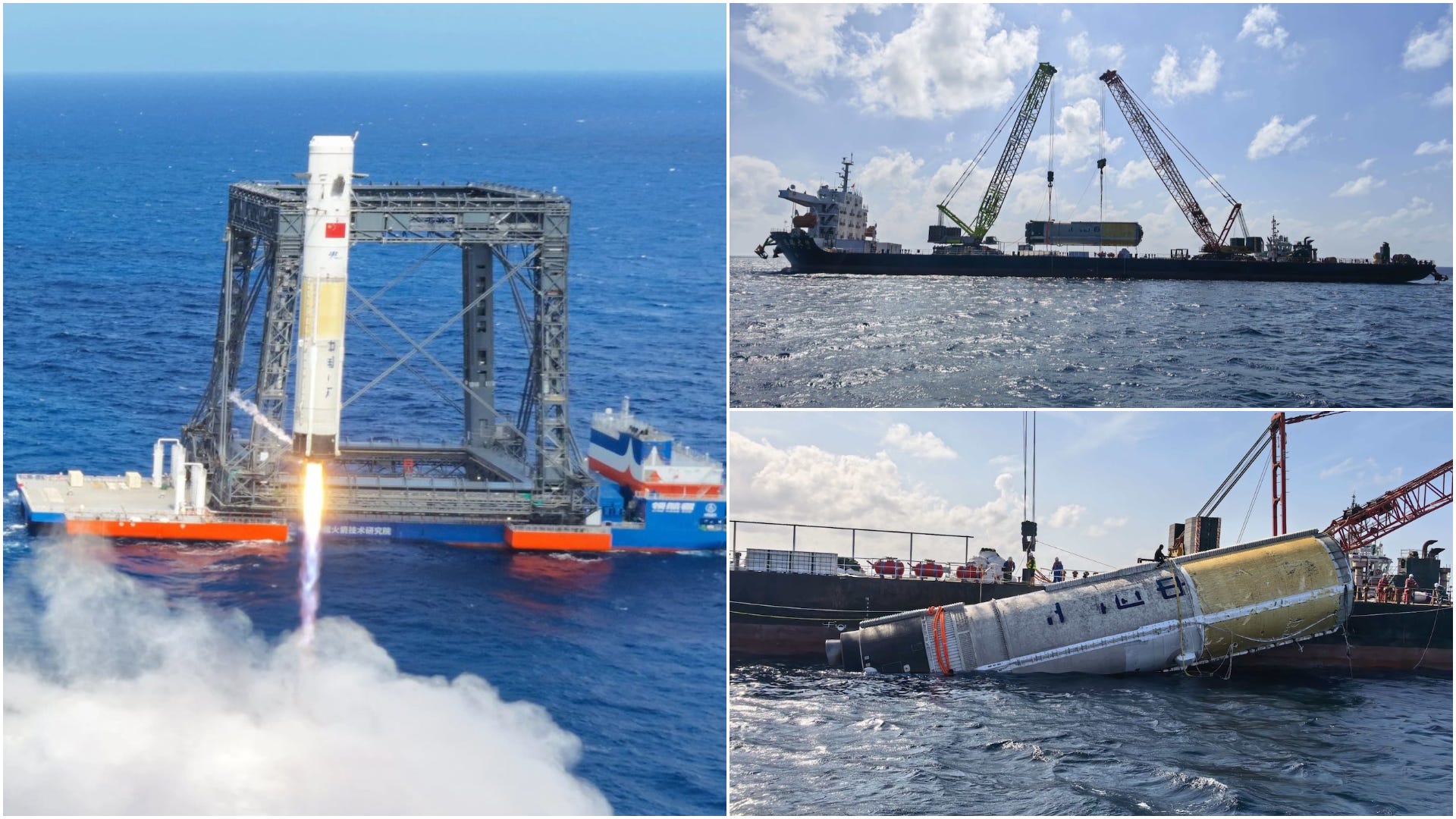
On February 11th, the Long March 10A test booster flew from Launch Complex 301 at the Wenchang Space Launch Site, carrying the Mengzhou capsule skyward for its in-flight abort test. Following the capsule’s test, the booster continued on, culminating in a simulated catch next to the autonomous recovery ship ‘Linghangzhe (领航者)’ and a splashdown into the South China Sea.
During the test booster’s flight, it passed just above the Kármán line, reaching a peak altitude of 105 kilometers and performing a pseudo-entry burn to demonstrate part of reusable first-stage flight. Just before the burn, two grid fins were deployed, with one theorized as failing to unfurl correctly and leading to flight computers commanding the fin opposite to remain stowed. Despite that issue, the Long March 10A test booster guided itself next to its recovery ship and performed a planned hover five meters above the sea.
After the Long March 10A test booster splashed down, its boiler plate upper-half1 sheared off upon contact with the sea’s surface, and recovery teams moved in to retrieve its remaining lower-half. Recovery operations were reported to have concluded on February 13th when the boosters’ propellant tanks and five functioning YF-100K engines, as well as two mockup YF-100K’s, were lifted out in one piece to be brought back ashore for extensive study.
As part of a post-test interview shared by the China Aerospace Science and Technology Corporation, Rong Yi (容易), an Expert Rocket Designer leading development of the Long March 10A while serving as the Long March 2F’s Chief Designer, shared that the booster’s flight occurred as previously expected by involved teams:
“Our test this time was very close to the future official state, with a maximum flight altitude of 105 kilometers, the first-stage length and aerodynamic shape, weight and center of mass characteristics, and the reentry flight sequence are all basically the same as the operational specifications, precisely to truly verify our flight profile.”
If there are any problems with this translation please reach out and correct me.
In the days after the test, the Academy of Aerospace Liquid Propulsion Technology (航天推进技术研究院) shared that the five real YF-100K’s flown on February 11th were the same that had been fired up in static fires atop of Launch Complex 301 in August and September 2025.
Moon rocket progress continues elsewhere
Within the same blog post about flying the static-fired YF-100K engines, the Academy of Aerospace Liquid Propulsion Technology revealed that the tri-core Long March 10 Moon rocket has had its second and third stages fired up on test stands, sometime in 2025. The rocket’s second-stage is equipped with two vacuum-optimized YF-100M engines (with the Long March 10A’s second-stage is expected to have just one), while the third-stage uses three hydrogen-burning YF-75DA’s. With current launch vehicle’s, the YF-100M is yet to fly, but the YF-75DA has flown seven times in pairs via the Long March 8A.
Beyond updates for hardware, Yang Liwei (杨利伟), the first Chinese person to be sent into space and Deputy Chief Designer at the China Manned Space Agency, told China Central Television on February 14th that taikonauts selected in the 1990s2 stopped being selected for upcoming missions after October 2025, to either the Tiangong Space Station or the Moon, but noting they can be called upon if specific expertise is needed. At the start of the year, Yang also shared that steady progress is occurring on all systems necessary for China’s first crewed lunar landings in 2028 or 2029.
An extension placed atop of the Long March 10 series static fire article to install four grid fins and catch hooks, making it the Long March 10A test booster.
Those taikonauts are:
Yang Liwei, who went to space onboard Shenzhou-5, becoming a national hero and was then grounded afterwards due to his new status.
Fei Junlong (费俊龙) of the Shenzhou-6 and Shenzhou-15 missions.
Jing Haipeng (景海鹏) of the Shenzhou-7, Shenzhou-9, Shenzhou-11, and Shenzhou-16 missions.
Liu Boming (刘伯明) of the Shenzhou-7 and Shenzhou-12 missions.
Nie Haisheng (聂海胜) of the Shenzhou-6, Shenzhou-10, and Shenzhou-12 missions.
Zhai Zhigang (翟志刚) of the Shenzhou-7 and Shenzhou-13 missions.
Liu Wang (刘旺) of the Shenzhou-9 mission.
Zhang Xiaoguang (张晓光) of the Shenzhou-10 mission.
Deng Qingming (邓清明) of the Shenzhou-15 mission.
It should also include Zhao Chuandong (赵传东), Pan Zhanchun (潘占春), Chen Quan (陈全), Wu Jie (吴杰), and Li Qinglong (李庆龙), who were all selected in the 1990s but never flew.